
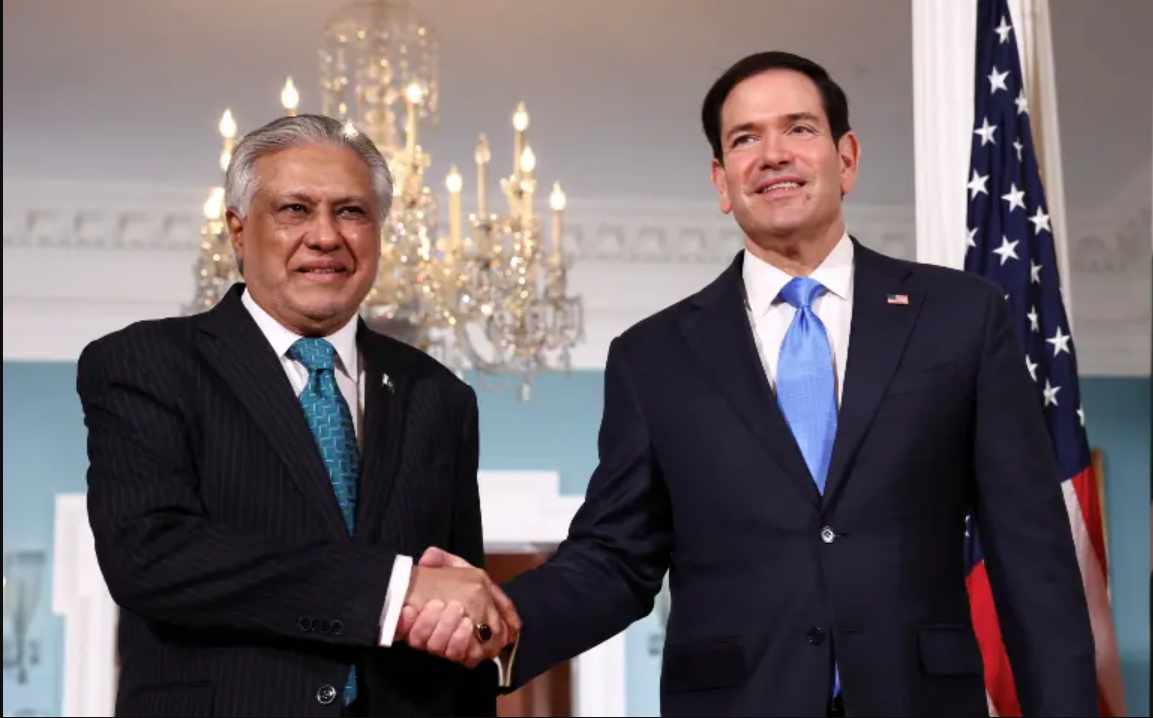

Pakistan’s Deputy Prime Minister and Foreign Minister Ishaq Dar held high-level discussions in Washington. He met US Secretary of State Marco Rubio during his official visit.
The talks focused on bilateral relations, regional stability, and ongoing Middle East tensions. Moreover, both sides reviewed cooperation in security and diplomatic engagement.
Dar also addressed questions during a press interaction at Pakistan’s embassy. The discussion highlighted Pakistan’s position on Palestine and evolving regional diplomacy.
Strong Reaffirmation of Palestine and Gaza Policy
During the briefing, Ishaq Dar clearly reaffirmed Pakistan’s long-standing policy on Palestine. He emphasized continuity in Islamabad’s diplomatic stance.
He stated, “Pakistan remains steadfast in its position on Palestine and Gaza,” highlighting policy consistency.
Furthermore, he clarified Pakistan’s position on Israel. He said Israel “must move towards the establishment of a Palestinian state” before any policy shift becomes possible.
This position reflects Pakistan’s continued support for a two-state solution framework. It also signals no immediate change in diplomatic recognition policy.
Abraham Accords Question Brings Clarity
During the interaction, Dar was asked about the Abraham Accords and potential normalization discussions. The question related to speculation about shifting regional alignments.
However, he did not directly respond to the specific query. Instead, he reiterated Pakistan’s established diplomatic stance.
He referred back to his earlier engagements at the United Nations. This reinforced continuity in Pakistan’s foreign policy messaging.
Meanwhile, the Abraham Accords remain a regional framework for normalization between Israel and certain states. Pakistan, however, maintains a conditional stance tied to Palestinian statehood.
Pakistan’s Role in Iran–US Mediation Efforts
A key part of the discussions focused on Pakistan’s diplomatic engagement in the Middle East. In particular, Pakistan’s mediatory role between Iran and the United States was highlighted.
US officials acknowledged Pakistan’s contribution to regional stability efforts. This recognition came during Dar’s meeting with Secretary Rubio.
A statement noted that “the Secretary thanked the minister for the constructive role Pakistan continues to play […] for peace in the Middle East and its mediation efforts with Iran.”
Additionally, both sides agreed on deeper cooperation. They emphasized “the importance of working together to further strengthen a meaningful partnership that fosters security and prosperity for both Americans and Pakistanis”.
This reflects ongoing efforts to maintain diplomatic channels amid regional tensions.
Bilateral Relations and Expanding Cooperation
Pakistan and the United States reviewed their broader bilateral relationship during the meeting. Discussions included trade, investment, security, and counter-terrorism cooperation.
Officials from both sides expressed satisfaction over positive momentum. Moreover, they highlighted shared interests in regional peace and economic stability.
A formal statement also reflected mutual appreciation for diplomatic engagement. It noted continued coordination on regional and global issues.
Dar also commented positively on the meeting. He said, “Always a pleasure to engage with him on further strengthening Pak-US bilateral relations and advancing our shared goals of peace, stability, and prosperity for our two countries and the wider region.”
This statement underscored an effort to stabilize and strengthen long-term diplomatic ties.
Strategic Partnership Discussions Gain Attention
During the talks, Ishaq Dar proposed deeper strategic engagement between Pakistan and the United States. This suggestion received a positive response from the US side.
The discussion included the possibility of advancing structured cooperation. It also focused on long-term diplomatic alignment.
Dar indicated that both sides showed interest in expanding dialogue. However, he avoided disclosing detailed negotiation points.
Secrecy Around Mediation Efforts Maintained
Dar stressed the sensitive nature of Pakistan’s mediatory role in regional conflicts. He emphasized confidentiality in diplomatic communication.
He stated, “Pakistan cannot compromise its role as a mediator by divulging details of the talks because we are deeply invested in the peace process”.
He further added, “We are the mediators and, as such, we are required to maintain secrecy”.
These remarks highlight Pakistan’s approach to backchannel diplomacy. They also reflect caution in publicly discussing ongoing negotiations.
Pakistan’s Position in Global Mediation Landscape
Pakistan’s diplomatic role has gained attention in recent international discussions. Officials claim that its mediation efforts have received recognition from multiple global actors.
Dar noted, “The mediation has brought global recognition for us, as did our victory against India [in May 2025],”.
He also stated that several countries, including Qatar and Oman, showed interest in hosting talks. However, Pakistan was selected due to its relationships with involved parties.
This positions Pakistan as an active diplomatic intermediary in selected regional issues.
Regional Context and Ongoing Developments
The Washington visit took place amid broader geopolitical discussions involving Iran, the United States, and regional ceasefire efforts.
Reports indicate that indirect negotiations are ongoing to stabilize tensions. These discussions include maritime security and movement in strategic waterways.
However, final agreements remain under consideration and are not yet confirmed.
Pakistan continues to position itself as a facilitator of dialogue rather than a direct participant in conflict.
Conclusion
Pakistan’s diplomatic messaging in Washington reinforced consistency on Palestine and Gaza policy. It also highlighted its growing role in regional mediation efforts.
While engaging with the United States on broader cooperation, Pakistan maintained a firm stance on Israel recognition.
At the same time, discussions on Iran mediation and strategic partnership signaled expanding diplomatic engagement.
Overall, the visit reflected a balance between principled foreign policy and evolving international cooperation.

