
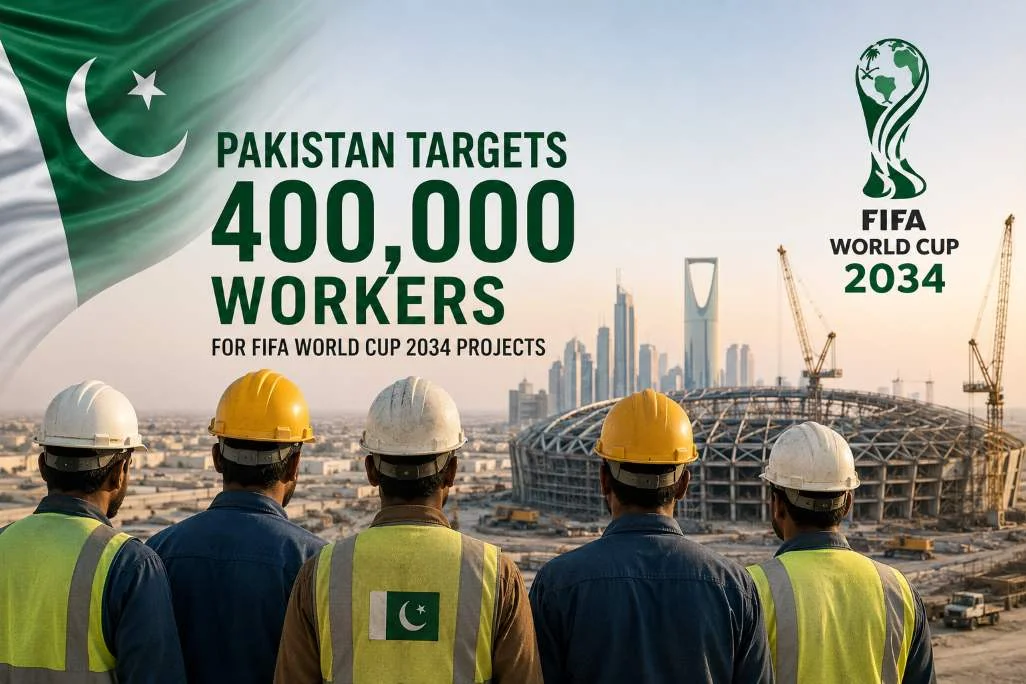

Workforce Strategy Linked to Global Football Event
Pakistan is planning to train and deploy up to 400,000 workers for projects linked to the FIFA World Cup 2034 in Saudi Arabia.
According to official documents, the government is preparing a workforce strategy to meet expected labour demand in the Kingdom between 2026 and 2034.
The workers are expected to support major sectors connected to the global football event.
These include infrastructure development, aviation, tourism, hospitality, transport, construction, and related services.
Officials said the plan is part of Pakistan’s wider effort to expand overseas employment and improve the skill profile of its workforce.
Skills Training and Overseas Employment Gain Focus
The government is already investing in training programmes to prepare workers for international job markets.
During July-March FY2025-26, a total of 215,719 workers received soft-skills training.
The training focused on workplace adaptability, productivity, communication, and global employability.
Officials said overseas employment remains a key pillar of Pakistan’s labour market strategy.
In 2025, the Bureau of Emigration and Overseas Employment registered 762,499 workers for foreign jobs.
Since 1972, more than 15 million Pakistanis have gone abroad for employment through official channels.
More than 96 percent of Pakistani workers moving abroad through official channels are employed in Gulf Cooperation Council countries.
Saudi Arabia and the United Arab Emirates remain the top destinations.
Saudi Arabia Remains Leading Job Market
Saudi Arabia received 530,256 Pakistani workers in 2025.
This accounted for 69.54 percent of total overseas employment registrations during the year.
Officials said Saudi Arabia’s Vision 2030 programme has created major opportunities in construction, infrastructure, services, tourism, and hospitality.
The FIFA World Cup 2034 is expected to further increase demand for skilled and semi-skilled labour.
Pakistan is also working to expand labour mobility partnerships beyond the Gulf region.
Under the Pakistan-EU Migration and Mobility Dialogue, talks are underway with European countries for legal migration and workforce cooperation.
Italy has announced a quota of 10,500 seasonal and non-seasonal workers for Pakistan over three years.
Germany and Greece are also moving toward labour cooperation arrangements focused on skilled workers.
The government is also modernising the emigration process through digital systems.
The Pakistan Emigrant Management Framework and Digital HR Pool aim to improve verification, job matching, and transparent recruitment.
Officials believe continued investment in skills and overseas employment systems can help Pakistan secure higher-value jobs for its workforce.

