
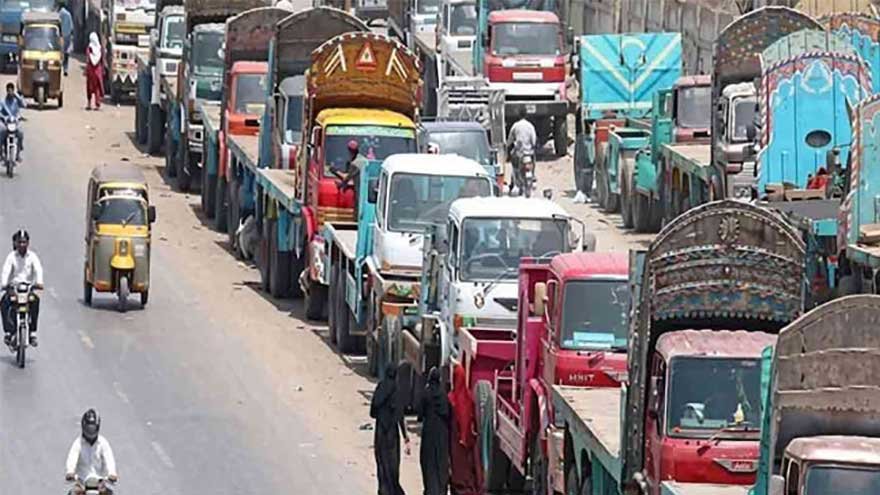

Nationwide Wheel-Jam Continues Despite Government Negotiations
Pakistan’s goods transporters have decided to continue their nationwide wheel-jam strike after the latest round of negotiations with the federal government ended without a final settlement.
The All Pakistan Goods Transport Owners Association said on Tuesday that freight services would remain suspended until its key demands were practically accepted by the authorities.
The strike began on Saturday and has already disrupted the movement of goods across major cities, industrial areas and ports. Transporters are protesting against fuel pricing policies, high toll charges, taxes and other regulatory issues affecting the road freight sector.
Association representative Muhammad Owais Chaudhry said transporters were willing to continue talks with the government but would not withdraw their demands.
He said the strike would remain in place until authorities implemented an acceptable solution.
The latest negotiations were held at the Ministry of Communications in Islamabad.
Federal Minister for Communications Abdul Aleem Khan assured representatives that the government would cooperate in resolving their concerns.
However, the meeting ended without formal acceptance of the transporters’ full list of demands.
Transport representatives have now said that their main protest camp will move to Karachi.
Chaudhry said any further negotiations could take place there as the strike continues.
Diesel Prices, Toll Taxes and Axle Loads Remain Key Disputes
One of the biggest disagreements concerns diesel pricing.
Transporters oppose frequent fuel price changes and want diesel rates to be revised monthly or at least every two weeks.
They argue that daily changes make it difficult to calculate freight charges, sign contracts and plan operating expenses.
Pakistan shifted towards more frequent fuel price adjustments amid volatility in international oil markets.
Prices are calculated using a rolling average of global benchmark rates, according to the petroleum ministry.
Transporters have also demanded a reduction in diesel-related taxes and previously called for fuel prices to return closer to levels recorded on July 1, 2024.
Another major dispute involves toll taxes.
The transport sector wants lower toll charges and greater certainty over future increases.
Sources familiar with Tuesday’s negotiations told Geo News that the government had agreed in principle not to increase toll taxes for one year.
The same sources said discussions also included maintaining petroleum prices for between one and two weeks.
However, transporters have not treated those understandings as sufficient to end the strike.
The association is also demanding uniform enforcement of axle-load limits across Pakistan.
Transporters want the legally permitted load limits applied consistently instead of different enforcement practices across routes and provinces.
Some representatives have demanded that 10-wheel vehicles be permitted to carry up to 35 tonnes, compared with the lower limit currently being enforced on major roads.
Other demands include relief in withholding taxes and changes to customs rules that can result in the confiscation of commercial vehicles involved in customs violations.
Government Promises Modern Weigh Stations as Economic Pressure Grows
The Ministry of Communications has presented a more positive account of the negotiations.
According to the ministry, decisions reached during two days of talks were being given final shape.
Abdul Aleem Khan assured transporters that maximum possible relief would be provided and complaints involving weigh stations would be addressed quickly.
The minister also announced plans to establish modern weigh stations on motorways with reduced human involvement.
The government believes greater automation could improve transparency and reduce disputes involving vehicle weight enforcement.
Despite those assurances, transporters say no final agreement has been reached.
The continuing strike is now creating growing concern among industries dependent on road freight.
Pakistan’s textile sector has warned that prolonged disruption could delay raw material deliveries and prevent export shipments from reaching ports on time.
Pakistan Textile Council Chairman Fawad Anwar has asked Prime Minister Shehbaz Sharif to intervene, warning that the economic cost of the deadlock will increase if the shutdown continues.
Road freight plays a critical role in transporting food, industrial goods, fuel, raw materials and export cargo across Pakistan.
A prolonged strike could therefore affect factories, ports, wholesale markets and supply chains.
For now, both sides say they remain willing to negotiate.
However, transporters insist that discussions alone will not end the strike.
They say freight vehicles will return to the roads only after the government formally accepts and implements their major demands.

