
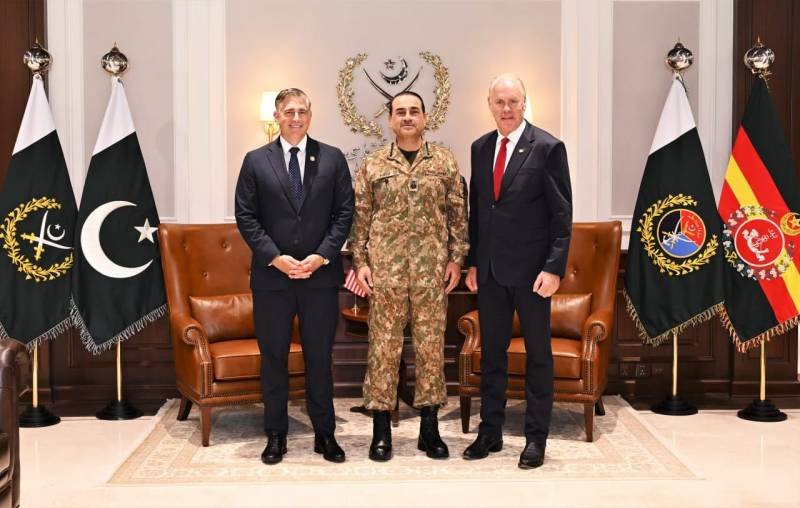

Two US Lawmakers Hold High-Level Talks at GHQ
Two members of the United States House of Representatives met Field Marshal Syed Asim Munir in Rawalpindi on Monday.
The meeting took place at the General Headquarters.
The discussions focused on regional security, bilateral defence cooperation and economic relations between Pakistan and the United States.
Field Marshal Asim Munir currently serves as Pakistan’s Chief of Army Staff and Chief of Defence Forces.
The visiting lawmakers were Ryan Keith Zinke and Michael James Baumgartner.
Zinke represents Montana’s First Congressional District in the US House of Representatives.
Baumgartner represents Washington state’s Fifth Congressional District.
He also serves on the House Foreign Affairs Committee, including subcommittees covering South and Central Asia.
Some initial reports identified the Washington lawmaker only as Michael James.
Official congressional records confirm his full name as Michael Baumgartner.
The Inter-Services Public Relations said the talks covered matters of mutual interest.
Both sides reviewed the security situation in the region and opportunities for deeper institutional cooperation.
No formal defence, trade or investment agreement was announced after the meeting.
Economic Growth and Foreign Investment Take Centre Stage
Field Marshal Munir highlighted Pakistan’s economic potential during the discussions.
He said long-term regional stability was closely connected with economic development.
He also emphasised the importance of greater trade, regional connectivity and private investment.
Pakistan is seeking to attract international businesses by improving its investment environment and reforming important economic sectors.
The military chief briefed the US delegation on structural reforms intended to support investors and strengthen economic activity.
He presented Pakistan as a market offering opportunities in trade, infrastructure and commercial partnerships.
The discussions also covered possible cooperation between businesses from both countries.
Private-sector partnerships were identified as one possible route for strengthening economic relations.
Both sides examined ways to expand trade and create stronger commercial links.
However, the official statement did not identify any particular company, project or investment commitment.
Pakistan has repeatedly argued that regional peace cannot be sustained without economic opportunity.
Improved connectivity can increase trade between South Asia, Central Asia and the wider region.
Greater commercial activity could also support employment, infrastructure development and economic resilience.
The visiting lawmakers acknowledged Pakistan’s economic potential and its efforts to create a more business-friendly environment, according to the military’s statement.
They also recognised the country’s role in supporting regional economic resilience.
Regional Security and Defence Cooperation Discussed
Regional security remained a major part of the meeting.
Pakistan and the United States have a long history of defence and counterterrorism cooperation.
The latest discussions examined how both countries could maintain institutional engagement amid changing regional conditions.
The official statement did not provide details about any specific military operation, security threat or weapons programme.
It also did not announce a new defence agreement.
Instead, the meeting focused on the broader importance of continued communication and cooperation.
The US delegation acknowledged Pakistan’s role in promoting regional stability, according to ISPR.
The lawmakers also expressed interest in strengthening commercial and institutional relations with Islamabad.
Field Marshal Munir emphasised that security and economic development should progress together.
He argued that stable economic conditions could help support sustainable peace across the region.
The visiting lawmakers thanked Pakistan’s military leadership for its hospitality.
They expressed a shared commitment to developing relations between Pakistan and the United States.
The meeting reflected continuing engagement between the two countries on defence, security, trade and investment.
Future progress will depend on whether the discussions lead to specific commercial projects, policy initiatives or institutional agreements.
For now, both sides have signalled their intention to maintain dialogue and explore new areas of cooperation.

