
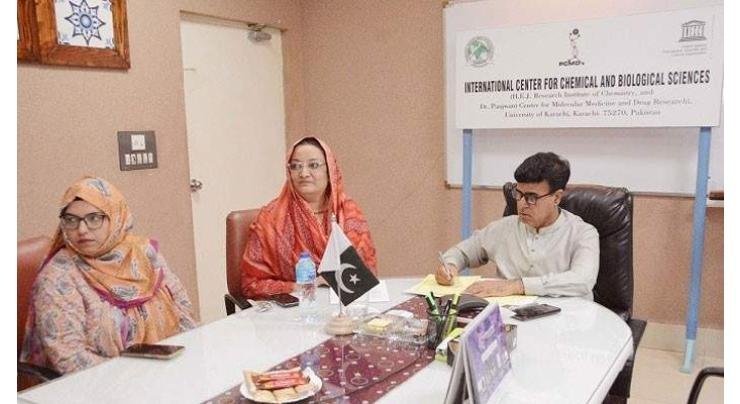

A major step toward international academic collaboration has been taken. A leading research institute from Azerbaijan has signed a formal agreement with a top scientific center in Pakistan. The partnership aims to boost research, education, and knowledge exchange between the two countries.
The agreement was signed between the Institute of Botany Azerbaijan and the International Center for Chemical and Biological Sciences. The ICCBS operates under the University of Karachi.
MoU Signed to Expand Academic Cooperation
The Memorandum of Understanding was finalized through official communication. Representatives from both institutions confirmed the agreement via email.
Muhammad Raza Shah, Director of ICCBS, signed the agreement on behalf of Pakistan. Sayyara Ibadullayeva, Acting Director of the Institute of Botany, signed for Azerbaijan.
Both sides agreed to promote cooperation based on equality and mutual benefit. The goal is to strengthen long-term academic and research ties.
Focus on Scientific Research and Innovation
The partnership will focus on joint research activities. Scientists from both institutions will work together on projects in key scientific areas.
These include plant sciences, biology, chemistry, and environmental studies. The collaboration aims to generate new knowledge and innovative solutions.
In addition, both institutions will share research findings. This will help improve scientific understanding and global knowledge exchange.
About the Azerbaijan Institute of Botany
The Institute of Botany in Azerbaijan is a leading scientific body. It focuses on plant sciences and environmental research.
The institute was formed after merging botany and dendrology research centers. It now studies plant biodiversity, ecology, taxonomy, and plant physiology.
Researchers at the institute also work on genetic resources and vegetation science. Therefore, it plays a key role in preserving plant diversity.
ICCBS: A Leading Scientific Center in Pakistan
The ICCBS is one of Pakistan’s top research institutions. It specializes in chemical, biological, and biochemical sciences.
The center has trained scholars from many countries. It is recognized as an international hub for scientific education and research.
Its collaboration with global institutions helps strengthen Pakistan’s research capacity. Therefore, this new agreement adds further value.
Training and Skill Development Opportunities
The MoU also includes training programs. Both institutions will provide opportunities for young researchers and technical staff.
Students, research assistants, and laboratory technicians will benefit from this exchange. They will gain practical skills and international exposure.
Moreover, the partnership will support capacity building. It will help develop expertise in modern scientific techniques.
Knowledge Exchange and Cultural Collaboration
Beyond research, the agreement also promotes cultural and academic exchange. Scientists will share ideas and best practices.
This interaction will help build stronger professional networks. It will also encourage innovation through collaboration.
Long-Term Impact of the Agreement
Experts believe this partnership will have long-term benefits. It will strengthen scientific cooperation between Pakistan and Azerbaijan.
Joint research projects may lead to new discoveries. They may also address global challenges in science and environment.
Furthermore, such collaborations enhance the global reputation of both institutions.
Future Outlook
Both sides are expected to begin collaborative projects soon. Regular communication and exchange programs will follow.
This agreement reflects a growing trend. Universities and research centers are building international partnerships to advance science.
Overall, the MoU marks an important milestone. It opens new opportunities for research, education, and innovation.

