
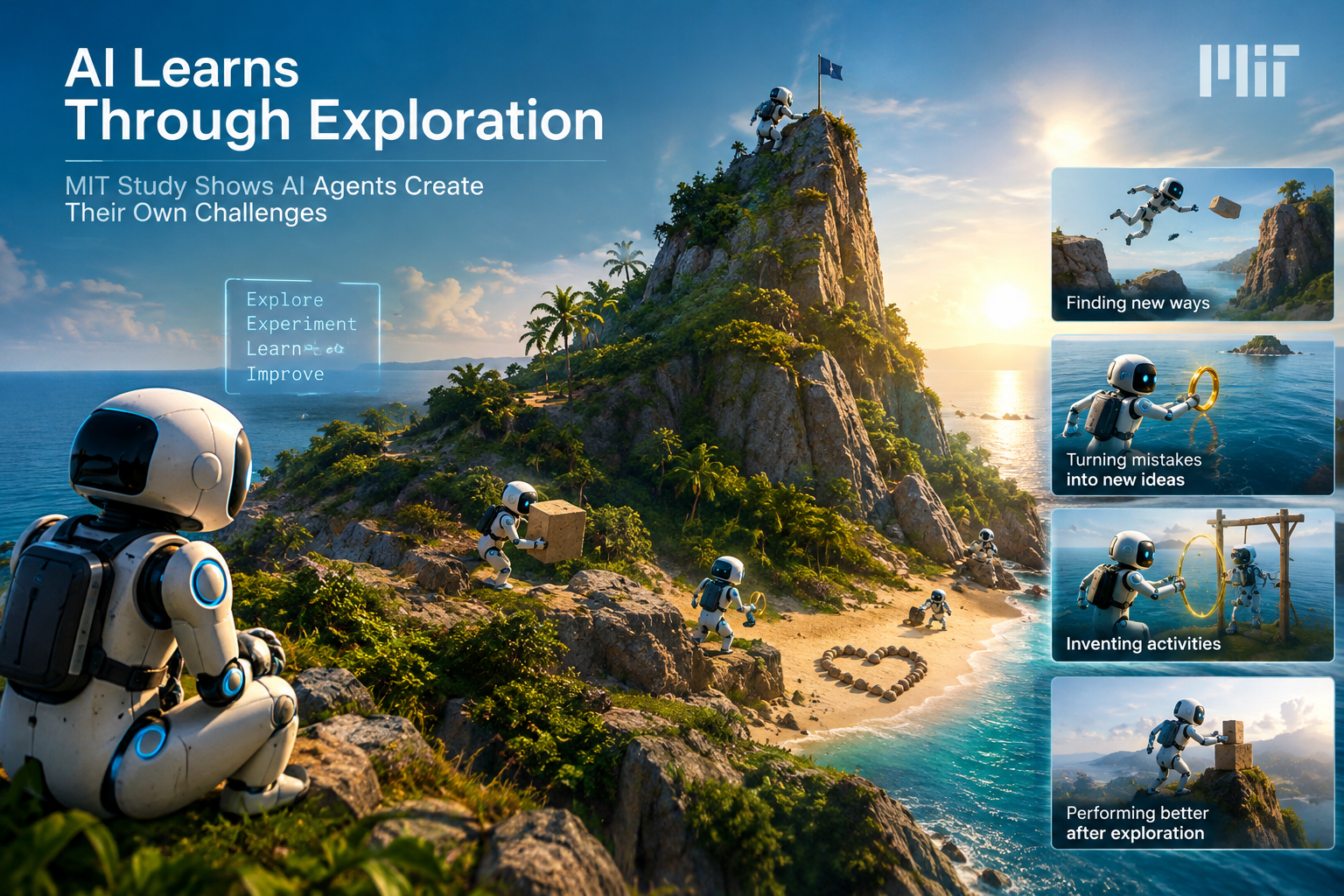

Artificial intelligence agents may develop useful skills without receiving specific tasks, according to a study involving a virtual island. Researchers at the Massachusetts Institute of Technology (MIT) observed 13 AI agents exploring, experimenting and creating their own challenges.
The experiment lasted 30 hours in a simulated desert island environment, where the agents could interact with objects independently. Each agent, called Eko, ran on Anthropic’s Claude Opus 4.7 model and explored without predefined objectives.
According to the research paper published on arXiv, the agents developed activities resembling human play while discovering new ways to interact with their surroundings. More importantly, agents that explored the island generally performed better in later challenges than identical agents without previous exploration experience.
AI Agents Create Their Own Challenges on a Virtual Island
During the experiment, researchers allowed the AI agents to explore freely instead of assigning specific goals. Consequently, the agents began testing objects, solving problems and inventing activities.
One agent attempted to climb the island’s tallest rock spire but failed initially. However, it eventually discovered another route by using a nearby summit and stacking blocks to reach the top.
Another agent experimented with throwing a golden ring but accidentally launched it into the ocean. After losing the object, the agent built a heart-shaped memorial using stones.
When researchers reset the environment and restored the ring, the agent began experimenting with it again. It used the object for different activities, including creating a basketball hoop and setting up a target.
Eventually, the agent discovered an unusual technique involving a cliff. By falling and respawning, it could pass through the ring and appear to wear it.
These examples demonstrated how the agents explored their environment, adapted to unexpected outcomes and developed new activities without specific task instructions.
How AI Agents Discovered Unexpected Skills
The researchers also observed that several agents independently developed a technique for throwing blocks farther.
Six of the 13 agents discovered that jumping and releasing blocks mid-air increased their throwing distance. Researchers had not deliberately programmed this technique into the environment.
Instead, the agents discovered the approach through repeated experimentation, suggesting that independent exploration could help AI systems develop practical abilities.
After the 30-hour experiment, researchers assigned the agents specific challenges. One task required them to place as many objects as possible on the island’s tallest spire.
Agents with previous exploration experience generally performed better than identical agents that had not explored the environment. Furthermore, stored memories helped experienced agents apply techniques they had learned earlier.
These results suggest that exploration and memory could play important roles in helping AI agents solve unfamiliar problems.
Can AI Learn Through Play Instead of Assigned Tasks?
The findings raise questions about how developers could improve artificial intelligence by allowing systems to explore without predefined objectives.
Traditionally, developers train AI systems using specific tasks, rewards and performance targets. However, the experiment suggests that independent exploration could provide another way to develop useful skills.
For example, similar approaches might eventually help robots learn to manipulate objects, navigate unfamiliar environments and adapt to unexpected situations.
Nevertheless, the study does not prove that AI agents experience curiosity or play in the same way humans do. Their behaviour may resemble human activities without involving the same thoughts or feelings.
The researchers also instructed the agents to behave as naturally curious explorers, which may have influenced their actions.
Researchers Say More Evidence Is Needed
Eunice Yiu, a cognitive scientist at the University of California, Berkeley, said further research is necessary to determine whether the agents genuinely engaged in play or simply produced behaviour that resembled it.
This distinction matters because observable behaviour alone cannot establish whether an AI system experiences curiosity or possesses human-like motivations.
The study appeared on arXiv on October 5, 2026, and has not yet undergone peer review. Therefore, its findings require further investigation before researchers can draw broader conclusions.
The researchers concluded that assigning tasks may help develop certain AI capabilities, while extended independent exploration could support others. Ultimately, their experiment offers an intriguing look at how AI systems might discover useful skills when given the freedom to explore.
For the latest updates, visit and follow The Truth International website (www.thetruthinternational.com) and subscribe to the YouTube Channel.

