
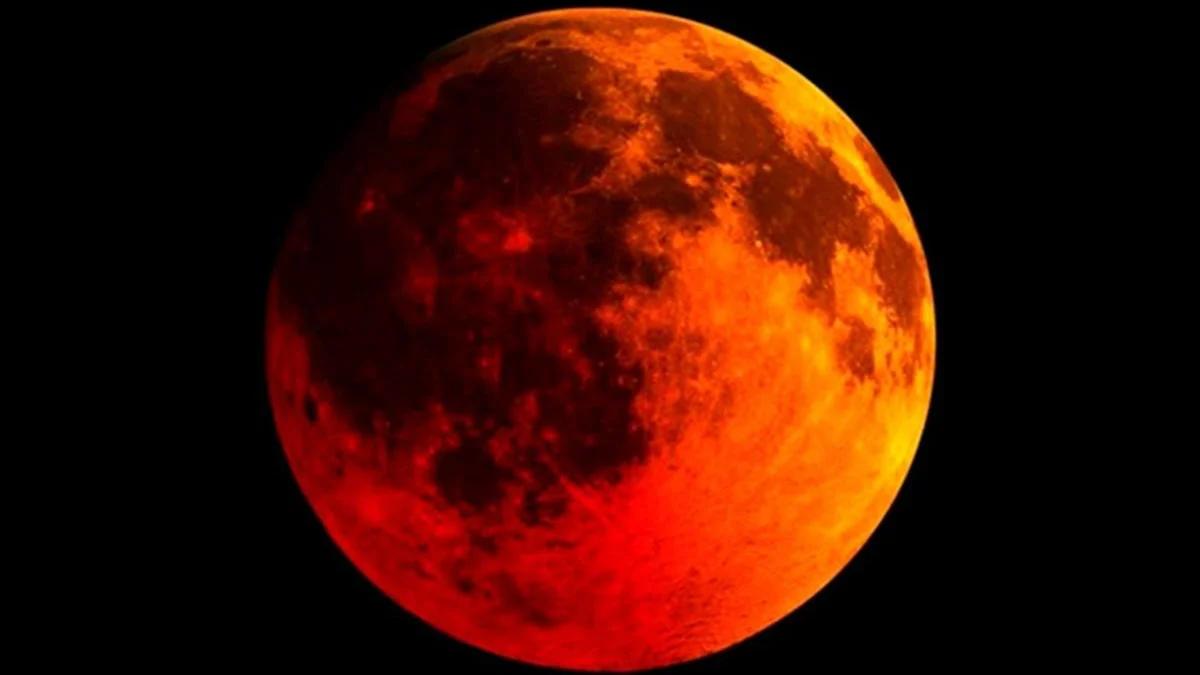

Earth’s umbral shadow will cover more than 93 percent of lunar diameter at maximum, leaving only a narrow illuminated section
A striking partial lunar eclipse will unfold overnight on August 27-28, 2026, as Earth moves between the Sun and Moon and casts its shadow across most of the lunar surface.
Although astronomers classify the event as a partial lunar eclipse, its magnitude will make it appear close to totality. At maximum eclipse, Earth’s dark umbral shadow will cover approximately 93.2 percent of the Moon’s diameter.
Calculations based on the geometry of the eclipse indicate that the umbra will obscure roughly 96 percent of the visible lunar disk by area. Consequently, observers should see only a narrow illuminated portion near the Moon’s northern edge.
Eclipse to Reach Maximum at 04:12 UTC
The eclipse will begin with the penumbral phase at approximately 01:23 UTC on August 28, when the Moon enters Earth’s lighter outer shadow.
Subsequently, the more noticeable partial phase will start at about 02:33 UTC as the Moon begins entering the umbra.
The event will reach its greatest phase at approximately 04:12 UTC, when most of the lunar disk will sit inside Earth’s darkest shadow.
Afterward, the Moon will gradually emerge from the umbra, with the partial phase ending at around 05:52 UTC.
Penumbral Phase Ends Around 07:02 UTC
The remaining penumbral shading will continue after the main partial eclipse ends. Finally, the Moon will completely leave Earth’s outer shadow at approximately 07:02 UTC, concluding the celestial event.
Unlike a solar eclipse, a lunar eclipse presents no danger to eyesight. Therefore, observers can safely watch the event directly without protective glasses, filters or other specialised equipment.
Visibility will depend on location, weather conditions and whether the Moon remains above the horizon during the eclipse.
The unusually high umbral magnitude should make the August event particularly dramatic, despite technically falling short of a total lunar eclipse.

