
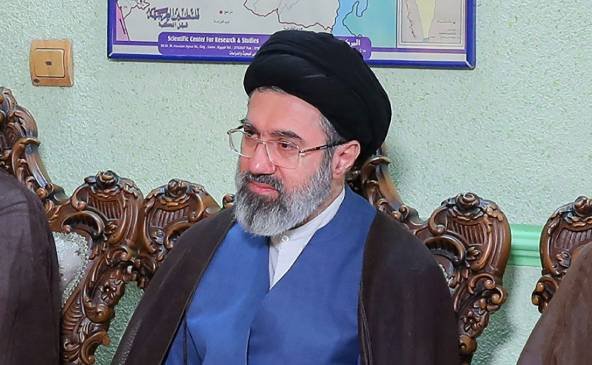

Iran’s political and military leadership structure faces renewed global attention following reports of a severe airstrike incident. The situation has raised questions about continuity at the highest levels of authority.
Moreover, emerging details suggest significant internal adjustments within Iran’s decision-making framework. The leadership transition appears closely linked to security and military developments.
Reported Condition of Mojtaba Khamenei
The new supreme leader, Mojtaba Khamenei, was reportedly seriously injured in an airstrike that also killed his father and predecessor, Ali Khamenei.
However, despite the severity of injuries, he remains mentally alert and engaged. His condition has triggered widespread speculation regarding his operational role and visibility.
The report stated, “gravely wounded (in the February 28 airstrike), he is mentally sharp and engaged.”
Additionally, medical complications remain significant. According to the same account, “One leg was operated on three times, and he is awaiting a prosthetic. He had surgery on one hand and is slowly regaining function. His face and lips have been burned severely, making it difficult for him to speak,” it cited the officials as saying, adding that “eventually, he will need plastic surgery.”
Limited Public Presence and Restricted Access
Meanwhile, Mojtaba Khamenei has not appeared publicly since assuming leadership. He has only issued written statements, which has fueled uncertainty about his condition.
Access to him remains extremely restricted for security reasons. Communication reportedly occurs through handwritten messages only.
Furthermore, direct visits from senior military commanders have not been allowed. This isolation has intensified speculation about internal governance arrangements.
Delegation of Authority to Military Commanders
In addition, reports indicate a temporary shift in decision-making authority. Mojtaba Khamenei has allegedly delegated key responsibilities to senior Revolutionary Guards commanders.
These commanders play a central role in Iran’s ideological and military structure. They now appear to be shaping strategic decisions during this sensitive period.
Moreover, the leadership adjustment reflects operational continuity concerns. Military figures reportedly view regional conflict dynamics as a threat to regime stability.
Military Strategy and Regional Tensions
Furthermore, the Revolutionary Guards have assumed a stronger strategic position. They are actively involved in military planning and national security decisions.
The same commanders are reportedly overseeing broader regional responses. These include maritime security considerations and strategic deterrence measures.
In addition, military discussions have included sensitive maritime corridors. The Strait of Hormuz remains a key focus due to its global energy significance.
Consequently, strategic control of this waterway continues to hold geopolitical importance. Iran’s security establishment treats it as a critical leverage point in regional stability discussions.
Governance Challenges and Internal Coordination
Meanwhile, internal governance appears to be adapting to the leadership’s physical limitations. Decision-making is increasingly distributed among senior military and political figures.
Additionally, coordination between state institutions and military bodies has become more structured. This ensures continuity during a period of leadership vulnerability.
However, uncertainty persists regarding long-term succession stability. The absence of public appearances has intensified scrutiny from international observers.
Conclusion
Iran’s leadership situation remains complex and closely monitored. Reports of Mojtaba Khamenei’s condition have raised questions about authority, governance, and strategic control.
Moreover, the delegation of power to military commanders highlights shifting internal dynamics. While operational continuity continues, uncertainty over leadership visibility remains a central concern.
Consequently, attention remains focused on how Iran’s political and military structures adapt in the coming period.

