
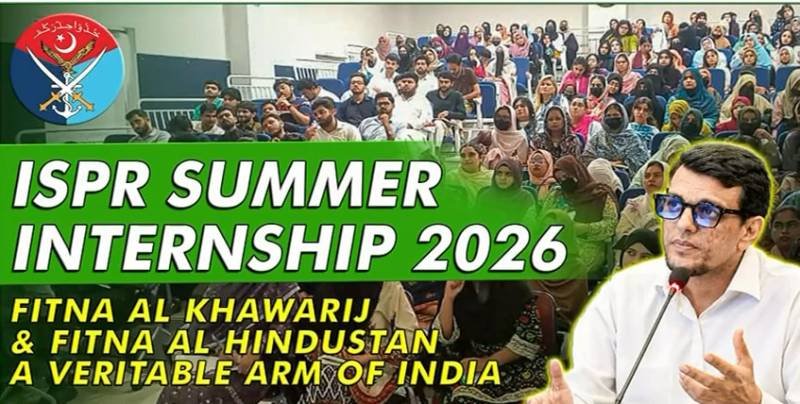

More Than 6,000 Students Join Nationwide Programme
The Inter-Services Public Relations has organised its Summer Internship Programme 2026 for university students from across Pakistan.
More than 6,150 male and female students are participating in the programme. The activities are being conducted at 21 stations nationwide.
The internship is designed to engage young people in discussions on national security, public communication, governance and Pakistan’s major internal challenges.
Students are also being provided opportunities to interact with analysts, scholars and experts from different fields.
As part of the programme, analyst and scholar Ahmad Hassan Al-Arbi held a special interactive session with the participants.
He discussed terrorism, misleading narratives and the wider conditions required for long-term national stability.
Official social media material linked to the programme also confirmed that Al-Arbi addressed thousands of students participating from 21 locations across Pakistan.
Security Operations Alone Cannot Deliver Lasting Peace
During the session, Al-Arbi said military and security operations remained important for confronting terrorist groups.
However, he stressed that security action alone could not completely eliminate terrorism.
He argued that lasting peace required modern governance, strong institutions and effective administrative reforms.
According to him, weak governance creates gaps that hostile groups can exploit. Poor service delivery, limited state presence and ineffective administration can also increase public frustration.
He said the state must combine counterterrorism operations with improved civilian institutions.
Government departments must become more responsive. Administrative systems must also be capable of addressing public grievances before they develop into wider instability.
Al-Arbi maintained that terrorism should be confronted at both the security and ideological levels.
In an earlier ISPR internship session, he also urged young people to understand the ideological foundations and propaganda methods used by terrorist organisations. He called for national unity against extremist violence.
Governance Linked With National Security
The session highlighted the growing policy debate over the connection between governance and national security.
Security forces can target armed networks and prevent attacks. However, long-term stability also depends on functioning schools, hospitals, courts, police services and local administrations.
Effective governance can strengthen public confidence in state institutions.
It can also reduce the administrative and social spaces in which extremist organisations attempt to operate.
Participants were told that modern governance required faster decision-making, stronger coordination and better delivery of public services.
Administrative reforms were also presented as an important part of Pakistan’s broader counterterrorism strategy.
The discussion came as political and security officials increasingly emphasise the need to improve governance across the country.
Al-Arbi said sustainable peace required a comprehensive approach. Security operations, institutional development, administrative reform and public awareness must work together.
Students Engage With National Issues
The interactive session allowed students to raise questions about terrorism, extremist propaganda and the responsibilities of citizens.
Al-Arbi responded to their questions and encouraged participants to evaluate information carefully.
He also highlighted the role of young people in resisting misinformation and divisive narratives.
The large number of participants reflects the programme’s nationwide reach.
Students from different regions are taking part in activities intended to strengthen their understanding of national security and public policy.
The ISPR internship programme is also providing participants with exposure to strategic communication and national-level discussions.
Organisers said such engagement could help young people better understand Pakistan’s security challenges and the importance of effective state institutions.
The central message of the session was that terrorism cannot be eradicated through force alone.
Lasting peace requires a modern administrative structure, responsive governance and a united national approach.

