

Charge Card Enters Soft Launch as Financing Card Takes Shape
Meezan Bank is preparing to introduce two new Shariah-compliant card products as it expands its consumer banking services in Pakistan.
The products will be called the Meezan Charge Card and Islamic Financing Card, according to information shared by the bank’s management during its latest analyst briefing.
Both products have received Shariah approval and are being developed as alternatives to conventional interest-based credit cards. Their commercial rollout is expected during 2027.
The Meezan Charge Card has already entered a soft-launch phase.
This stage allows the bank to test the product, technology and customer experience before making it widely available.
The Islamic Financing Card remains under development and will require further technical and operational work before launch.
Management said both cards are expected to become commercially available in 2027, subject to the completion of development and rollout requirements.
Earlier in 2026, Meezan had already disclosed plans to enter the card-financing segment, with system configuration underway for a wider launch by 2027.
The move could represent an important expansion for Pakistan’s largest dedicated Islamic bank.
Meezan already offers debit cards and several consumer financing products, but the new cards would give customers additional Shariah-compliant payment and financing options.
Deposits Climb to Rs3.7 Trillion as Branch Network Expands
Meezan Bank’s expansion into new card products comes alongside strong growth in its deposit base.
Management said deposits reached approximately Rs3.7 trillion in June 2026, increasing 23 percent year-on-year and three percent compared with the previous quarter.
The bank’s deposit market share climbed to around 9.15 percent.
Meezan continues to focus heavily on low-cost deposits.
Its current and savings account ratio stood at approximately 91 percent in June, while current account deposits increased 20 percent year-on-year.
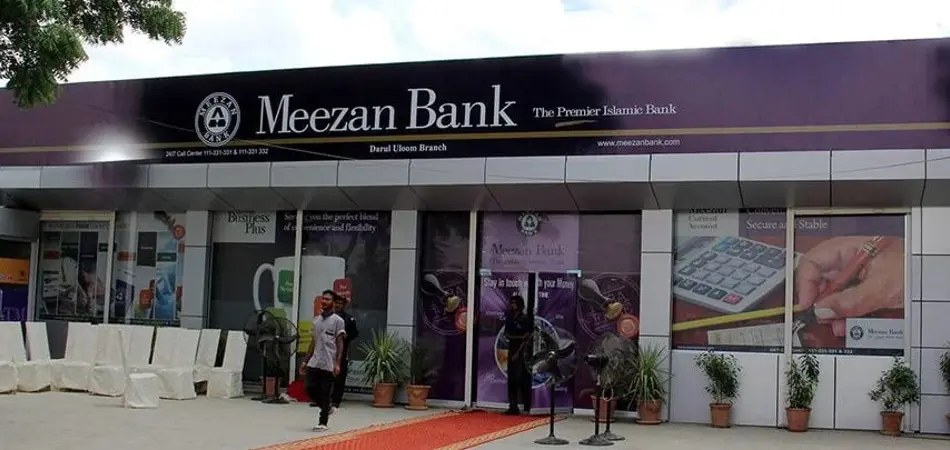
The bank is also continuing an aggressive expansion of its physical presence.
Meezan operated 1,150 branches across 372 cities by the end of June 2026, supported by 1,376 ATMs, according to its official half-year financial results.
Management plans to add another 100 branches before the end of 2026.
However, the bank says its strategy is not focused entirely on physical branches.
Meezan is pursuing what management describes as a “phygital” model, combining traditional branch banking with mobile and digital services.
The bank believes physical and digital banking channels can complement each other rather than relying exclusively on one model.
Meezan Reports Rs48.88 Billion Half-Year Profit
Meezan Bank also reported strong financial results for the first six months of 2026.
Official results show profit after tax reached Rs48.88 billion, representing year-on-year growth of six percent.
Basic earnings per share increased to Rs27.15, compared with Rs25.72 during the same period last year.
The bank announced an interim cash dividend of Rs8 per share for the second quarter.
This brought total dividends for the first half of 2026 to Rs15.50 per share, according to the analyst briefing.
Meezan’s total assets reached approximately Rs5.14 trillion at the end of June, compared with Rs4.81 trillion at the end of 2025.
The bank also maintained a capital adequacy ratio above 19 percent.
Its non-performing financing ratio remained low at 1.83 percent, while the coverage ratio against non-performing financing stood at 152 percent.
Non-funded income also increased strongly.
Meezan reported non-funded income of Rs21.63 billion during the first half of 2026, up 36 percent from Rs15.92 billion a year earlier.
The bank attributed the increase mainly to stronger foreign exchange income, branch banking fees and debit-card-related income.
Meanwhile, its advances-to-deposits ratio fell to 44 percent in June from 51 percent at the end of December 2025.
Management linked the decline to strong deposit growth, seasonal factors and relatively weak financing demand from businesses, but expects the ratio to improve in future periods.
Around 85 percent of Meezan’s investment portfolio is invested in government-issued Ijarah Sukuk.
Management said the growing supply of Shariah-compliant investment instruments is creating further investment opportunities for the bank.
With its deposit base expanding and branch network growing, the planned Charge Card and Islamic Financing Card could become an important new part of Meezan Bank’s retail strategy in 2027.

