
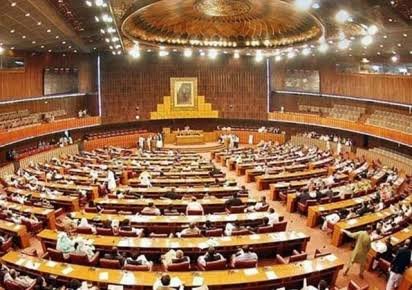

Pakistan’s National Assembly has approved a resolution endorsing the imposition of an emergency in Khyber Pakhtunkhwa (KP), triggering a heated debate over security and constitutional authority. Lawmakers from government and opposition benches exchanged accusations while discussing terrorism, political negotiations and the provincial government’s response to growing security challenges.
Federal Minister for Parliamentary Affairs Tariq Fazal Chaudhry presented the resolution, which secured majority support despite opposition protests. Following the proceedings, the National Assembly adjourned its session until Friday at 11am.
The debate exposed sharp political divisions over the federal government’s decision. While treasury members defended the emergency as necessary for national security, opposition representatives questioned its constitutional justification.
Azam Nazir Tarar Cites Thousands of Terrorism Incidents
Federal Law Minister Azam Nazir Tarar defended the emergency, arguing that the decision followed worsening security conditions in the province. He rejected the impression that the federal government had simply dismissed an elected provincial administration.
“Emergency was imposed in the province due to internal strife and incursion of militants from across the border,” the minister said. He added, “The imposition of emergency in the province is in accordance with the constitution.”
Tarar told the National Assembly that KP had experienced 3,787 terrorism incidents within one year. He accused former chief minister Sohail Afridi of overlooking these attacks and the sacrifices made by security personnel.
The law minister also criticised Afridi’s activities during the security crisis. According to Tarar, the federal government had favoured negotiations over using force against those planning to march on Islamabad.
However, he argued that PTI had focused on meetings with its imprisoned leader and the facilities available to him rather than supporting victims of terrorism.
Bilawal Bhutto Calls for Political Dialogue
Pakistan Peoples Party Chairman Bilawal Bhutto Zardari blamed the former KP chief minister for the situation that led to the emergency. He described PTI’s performance in the province as a serious political setback.
“What PTI has done in KP is a political suicide,” he commented, adding that the former provincial chief minister was responsible for the imposition of emergency.
Bilawal maintained that the federal government had tried to prevent the situation from reaching this point. He said the centre held discussions with PTI before taking the decision and attempted to resolve the political deadlock.
He also urged political parties to set aside their differences and develop a joint strategy against terrorism. Moreover, he renewed his offer of talks with PTI, stressing that emergency rule could not continue indefinitely.
“Let’s talk to each other. Because emergency cannot continue in the province forever.”
Khawaja Asif Says Counterterrorism Remains Government’s Priority
Defence Minister Khawaja Asif accused the previous PTI government of attempting to bring militants back to Pakistan during its four-year tenure. He also alleged that the former administration had taken several unconstitutional steps.
Asif criticised PTI for making former prime minister Imran Khan’s release a central political issue. He contrasted the party’s position with that of PML-N leaders, whom he claimed had remained committed to Nawaz Sharif despite imprisonment.
The defence minister emphasised the scale of the security challenge facing KP and the rest of the country.
“Our priority is solely the elimination of terrorism from the country,” he added.
Asif also claimed that meetings with Imran Khan had been arranged but were not made public. He further alleged that the former KP chief minister followed instructions from an individual residing in Afghanistan.
These remarks added to the confrontation between government members and PTI representatives during the parliamentary debate.
Farooq Sattar Supports Emergency in KP
Muttahida Qaumi Movement-Pakistan leader Farooq Sattar said his party supported the emergency in Khyber Pakhtunkhwa. He argued that the opposition had not presented convincing grounds against the government’s decision.
Sattar acknowledged that imposing an emergency in the province was a difficult step. Nevertheless, he urged PTI’s leadership to clearly condemn terrorism and demonstrate its commitment to counterterrorism efforts.
Meanwhile, Prime Minister’s Special Assistant Rana Sanaullah argued that the provincial government needed to improve its performance. He questioned the rationale for negotiating with individuals who, he alleged, advocated breaking up Pakistan.
Mohsin Naqvi Says PTI Negotiations Collapsed Before Emergency Decision
Interior Minister Mohsin Naqvi told the Senate on Tuesday that negotiations with PTI had nearly produced an agreement before the process collapsed. According to him, consultations involving KP Chief Minister Sohail Afridi and PTI leader Murad Saeed derailed the discussions.
Naqvi said the initial negotiations focused entirely on terrorism rather than political demands. He claimed PTI leader Asad Qaiser had assured the government that his party would support counterterrorism efforts.
“Asad Qaiser said they would stand at the forefront for Pakistan,” Naqvi told the Senate.
The interior minister said he highlighted differences between Qaiser’s position and the provincial government’s approach. He then asked Qaiser to consult the party leadership before proceeding.
According to Naqvi, the government contacted PTI Chairman Barrister Gohar on October 10 and requested proposed amendments to Paragraph 4 of the draft agreement. He said discussions with PTI representatives resulted in six amendments.
Naqvi added that the negotiating team regularly briefed Chief Minister Sohail Afridi, who remained in contact with Murad Saeed. The draft agreement eventually reached the chief minister, who forwarded it to Saeed before the negotiations broke down.
“Two days of our hard work went to waste,” he said.
Naqvi maintained that a successful agreement could have prevented the government from imposing an emergency or governor’s rule. He also said the government had considered these options on November 26 and earlier but had not exercised them.
The interior minister described the latest decision as difficult and rejected suggestions that the government had taken it lightly. He also criticised the provincial administration’s response to attacks on security personnel.
Furthermore, Naqvi alleged that several PTI members had links with the Tehreek-e-Taliban Pakistan (TTP). He said the government would present evidence supporting these allegations at an appropriate time.
PTI Challenges the Constitutional Basis of Emergency
PTI Senator Syed Ali Zafar challenged the constitutional grounds for imposing an emergency and governor’s rule in Khyber Pakhtunkhwa. He accused the federal government of using terrorism as a pretext to remove an elected provincial administration.
Ali Zafar acknowledged that fighting terrorism required a united national response. However, he argued that counterterrorism measures must remain within constitutional limits.
“We are united in the resolve to defeat terrorism. However, let us not consign the Constitution to the wastebasket while fighting the war against terror,” he said.
His remarks highlighted the central disagreement surrounding the emergency: whether the federal government’s action represents a necessary security measure or an unconstitutional interference in provincial governance.
Political Tensions Continue Over KP’s Security Future
The National Assembly’s approval has intensified debate over how Pakistan should address terrorism in Khyber Pakhtunkhwa. Government leaders have defended the emergency by pointing to security threats and failed negotiations, while PTI has questioned the constitutional basis of the decision.
At the same time, Bilawal Bhutto has urged renewed dialogue, arguing that political differences should not obstruct a collective response to terrorism. However, accusations from both sides continue to complicate efforts to establish common ground.
The debate now centres on security, constitutional authority and the future of political negotiations. Although lawmakers broadly acknowledge the need to combat terrorism, they remain sharply divided over the measures required to achieve that goal.
For the latest updates, visit and follow The Truth International website (www.thetruthinternational.com) and subscribe to the YouTube Channel.

