
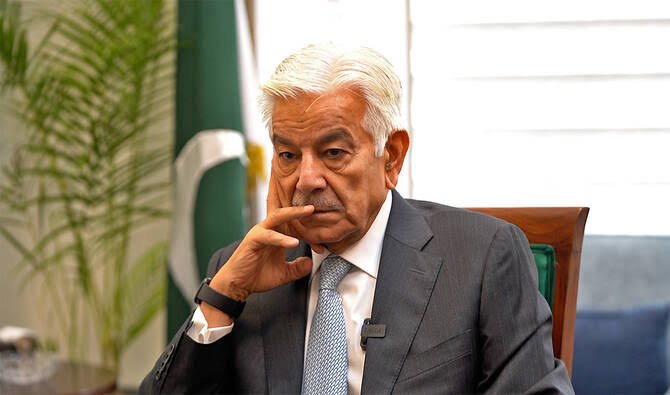

Defence Minister Predicts Continuity of Current System
Defence Minister Khawaja Asif has dismissed speculation that Pakistan’s current political system or federal government could soon collapse.
Speaking on Geo News, Asif said he had seen no indication that the existing arrangement was approaching its end. He described the country’s “hybrid system” as a mechanism designed to correct mistakes made during previous periods of governance.
The defence minister argued that coordination between major civilian and state leaders was necessary to address Pakistan’s political, economic and administrative challenges.
According to Asif, President Asif Ali Zardari, Prime Minister Shehbaz Sharif, Field Marshal Asim Munir and several other senior national figures should hold consultations and determine a collective way forward.
He maintained that cooperation among the country’s most influential decision-makers was currently the only realistic method of resolving longstanding national problems.
Asif’s remarks appeared to defend the existing civil-military governance arrangement at a time when senior officials are publicly questioning the effectiveness of Pakistan’s administrative structure.
Naqvi’s Governance Remarks Trigger Political Debate
The defence minister was responding to Interior Minister Mohsin Naqvi’s recent statement that Pakistan’s existing governance system had collapsed.
Addressing the Pakistan Economic Summit in Islamabad on July 30, Naqvi said the current structure was no longer capable of solving the country’s major problems.
He warned that Pakistan could continue facing the same challenges for another decade unless political leaders introduced fundamental reforms.
Naqvi also called for the creation of smaller administrative units or additional provinces. He argued that government institutions needed to move closer to citizens to improve public services and administrative performance.
However, Asif said Naqvi’s statement contained a political dimension and represented his personal assessment.
The defence minister noted that Naqvi had remained part of the existing governance system for more than three years. He suggested that the interior minister’s criticism should therefore be viewed in that context.
Asif also agreed with the military spokesperson’s position that Naqvi had expressed a personal opinion rather than presenting an official institutional policy.
Good Governance Linked to National Security
The debate intensified after Director General Inter-Services Public Relations Lieutenant General Ahmed Sharif Chaudhry addressed the issue during a press conference.
The DG ISPR said effective governance was essential for Pakistan’s security and stability.
He argued that unresolved political, economic and administrative problems indicated the need for serious discussion about governance reforms.
However, he stressed that any administrative reset must be carried out through constitutional procedures, legal mechanisms and the consent of Pakistan’s people.
The military spokesperson also said elected representatives and political parties should lead the debate over possible structural changes.
He maintained that Pakistan’s population had expanded significantly while its provincial structure had remained largely unchanged. He said policymakers should examine whether the current arrangement was still delivering effective governance.
Asif, however, drew a distinction between the DG ISPR’s emphasis on good governance and Naqvi’s declaration that the system had collapsed.
He said the military spokesperson had focused on improving governance through constitutional debate, while the interior minister’s remarks carried a broader political message.
The defence minister’s comments indicate that the federal government does not currently view the renewed governance debate as evidence of an approaching political breakdown.
Instead, Asif presented the hybrid arrangement as a continuing system of coordination intended to provide stability and correct earlier policy failures.

