
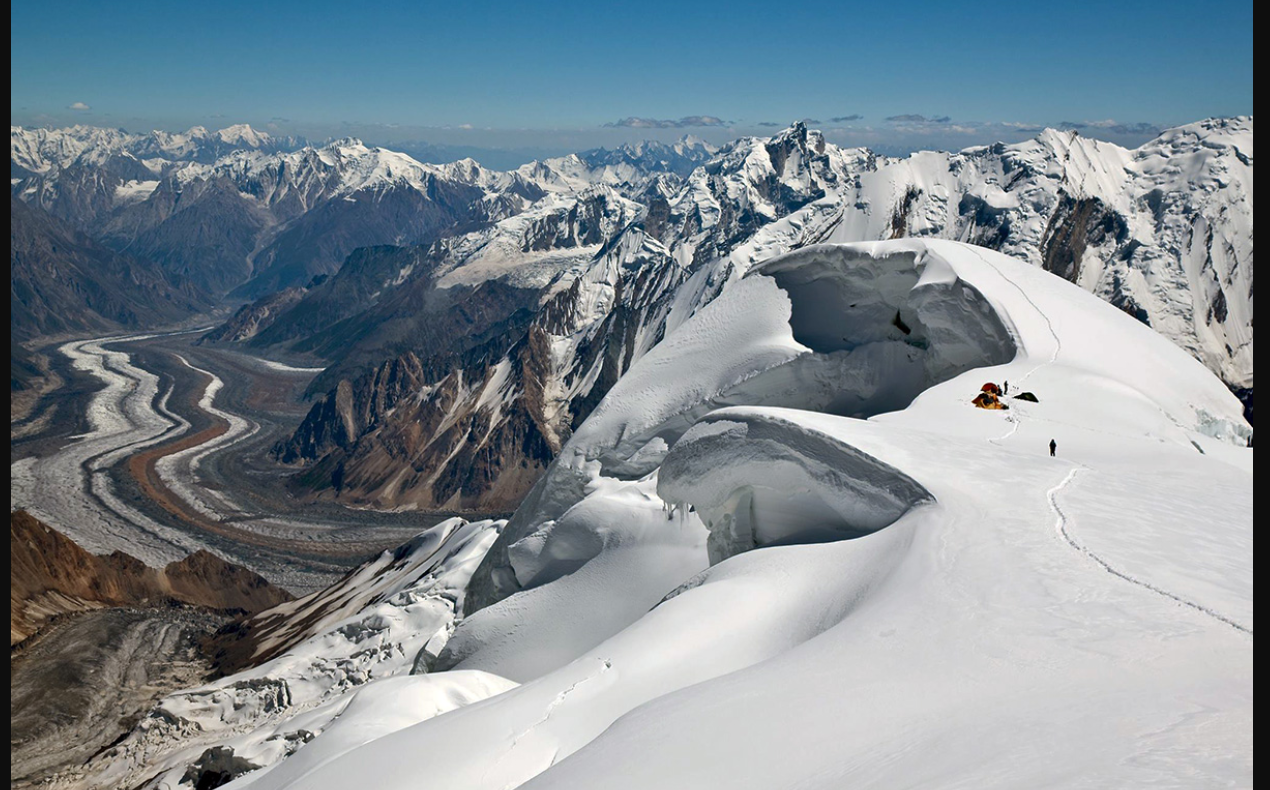

Heavy snowfall has halted efforts to recover Pakistani climber Dr Asma Mushtaq’s body from Spantik Peak in Gilgit-Baltistan.
The 34-year-old climber died while descending the 7,027-metre peak in Shigar district. She reportedly suffered from high-altitude sickness after reaching the summit.
Her body remains at a high-altitude camp as rescue teams wait for safer weather conditions.
Recovery Mission Halted Due to Snowfall
According to the Alpine Club of Pakistan, the recovery team left for the mountain on Saturday.
The team reached Camp 2 but could not continue because of heavy snowfall. Therefore, officials advised the rescuers to return to Base Camp.
The team will wait there for a suitable weather window before resuming the recovery effort.
“The recovery team departed on Saturday and reached Camp 2 today, but operations have been halted due to heavy snowfall,” the Alpine Club said.
“The team has been advised to return to Base Camp and wait for a suitable weather window.”
Dr Mushtaq’s body is currently reported to be around 6,400 metres above sea level. Earlier reports placed the body at Camp 3.
Meanwhile, approval for a humanitarian helicopter rescue mission was also being pursued with Pakistan Army support.
Ground Team to Bring Body Down
The recovery operation includes climbers from different teams. Dr Mushtaq’s expedition company is coordinating the mission with relevant authorities.
These include the tourism department, local government and Alpine Club of Pakistan. ACP General Secretary Ayaz Shigri said a ground team must first bring the body down from the mountain.
He explained that helicopters cannot retrieve the body directly from altitudes above 6,000 metres.
“Only the ground rescue team can bring down the body from the peak to base camp,” he said.
A six-member local team is currently involved in the effort. Once the body reaches Base Camp, a Pakistan Army helicopter is expected to transport it to Skardu.
Shigri said the timing of the operation would depend heavily on weather conditions.
“If the weather allows, the rescue team will bring the body down to base camp, and army helicopters will airlift it from the base camp to Skardu.”
Investigation Into Dr Mushtaq’s Death
The Alpine Club said the circumstances surrounding Dr Mushtaq’s death would be investigated.
The review will also examine the conduct and response of the expedition company.
“It was earlier reported that Dr Asma suffered from high-altitude sickness after summiting,” the statement said.
“The circumstances surrounding her death, as well as the conduct and response of the expedition company, will be fully investigated once the teams are safely down and her body has been recovered.”
The club said any necessary action would follow the investigation’s findings. It also urged people to avoid spreading unverified information about the recovery operation.
“Please refrain from spreading misinformation or making unverified claims about the recovery operation,” the club said.
The organisation stressed that recovering Dr Mushtaq’s body safely and with dignity remained the priority.
Tour Operator Faces Questions
Baltistan Division Commissioner Kamal Khan said the tour operator had violated mountaineering rules.
According to Khan, the operator failed to arrange a ground recovery team and helicopter arrangements. He said authorities were taking strict action over the alleged violations.
Khan said the operator initially refused to arrange a ground rescue team. He reportedly cited the absence of an agreement with the climber. He also said the operator had not paid insurance for helicopter services.
“Under the rules, if a ground rescue team or helicopter is needed, the tour operator is responsible to arrange a rescue team and pay insurance for helicopter,” he said.
The commissioner also alleged that the operator failed to conduct mandatory briefing and debriefing procedures. However, Khan rejected the impression that negligence caused a delay in the recovery mission.
He said the administration arranged a ground team soon after receiving information about the incident. The expenses of the ground recovery team are being covered by a non-governmental organisation.
Meanwhile, the Pakistan Army agreed to provide helicopter support on humanitarian grounds.
Dr Asma Mushtaq’s Mountaineering Journey
Dr Mushtaq was originally from Lahore and worked in the United Kingdom as an obstetrics and gynaecology doctor.
Beyond her medical career, she pursued mountaineering and documented her adventures online.
She also worked as a traveller and vlogger. Her previous mountaineering activities included a winter ascent of the 4,076-metre Musa ka Musallah peak.
She was also associated with expeditions to Rupal and Arandu. In a 2024 post seeking sponsorship for a K2 expedition, she described herself as “a doctor and mountaineer”. Recovering her body from such extreme altitude remains a highly challenging task.
Experts note that recovery operations above 6,000 metres can expose rescuers to severe risks.
In some cases, climbers who die at extreme altitudes remain on the mountain because recovery becomes too dangerous.
Broad Peak Recovery Also Awaits Better Weather
Meanwhile, poor weather has also delayed the helicopter recovery of US climber Sarah Mallory Geis from Broad Peak.
Three local porters voluntarily recovered Geis’s body on Friday. She had gone missing 22 days earlier following a deadly avalanche. The porters moved her body to Broad Peak Base Camp. Shigri said the body would be airlifted to Skardu once weather conditions improve.
Geis was among 10 members of an international expedition hit by an avalanche on July 30. The expedition was led by British-Nepali mountaineer Nirmal Purja.
Purja’s company later confirmed that there were no survivors from the expedition.
According to Shigri, nine bodies, including those of Purja and Pakistani climber Sohail Sakhi, have been recovered. The bodies have subsequently been handed over to their families. However, the search for the tenth deceased climber, Nawang Thindu Sherpa, will continue.
Broad Peak stands at 8,047 metres in the Karakoram range. It is the world’s 12th-highest mountain and remains a demanding high-altitude climb. An Austrian team made the mountain’s first successful ascent in 1957.

