
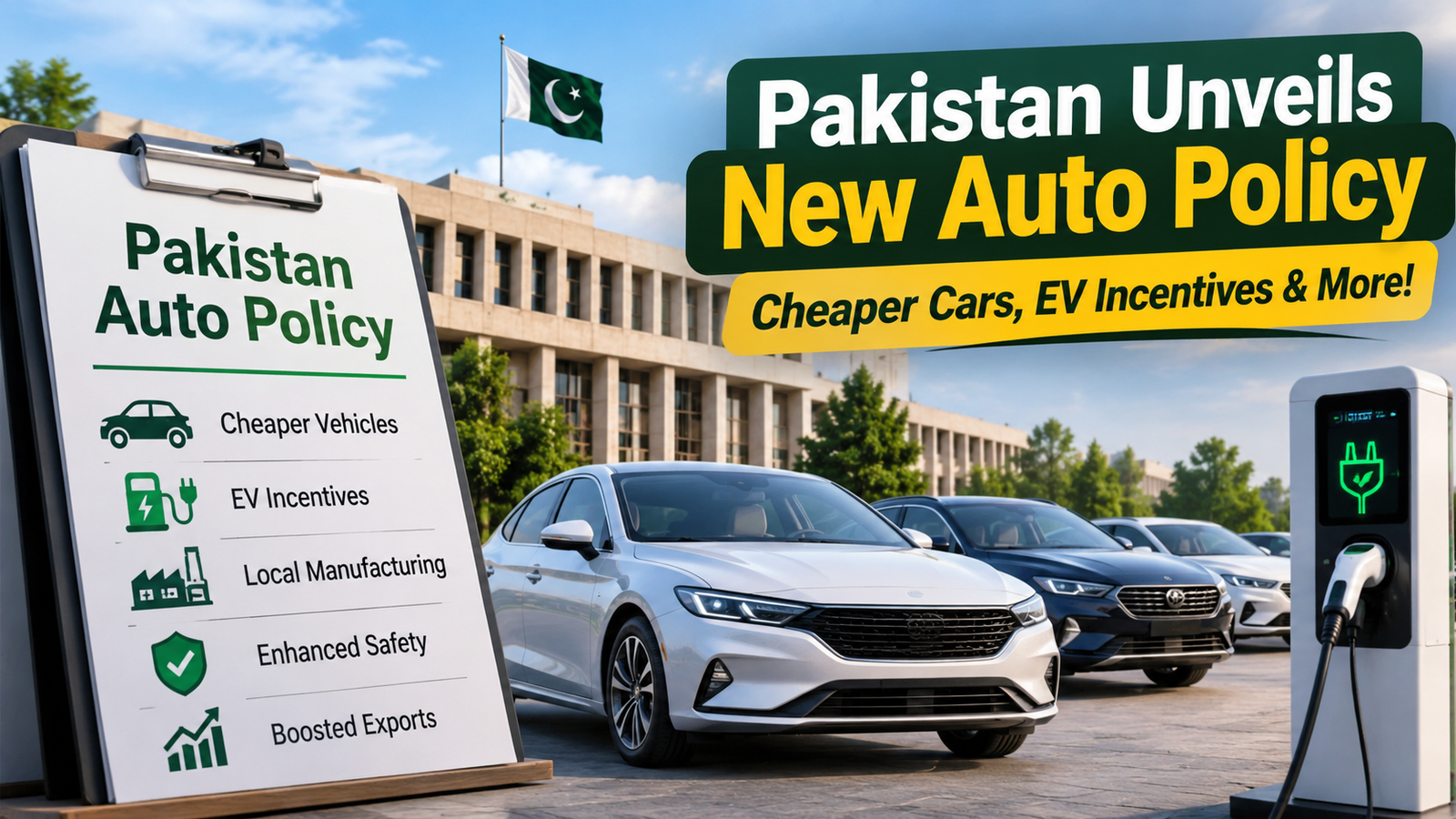

Pakistan’s federal government has announced a new automobile policy aimed at making vehicles more affordable and accelerating electric mobility. The policy focuses on cheaper cars, electric vehicles (EVs), exports, local manufacturing and improved vehicle safety.
Information Minister Attaullah Tarar and Adviser to the Prime Minister for Industries and Production Haroon Akhtar Khan announced the policy during a press conference in Islamabad on Saturday, November 7.
The government has built the framework around six key pillars. These include affordable vehicles, export growth, localisation, vehicle safety, electric mobility and transparency. Meanwhile, the cabinet approval process has begun.
New Auto Policy Aims to Reduce Vehicle Prices
One of the government’s main objectives is to bring down vehicle prices, particularly for middle-income and lower-middle-income households. Haroon Akhtar Khan said the government had worked extensively on the policy under Prime Minister Shehbaz Sharif’s instructions.
The new tariff framework aims to reduce production costs and lower the import bill for raw materials. Consequently, manufacturers could benefit from cheaper inputs, allowing them to reduce vehicle prices.
“You will see that prices of cars will come down … the manufacturing cost of automakers will come down; these were the prime minister’s specific instructions. The prices of all vehicles, except luxury vehicles, will come down,” Akhtar said.
However, the reductions will take place gradually rather than immediately. The government plans to lower duties on completely built units (CBUs), assembly plants and vehicle components every year.
After five years, the tariff structure will move towards competitive rates. Luxury vehicles, however, will remain outside the proposed price reductions.
Local Manufacturing and Vehicle Exports Get New Targets
The policy also places greater emphasis on localisation and domestic manufacturing. Automakers will receive specific localisation targets to encourage greater production of vehicle components within Pakistan.
Furthermore, the government plans to introduce a rewards and penalties system to increase exports. Manufacturers achieving their export targets will receive a 5% Duty Drawback on Local Taxes and Levies (DLTL).
The incentive could increase by another 10% as exports grow. However, manufacturers must also meet their domestic production and localisation commitments.
Akhtar warned that companies failing to achieve their assigned targets would face penalties. He also clarified that manufacturers would not receive DLTL benefits without meeting both export and local manufacturing targets.
The government wants these conditions to encourage investment in domestic production facilities. Moreover, increased manufacturing activity could create additional employment opportunities.
Pakistan Introduces 45 Additional Vehicle Safety Standards
Vehicle safety represents another major component of the new automobile policy. The government plans to introduce 45 additional safety standards aligned with the United Nations WP.29 regulations.
These standards aim to bring locally manufactured vehicles closer to international safety requirements. They will also apply to vehicles covered by the relevant safety framework.
Akhtar said, “When our vehicles will go through these safety codes, they will be considered the world’s safest vehicles — both manufactured and used.”
The proposed changes form part of the government’s broader effort to improve vehicle quality. In addition, stronger safety requirements could encourage manufacturers to upgrade their production processes.
EV Incentives: New Sales Tax Rates and Tax Exemptions
Electric vehicles feature prominently in the new auto policy, with the government proposing several tax incentives. Pakistan aims to transition 30% of all new vehicles to electric power by 2030.
However, Akhtar suggested that the target could be achieved earlier than expected.
The proposed sales tax structure includes three separate categories:
- Pure electric vehicles: 1% sales tax.
- Range-extended electric vehicles (REEVs): 6% sales tax.
- Hybrid electric vehicles: 9% sales tax.
These proposed rates remain subject to approval by the International Monetary Fund (IMF).
Additionally, the government plans to exempt qualifying electric vehicles from several existing taxes. EVs priced up to $50,000 would not face capital value tax (CVT), withholding tax or federal excise duty (FED).
However, vehicles exceeding the $50,000 threshold would fall into the luxury category. Consequently, they would remain subject to normal taxation.
EV Financing Limit Increased to Rs10 Million
The government also plans to expand financing opportunities for electric vehicle buyers. Currently, the State Bank of Pakistan’s car financing plan offers up to Rs3 million for ordinary vehicles.
Under the proposed changes, the financing limit for EVs would increase to Rs10 million. Furthermore, the repayment period would extend from three years to five years.
These changes aim to make electric vehicles more accessible to potential buyers. Longer repayment periods could also help reduce the immediate financial burden on consumers.
Government Plans Incentives for EV Charging Stations
Expanding charging infrastructure remains another priority under the new automobile policy. The government recognises that limited charging facilities can discourage consumers from switching to electric vehicles.
At the same time, businesses may hesitate to establish charging stations without sufficient customer demand. Therefore, the government plans to address this gap through financial support.
Akhtar said the government would fund the existing viability gap to encourage investment in charging infrastructure. This support aims to make charging station projects more commercially feasible.
The proposed incentives also include a reduction in sales tax on charging equipment to 1%. Additionally, customs duty on the equipment would be removed.
The government sees charging infrastructure as an important requirement for expanding pure electric vehicle adoption. Meanwhile, hybrid and range-extended vehicles could support the transition.
Government Explains How It Plans to Manage Revenue
The proposed incentives come as Pakistan continues to operate under an IMF programme. Therefore, the government wants to maintain what Akhtar described as “neutral revenue on whatever incentives we are giving”.
Under this approach, the government plans to collect revenue from internal combustion engine vehicles above 1,000cc rather than electric vehicles.
Meanwhile, ordinary petrol vehicles below 1,000cc would remain exempt from the proposed changes. This provision aims to protect consumers who rely on smaller, more affordable vehicles.
The government also plans to use the collected revenue to support export rebates and research and development.
Electric Two-Wheeler Sales Increase Under NEV Policy
The government has also highlighted the growth of electric two-wheelers following the introduction of the New Energy Vehicle (NEV) Policy 2025-30 last year.
According to Akhtar, electric two-wheeler sales reached 240,000 units in FY2025-26. This represents a significant increase from 60,000 units during FY2024-25.
The figures indicate growing adoption of electric motorcycles and scooters in Pakistan. Moreover, the government sees electric mobility as a way to reduce dependence on imported fuel.
Government Highlights Rising Fuel Import Costs
Addressing the press conference, Information Minister Attaullah Tarar discussed the challenges facing Pakistan’s automobile industry. He criticised decades of protectionist policies that increased import duties while supporting local manufacturers.
According to Tarar, these policies did not encourage sufficient innovation or value addition within the industry. He also highlighted the growing use of electric motorcycles and scooters, describing their adoption as a “need of the time”.
Furthermore, he stressed the importance of reducing Pakistan’s oil import bill. Rising fuel imports can increase pressure on the economy and expose consumers to higher petrol prices.
Tarar clarified that the new policy would not change existing arrangements for ordinary petrol vehicles below 1,000cc. He noted that many ordinary citizens continue to depend on these vehicles.
In a statement on X, the minister said the government developed the policy after consulting stakeholders and analysing technical data. Officials also reviewed different international automobile industry models.
He said, “Innovation, value addition, and localisation will be promoted in the local industry to create employment opportunities and enable vehicle exports,”
Tarar added that promoting electric vehicles could reduce carbon emissions and Pakistan’s dependence on imported oil. He also highlighted the incentives planned for establishing charging stations.
The minister described the initiative as a “significant step toward providing Pakistani citizens with affordable, high-quality, and environmentally friendly transportation”.
The new auto policy now moves towards the cabinet approval process. Its proposed tax incentives, tariff reductions and manufacturing targets will shape the next phase of Pakistan’s automobile industry.
For the latest updates, visit and follow The Truth International website (www.thetruthinternational.com) and subscribe to the YouTube Channel.

