

Energy infrastructure expansion aims to diversify export routes amid regional security concerns
DUBAI: Gulf energy producers are accelerating major pipeline and port projects designed to reduce dependence on the Strait of Hormuz, as governments seek alternative export routes amid continued geopolitical tensions in the region.
According to a report published by the New York Post, several Gulf countries are investing heavily in infrastructure that could significantly increase the volume of oil transported overland rather than through the strategic waterway, which has traditionally handled a substantial share of global crude exports.
The report, citing projections by Goldman Sachs, estimates that alternative export routes could divert approximately 45 percent of pre-conflict Gulf oil exports away from the Strait of Hormuz by the end of 2027. By the end of 2028, the report projects bypass capacity could reach around 7.3 million barrels per day, equivalent to roughly 60 percent of previous export volumes.
Major projects expand export options
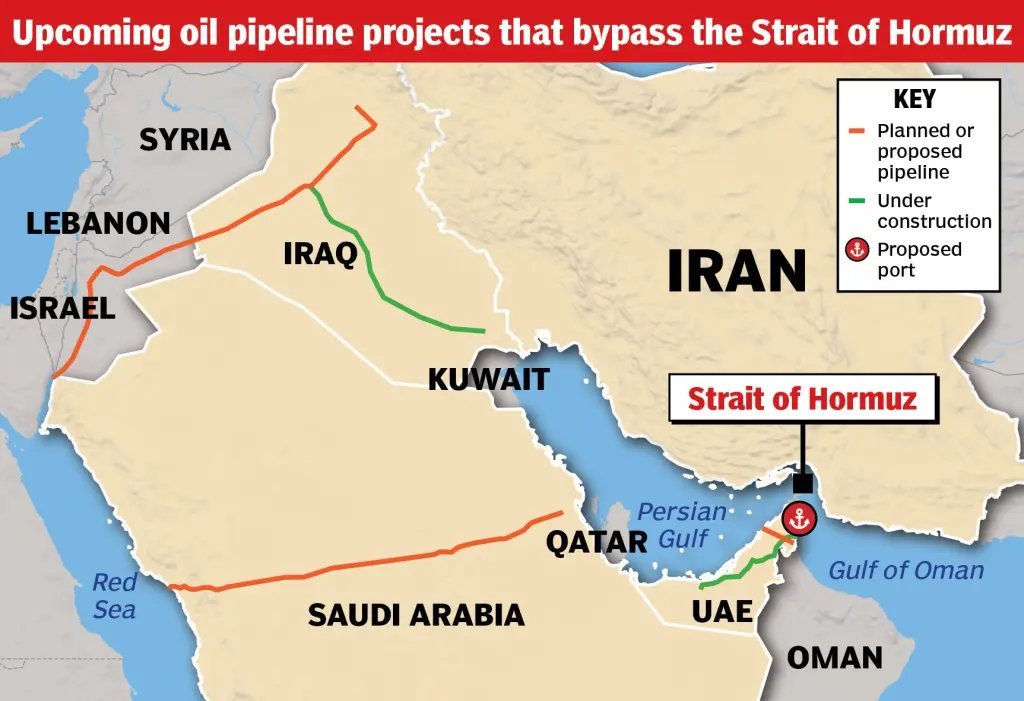
Among the planned developments, the United Arab Emirates is expanding its West-East Pipeline, which reportedly aims to double overland export capacity to approximately 3.6 million barrels per day upon completion.
Meanwhile, Iraq is advancing a reported $1.5 billion Basra-Haditha pipeline project intended to transport up to 2.5 million barrels of oil daily toward Jordan, Syria and Türkiye. Saudi Arabia is also considering expanding its Red Sea pipeline network to increase export capacity.
In addition, the UAE is reportedly planning a new commercial port on the Arabian Sea to strengthen trade links while reducing reliance on routes through the Strait of Hormuz.
Challenges remain despite diversification
Despite the planned infrastructure, analysts note that a significant share of Gulf energy exports is still expected to pass through the Strait of Hormuz for the foreseeable future.
The report also points out that some alternative shipping routes face their own security challenges, including areas affected by regional instability.
Energy analysts say the expansion of pipeline networks reflects a broader strategy to improve supply chain resilience, diversify export options and reduce vulnerability to disruptions in critical maritime corridors. However, they caution that the Strait of Hormuz is expected to remain one of the world’s most strategically important energy transit routes even as alternative infrastructure comes online over the coming years.
🚨🇺🇸🇮🇷 The Gulf is racing to make its oil "strait-proof," with pipelines that could bypass 60% of Hormuz dependence by 2028…
-Gulf producers are rushing pipelines and a new port to break Iran's grip on the waterway that carried 20% of the world's oil
-Goldman Sachs estimates… pic.twitter.com/MtF2kCC7IC
— Mario Nawfal (@MarioNawfal) July 15, 2026

