

By Humaira Motala
KARACHI: Bills, breakdowns, and blackouts have defined K-Electric for years. For millions in Karachi, K-Electric is not just a company. It’s a monthly bill, a summer night without fans, and a phone call to the helpline.
As Karachi braced for another brutal summer, K-Electric got a new captain in April 2026. Newly appointed CEO Syed Muhammad Taha took charge with a promise to put “customer experience, reliability, and transparency” at the center of the utility’s next phase, signaling a shift in how the city’s sole power provider plans to deal with complaints of its 3.4 million consumers. With that, the CEO also brought in major changes to his crew.
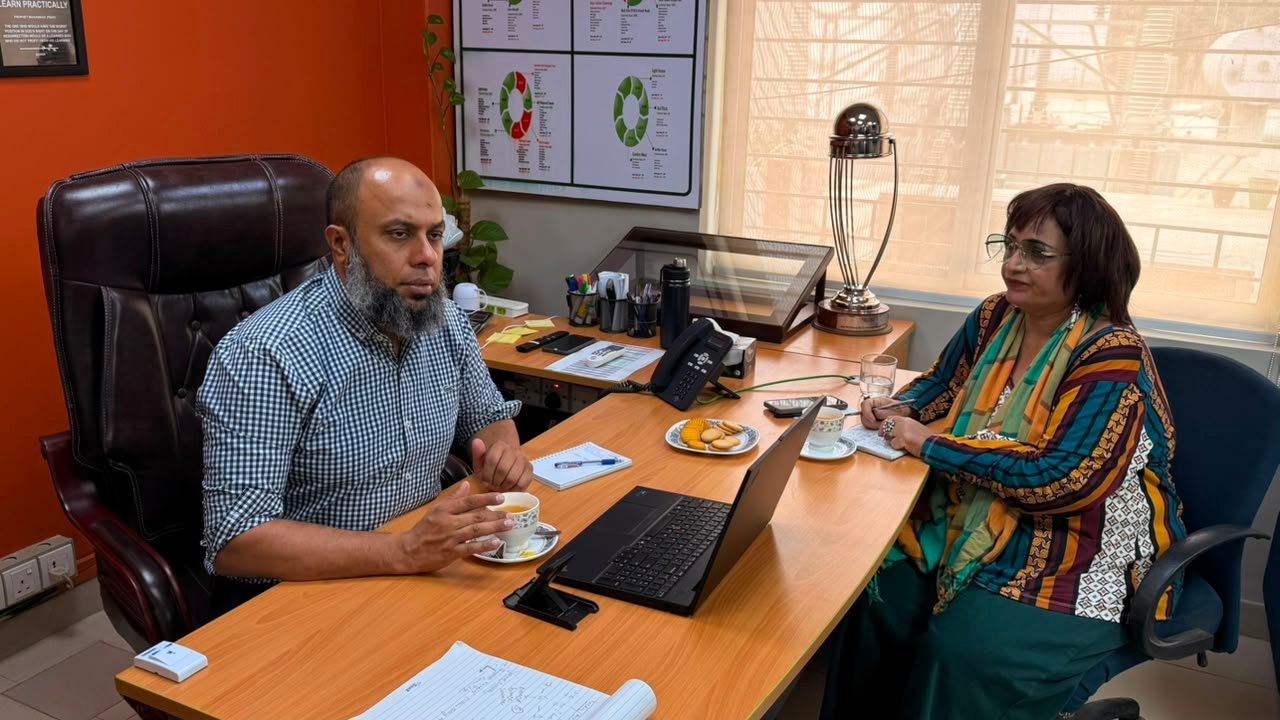
Eight years after walking into K-Electric’s Garden IBC as an Assistant Manager, Asim Nizami is back — this time as General Manager. The new GM, who took charge in July, says that narrative needs to change. In his first detailed interview since assuming office, he outlined his plans. His mandate is clear: protect and prioritize regular bill-paying customers, and take strict action against distribution losses and chronic defaulters.
CEO Taha’s Alignment with KE Vision
“Our CEO, Syed Muhammad Taha, in alignment with K-Electric’s vision to ‘restore and maintain pride in KE, Karachi’, is fully geared to serve customers through investment, revamping projects, introducing new technology and improving overall infrastructure to provide uninterrupted supply to star consumers,” Nizami said.
“But we have to make sure that investment returns in terms of revenue and recovery,” he added. “We are in the business of selling, like all DISCOs, and not a government-funded NGO.”
“The CEO also believes an employee should be taken care of. An employee without stress is an asset to the company and offers more value. A motivated team is what will deliver results on the ground.”
That is why he has brought in more experienced hands. The appointment of Ali Kamal as Chief Distribution Officer brings KE a leader built at the intersection of operations, technology and customer experience. Saad Ali Khan, formerly Cluster Head Society, has also taken on a new role. “He is a visionary young leader with a decade of experience at K-Electric,” Nizami said.
The Real Problem: Distribution Losses + Kundas
Nizami identified area distribution losses and low recoveries as the most uphill task in Garden IBC. “The biggest challenge is in areas with low propensity to pay,” he said. “Their excuse is always that they are from a lower income bracket. But the reality is they use kundas to run multiple ACs, refrigerators and other appliances.”
He added that while previous GM Col Dr Zaib made efforts to bring high-loss feeders down to medium or no-loss categories, the infrastructure has since deteriorated and the kunda mafia has stepped in as a “full business runner.”
What’s Changing Now
Since taking charge, Nizami said he has segregated regular bill-paying customers for priority complaint resolution. At the same time, inspection teams and technical staff have been deployed to plug losses and target theft.
“The goal is simple. Satisfy those who pay, and act strictly against those who steal,” he said. The office is now moving from reactive complaint handling to proactive monitoring.
On the social aspect, he drew a line between genuine hardship and organized theft. “We are not against the poor. But when a house is running 3 ACs on a kunda and then says they cannot pay Rs. 2,000 bill, that is not poverty. That is theft. And theft has to be stopped if we want to keep the lights on for those who are paying.”
Role of NEPRA
“NEPRA is our regulatory authority. Besides providing us the policy framework, they also entertain individual complaints and seek responses from K-Electric,” he said.
“However, since the company provides them the data and highlights the loopholes in the system that trigger load shedding, they cannot compel us to undo it. At the end of the day, K-Electric is a business-oriented service. No business can run in loss.”
Closing the Circle
For Nizami, the posting is personal. He started at Garden IBC in 2017 as an Assistant Manager. “The circle is complete. I know this office and I know these consumers. Returning as GM comes with both pride and pressure,” he said.
“Those who are still here welcomed me wholeheartedly and those who have left for other branches or the company, I got connected with them too,” he said with a smile. “It’s a nursery for me. It’s a real garden where I have bloomed fully.”
“The biggest challenge is expectations. People remember you as ‘Asim bhai’ from 2017,” Asim said. “I don’t want to be remembered as the GM who gave speeches or false hopes. I want to be remembered as the GM who reduced losses, reduced complaints, and gave relief to the honest consumer.”
The Journey: From Data to Defaulters
Nizami’s path to GM has been through almost every tough corner of K-Electric. He started in Data Analytics, learning losses feeder by feeder. Then as Manager Coordination for Cluster Head Society, dealing with resident associations.
As DGM Business Operations, Asim handled private and public sector clients. “Getting a government department to pay is a negotiation in itself,” he said. From 2024 to 2026, he headed chronic defaulter recoveries.
“70% were from VHL(Very High Losses) pockets. Imagine asking someone to pay with 16 hours load shedding. We brought them to the table with discounts, new meters and easy installments,” he said. That tenure saw recovery improve by 11%, amounting to Rs. 500 million paid to KE. He also dealt with the “builder mafia” issue where residents inherit huge property bills.
“I offered customized settlements. Pay what you can now, get individual meters later. Every project needs a different option,” Nizami added.
Beyond Challenges: Why He Stays
“Working in Operations at K-Electric is nerve-wracking, but at the same time fulfilling,” Asim said. “It requires 24/7 availability. People may call you at 2am if there is a breakout. It involves extended hours, night shifts, early mornings and constant accountability. It’s a distressful job, but also an accomplishing one”, Nizami highlighted.
“You can earn bread and butter in any other field. But to work in a complex region like Karachi, where challenges and venues are numerous. For me, KE was never just about a paycheck. It’s compassion, resilience, and tenacity. It gives me a sense of ownership — that you are trying to bring relief in people’s lives. In a complex city like Karachi, KE taught me how to navigate challenges. That learning is what keeps me going,” he said with head high.
The Glass Half Empty
But it’s not all fulfillment. “While disposing of my duty with honesty, devotion and integrity, I have had to compromise on family life,” he said. “I miss the fun of seeing my children growing. Though I’m always there for mentorship and financial assistance, I missed the fun part,” Nizami recalled.
“In a senior role in an organization like KE, where we are like a family, you cannot pursue personal passion. Be it education, art, music, or anything other than the job,” he said. He then smiled and added, “You know, I love traveling.”
“We Have Limits Too”: The Truth He Wants You To Hear
Asim Nizami was candid about the frustration.
“It sometimes really demotivates me when I am not able to satisfy the public,” he said. “People need to understand that whether it’s a GM or a CEO, we all have our limitations. But that does not mean we are not working on it.”
He said the new leadership is working with new zeal on areas that need to be rectified by KE itself. “But no company, not even one like K-Electric, can survive with such high distribution losses and poor recoveries.”
On high tariffs and surcharges, Nizami was clear. “That is the domain of policy makers, not ours. Our job is to deliver electricity and fix what’s in our control. We are ready to accept our shortcomings. But I genuinely feel the time has come for the community itself to realize its own responsibility too. Only then can Karachi truly become the City of Lights again,” he concluded.
The writer is a senior journalist and columnist covering crime, law, social issues, governance, energy, health, literature, women and children’s rights across Pakistan’s leading English media houses.
Feedback: mediawomen2014@gmail.com

