
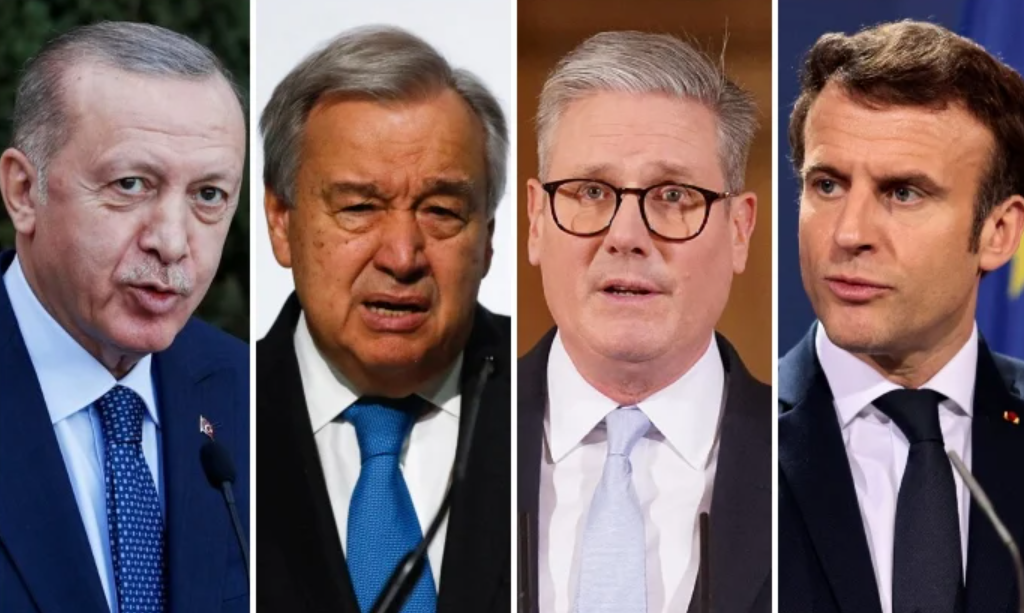

The announcement of a peace agreement between the United States and Iran has triggered a wave of international support, with global leaders calling it a major diplomatic breakthrough for regional stability.
The agreement aims to end hostilities, remove the US blockade on Iran, and reopen the Strait of Hormuz. Leaders across different regions described the development as an opportunity to reduce tensions and revive diplomacy.
US President Donald Trump announced on Sunday that the agreement framework had been completed. Shortly afterward, Prime Minister Shehbaz Sharif confirmed that negotiations had resulted in an understanding between both sides.
The memorandum of understanding (MoU) is expected to be formally signed in Switzerland on Friday.
UN Chief Calls Agreement a Major Step Toward Peace
UN Secretary-General Antonio Guterres welcomed the US-Iran peace deal and described it as an important move toward ending the conflict.
He congratulated Washington and Tehran for reaching an agreement that includes an immediate and permanent ceasefire, the reopening of the Strait of Hormuz, and a framework for future negotiations.
Guterres also acknowledged the role of regional countries in supporting the diplomatic process.
He expressed appreciation for Pakistan, Qatar, Egypt, Saudi Arabia, Turkiye, and other countries for helping create conditions that led to the agreement.
Erdogan Praises Pakistan’s Mediation Efforts
Turkiye President Recep Tayyip Erdogan welcomed the agreement and called it a positive step for regional peace and stability.
In his remarks, Erdogan said the understanding between Washington and Tehran could contribute to long-term tranquillity across the region.
He also recognised Pakistan’s role during the negotiations.
“I also wish to express my appreciation for the support provided to diplomatic initiatives by Qatar and Saudi Arabia,” he added.
Australia Supports De-Escalation and Diplomatic Engagement
Australian Prime Minister Anthony Albanese welcomed the agreement and reiterated his country’s support for reducing tensions.
“The Australian Government welcomes the agreement by the United States and Iran. Australia has long called for de-escalation and an end to the conflict, including in Lebanon. As we have said, the longer this war goes on, the greater the impact will be. Continued restraint and constructive engagement will be essential to prevent further escalation and secure a lasting agreement.”
He also recognised the contribution of regional mediators.
“We commend the efforts to date of Pakistan, Qatar, Saudi Arabia, Türkiye and other mediating countries,” he added.
UK Welcomes Diplomatic Breakthrough
British Prime Minister Keir Starmer described the agreement as a significant moment for regional security.
“I warmly welcome today’s agreement reached between the United States and Iran. This is a hugely important step forward in ending the war, ensuring regional stability and re-opening the Strait of Hormuz.”
Starmer also recognised the countries involved in facilitating negotiations.
“I congratulate President Trump and the mediators from Pakistan, Qatar and elsewhere who have contributed to this breakthrough. We have long urged de-escalation, and this is the progress we had hoped to see,” he added.
France Calls for Immediate Implementation
French President Emmanuel Macron welcomed the agreement and urged all parties to ensure its implementation.
“I welcome the agreement reached between the United States and Iran, the result of a diplomatic effort to which several partners contributed.”
He further stressed the importance of restoring maritime activity.
“This agreement must allow for the urgent and unconditional reopening of the Strait of Hormuz, which the international mission established with the United Kingdom is ready to support.”
Qatar Appreciates Regional Diplomatic Efforts
Qatari Prime Minister Sheikh Mohammed bin Abdulrahman bin Jassim Al Thani welcomed progress on the memorandum of understanding.
He thanked Pakistan and other regional and international stakeholders for helping create an environment that supported dialogue and encouraged diplomatic progress.
Germany Sees Opportunity for Stability
German Chancellor Friedrich Merz welcomed the agreement and described it as a diplomatic achievement.
“I welcome the agreement between the US and Iran and congratulate President Trump and the Iranian side on this diplomatic breakthrough. This can pave the way towards a reinvigorated global economy and a more secure Middle East. It is crucial to implement it with determination.”
Japan Stresses Safe Navigation and Continued Negotiations
Japanese Prime Minister Sanae Takaichi expressed support for maintaining secure maritime routes.
Japan “strongly hopes” that “free and safe navigation through the Strait of Hormuz will be ensured in practice, and that a final agreement on Iran’s nuclear issue and other matters will be reached as soon as possible.”
She also acknowledged countries involved in mediation.
“At the same time, we highly commend the efforts of the relevant countries that have played a mediating role to date.”
New Zealand Backs Dialogue Over Conflict
New Zealand Foreign Minister Winston Peters described the agreement as an important development.
“This pivotal, constructive deal is a step towards reducing tensions and promoting stability in a region that is critical to global economic security… Dialogue and diplomacy remain the most effective means of resolving longstanding issues.”
European Nations Signal Sanctions Relief Possibility
The E4 countries — the United Kingdom, France, Germany, and Italy — stated that they were prepared to consider lifting sanctions on Iran.
The decision would depend on progress regarding Iran’s nuclear programme following the agreement.
Their joint statement said:
“Iran must never acquire a nuclear weapon. We stand ready to work with the US, Iran and the IAEA to this end.”
The international reaction reflects broad support for diplomacy and de-escalation. At the same time, several leaders highlighted Pakistan’s mediation role and regional cooperation efforts as contributing factors behind the breakthrough.

