
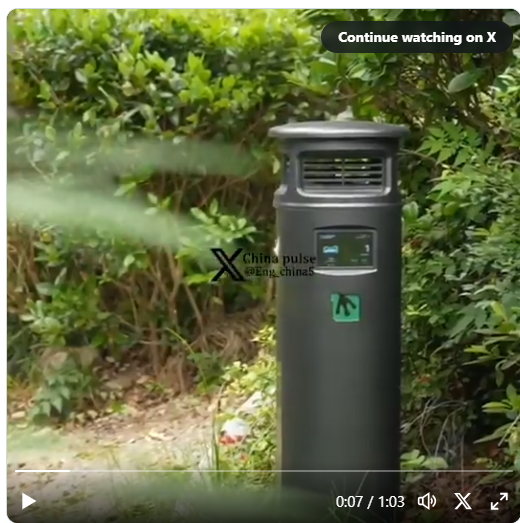

A public park in Hangzhou, China, has introduced a smart mosquito control system that eliminates mosquitoes without using chemical pesticides, offering an innovative approach to urban pest management.
The technology relies on intelligent mosquito traps designed to imitate human body signals. The devices generate heat, scent and carbon dioxide to attract mosquitoes in the same way humans naturally do.
Once the insects approach the trap, a powerful air suction mechanism captures and kills them. Consequently, the system reduces mosquito populations without spraying chemicals in public spaces.
The chemical-free approach provides an environmentally friendly alternative to conventional mosquito control methods. It also helps limit public exposure to insecticides while maintaining outdoor recreational areas.
UNUSUAL
Chemical-free, technology-based: A mosquito-free park in CHINAIn a park in Hangzhou, a smart mosquito control system has been implemented without the use of chemicals.
The traps mimic human body signals—heat, scent, and carbon dioxide—attracting mosquitoes and then… pic.twitter.com/gZb79p2lNj— China pulse 🇨🇳 (@Eng_china5) June 28, 2026
A video demonstrating the technology was shared on X by China Pulse, a verified account. The footage quickly attracted widespread attention on social media, with users praising the innovative solution.
Supporters said the initiative could improve comfort and public health in parks by reducing mosquito activity. Many also suggested the technology could be adopted in other cities facing seasonal mosquito problems.
Unlike traditional pest control programs, the smart system continuously targets mosquitoes using automated traps. As a result, authorities can manage mosquito populations with minimal environmental impact.
The initiative reflects the growing use of technology to improve urban infrastructure and public spaces. Cities around the world are increasingly exploring smart solutions that enhance sustainability and quality of life.
Although the system has generated positive reactions online, its long-term effectiveness will depend on continued monitoring and maintenance. Experts generally recommend combining multiple mosquito control strategies for the best results.
If proven successful on a larger scale, the technology could offer a practical model for mosquito management in parks and gardens.

