
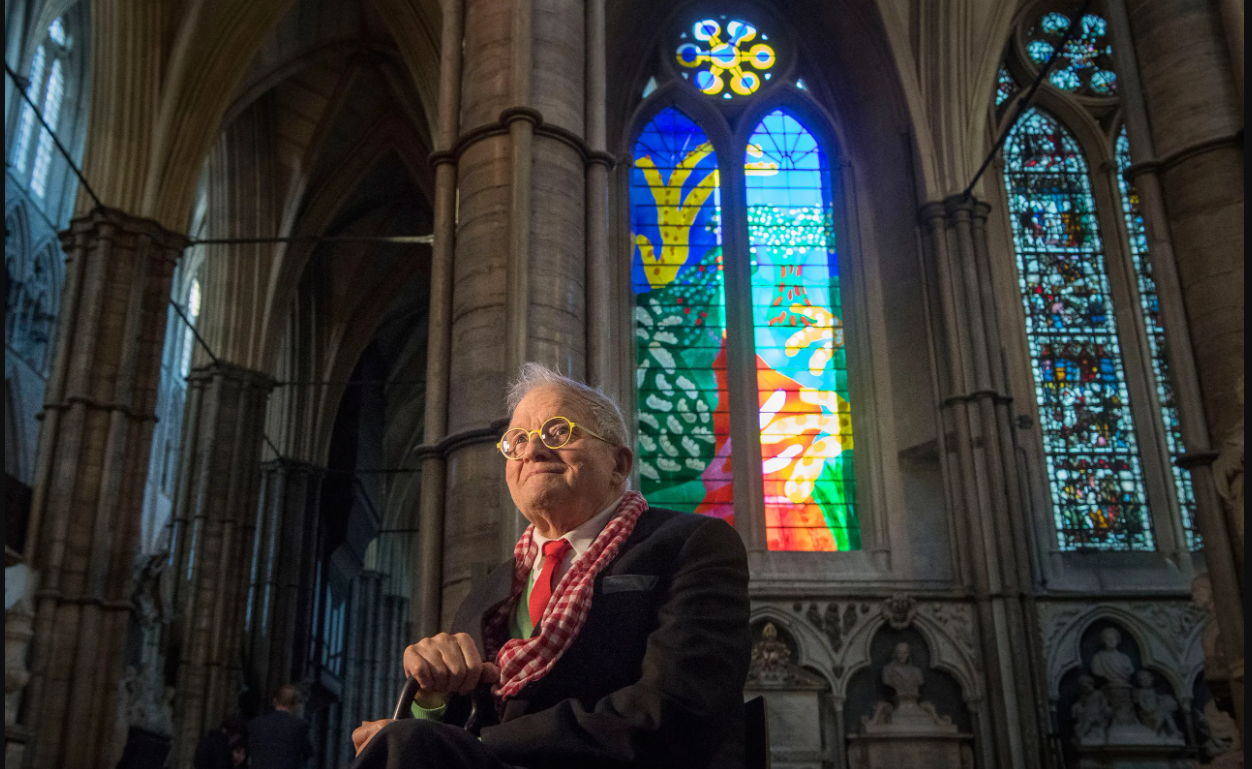

David Hockney, one of Britain’s most influential modern artists and a defining figure of pop art, has died at the age of 88. He is leaving behind a legacy that reshaped how light, colour and everyday life were represented in contemporary painting. Known for his vivid California pool scenes and later Yorkshire landscapes, Hockney’s career spanned more than six decades of constant experimentation and reinvention.
Early fascination with light and northern childhood influence
Born and raised in northern England, Hockney developed an early sensitivity to light and shadow, which later became central to his artistic identity.
As a child, he was struck by the sharply defined shadows in Hollywood films featuring Laurel and Hardy, which sparked a lifelong fascination with sunlight and brightness. “Strong shadows meant a lot of sun,” he once said. “So I thought, well, wherever that is, it’s always sunny.” This simple observation eventually guided his journey across continents in search of visual clarity and colour.
London years and rise in the pop art movement
In 1959, Hockney moved to London to pursue his art studies, where he quickly became part of the emerging British pop art scene.
His early work challenged traditional boundaries and often reflected themes that were considered unconventional at the time. Despite social restrictions of the era, he continued to express personal identity and creative freedom through his work, gradually gaining recognition for his distinctive artistic voice.
New York exposure and the California transformation
Hockney’s first visit to New York in 1961 marked a turning point in his career, where he encountered major figures of the art world, including Andy Warhol. Three years later, he moved to Los Angeles, driven by his desire to experience the light he had long imagined. That decision transformed his artistic direction, leading to his iconic California series featuring swimming pools, sunlit interiors and intimate human moments. He once reflected on this shift by saying, “I thought people who produced such work must live in colour, so I went in search of it,” and also added, “I had spent the first 20 years of my life in the gothic gloom of the North. Here I felt free.”
Fame, cultural identity and critical debate
As his reputation grew, Hockney became instantly recognisable not only for his artwork but also for his personal style, which included bold fashion choices and thick-rimmed glasses that symbolised the cultural energy of the 1960s.
While some critics questioned the depth of his focus on leisure and beauty, his influence continued to expand, making him one of the most celebrated British artists of the 20th century. His work remained deeply tied to personal expression rather than academic convention, which strengthened his global appeal.
Major works and record-breaking recognition
One of his most famous paintings, “Portrait of an Artist (Pool with Two Figures),” sold for $90.3 million in 2018, setting a record at the time for a living artist. The piece captured his signature themes of human presence, water, and layered perception, reflecting his ability to combine simplicity with emotional depth.
Over time, his works came to represent a unique blend of realism and stylised vision that influenced generations of artists.
Later years, innovation and Yorkshire return
In his later life, Hockney shifted focus from California to the landscapes of Yorkshire, where he rediscovered inspiration in seasonal changes, rural fields and natural light. This period became one of his most productive creative phases, as he produced large-scale works that captured the rhythm of changing environments.
He also embraced modern technology, experimenting with iPads and digital tools to continue expanding his artistic expression without limitation.
Lifelong dedication to art
Even in his final years, Hockney maintained a disciplined creative routine, often stressing the importance of daily work. His philosophy reflected his lifelong commitment to art when he said, “You don’t retire doing this.
You just do it until you fall over.” This dedication defined his legacy as an artist who continuously evolved while remaining deeply connected to observation and creation.
David Hockney’s death marks the end of an era in modern art, but his influence continues to shape how light, colour and everyday life are understood in visual culture across the world.

