
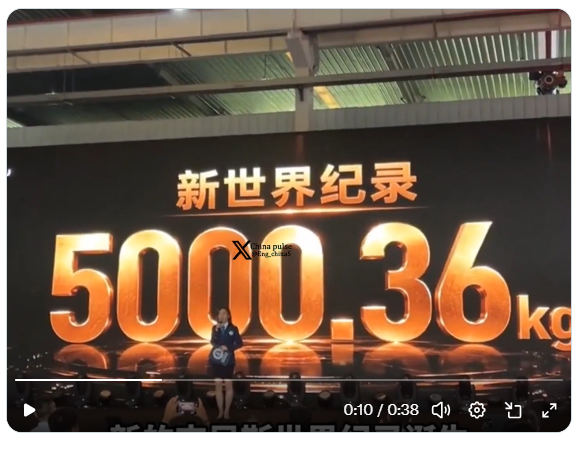

China has achieved a major milestone in industrial robotics after a Shanghai-based company developed a robot capable of lifting more than 5,000 kilograms, setting a new global record in heavy-duty robotics.
The achievement marks the first time a Chinese industrial robot has claimed the world record in this category. Shanghai-based company Chaifu Robot developed the CR5000-3700 unit, which successfully lifted over 5,000 kilograms during testing. As a result, the machine surpassed the previous record of 2,300 kilograms set in 2016 by Japanese robotics giant Fanuc.
UNUSUAL
CHINA OVERTAKES JAPAN IN HEAVY‑DUTY ROBOTICS FOR GOOD
A Chinese robot breaks the world record for heavy lifting.
Shanghai‑based Chaifu Robot has set a new global record for industrial robot load capacity.
Its CR5000‑3700 unit lifted more than 5,000 kilograms — more… pic.twitter.com/tKVq9IHLSN— China pulse 🇨🇳 (@Eng_china5) May 18, 2026
China Surpasses Japan in Heavy-Duty Robotics
The new record highlights China’s growing dominance in advanced manufacturing and industrial automation. For years, Japanese companies led the heavy-duty robotics sector; however, Chinese firms have rapidly expanded their capabilities through technological innovation and large-scale industrial investment.
According to Chaifu Robot, the CR5000-3700 was specifically designed for extremely heavy and potentially hazardous industrial operations that require high precision and reliability. Furthermore, the company stated that the robot can reduce labor costs by nearly 80 percent while increasing operational efficiency by more than three times.
Robot Expands Use Across Major Industries
Industries have already started using the powerful robotic system in several demanding sectors. The machine currently supports operations in electric vehicle manufacturing, railway engineering, nuclear energy facilities, metallurgy plants, chemical industries, and tunnel construction projects.
Experts believe the breakthrough could strengthen China’s position in the global robotics market as industries increasingly adopt automation to improve productivity and workplace safety. Meanwhile, the development also reflects the intensifying technological competition between China and Japan in advanced industrial machinery.

