

Agreement Targets Charging Infrastructure and Local Manufacturing
Pakistan’s electric vehicle sector has received a major boost as Chinese energy technology company StarCharge moves to expand its operations in the country.
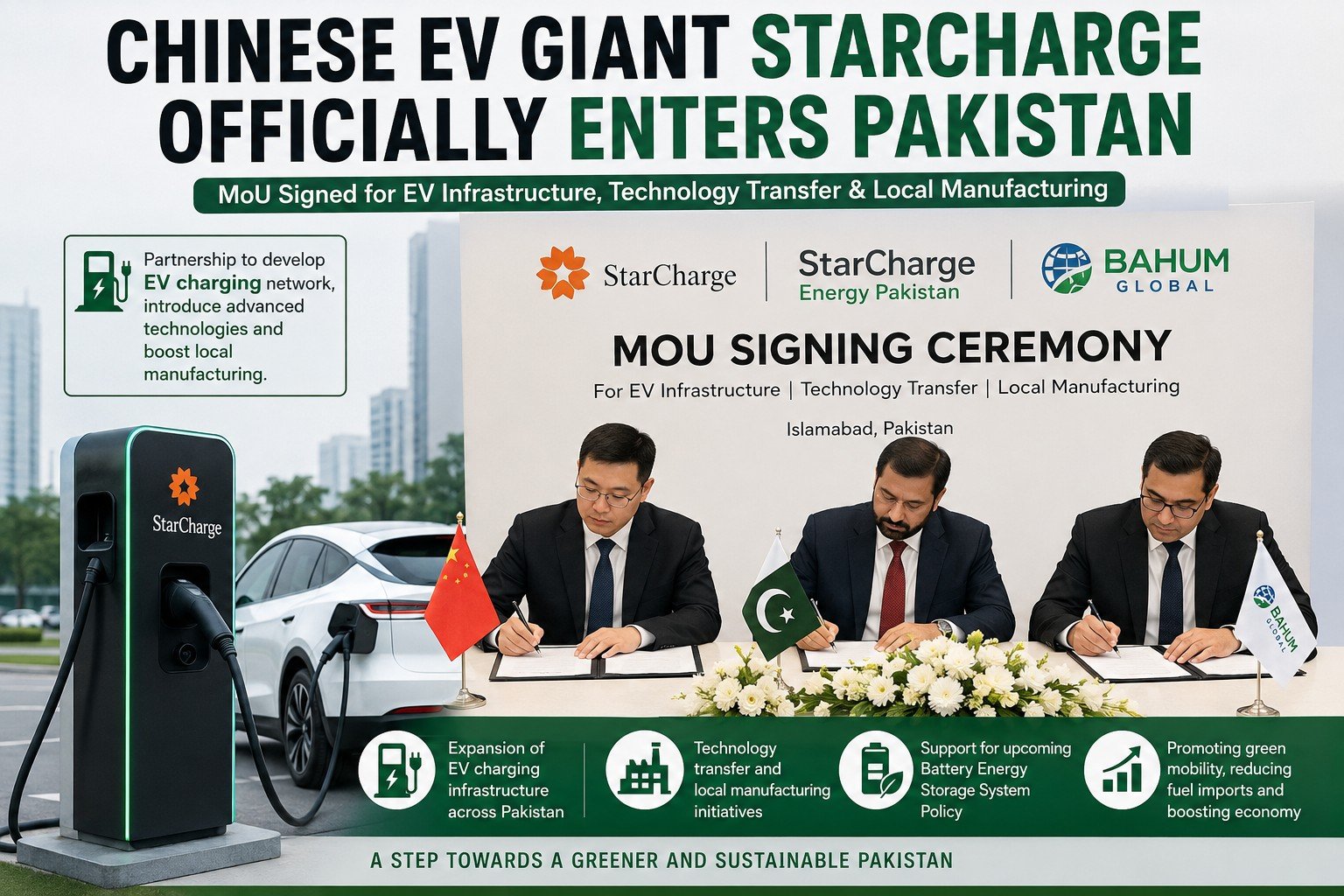
StarCharge, StarCharge Energy Pakistan and Bahum Global Limited have signed a Memorandum of Understanding in Islamabad.
The agreement focuses on electric vehicle charging infrastructure, smart energy technology, technology transfer and local manufacturing.
Under the partnership, the companies will explore the development of charging stations and related energy systems across Pakistan.
They also plan to establish local production capabilities for selected equipment.
The initiative is expected to reduce dependence on imported charging technology. It could also create new industrial and technical employment opportunities.
However, the agreement represents the beginning of the cooperation process. Details about investment value, factory location, production capacity and rollout timelines have not yet been announced.
StarCharge is not an electric car manufacturer. It is a major Chinese provider of EV charging equipment, energy storage systems and smart energy management solutions.
The company operates in more than 60 countries and provides residential, commercial and industrial charging technologies.
Pakistan Seeks Wider EV Charging Network
Speaking at the signing ceremony, Special Assistant to the Prime Minister on Industries and Production Haroon Akhtar Khan welcomed the partnership.
He said the government was working to accelerate Pakistan’s transition towards electric mobility.
The strategy includes attracting foreign investment, encouraging technology transfer and supporting local production.
The government also wants to expand charging infrastructure across major cities, highways and commercial areas.
A limited charging network remains one of the biggest challenges facing electric vehicle owners in Pakistan.
Drivers often hesitate to purchase electric vehicles because charging stations are not widely available.
The entry of an experienced international charging company could help address this problem.
Earlier official discussions between Pakistani authorities and StarCharge focused on charging infrastructure, smart energy systems and localisation.
The company also briefed government representatives about establishing a local office and deploying resources for long-term operations in Pakistan.
The partnership may include different types of charging equipment.
These could range from residential chargers to high-speed commercial stations for passenger vehicles and public transport fleets.
Smart charging systems could also allow operators to monitor electricity consumption, manage payments and balance demand on the national grid.
No final list of products planned for the Pakistani market has been disclosed.
Battery Storage Policy Expected to Support Investment
Haroon Akhtar Khan said the government’s planned Battery Energy Storage System Policy would support the growing electric vehicle industry.
Battery storage systems can preserve electricity generated during periods of lower demand.
That stored energy can later be used for charging stations, businesses and other facilities.
Such systems could become important in Pakistan, where electricity availability and grid stability vary between different regions.
The policy is expected to encourage private investment in batteries, energy management and local assembly.
StarCharge already develops large energy storage systems alongside its vehicle charging products. Its technology portfolio includes commercial and grid-level energy solutions.
Bahum Global is expected to provide local industry experience and market access.
The Pakistani company has worked in the power and energy sector for several decades.
It currently supplies solar equipment, batteries and other renewable energy solutions for residential, commercial and industrial customers.
Bahum Global has also announced plans to establish local assembly operations for lithium batteries, electric motorcycles and scooters.
The collaboration with StarCharge could expand those plans into charging equipment and advanced energy systems.
Electric Mobility Could Reduce Fuel Import Costs
The government believes wider electric vehicle adoption could help reduce Pakistan’s reliance on imported petroleum products.
Petrol and diesel imports place significant pressure on the country’s foreign exchange reserves.
Electric vehicles could lower fuel consumption, particularly if they are charged using locally generated renewable electricity.
The transition may also reduce urban air pollution and transport-related carbon emissions.
However, electric mobility will require more than the introduction of new vehicles.
Pakistan will need reliable charging stations, stable electricity supplies, trained technicians and clear technical standards.
Affordable vehicle prices and consistent government policies will also remain important.
The StarCharge partnership is expected to support technology transfer and workforce training.
Local production could eventually reduce equipment costs and improve access to replacement parts.
It may also allow Pakistani companies to develop skills in charger installation, maintenance and energy management.
The agreement comes as several Chinese automotive and energy companies increase their presence in Pakistan.
The growing investment reflects rising interest in the country’s electric mobility market.
StarCharge’s expansion could help build the infrastructure required to support that market.
The success of the partnership will depend on how quickly the companies move from the MoU stage to confirmed investment, local production and operational charging stations.

