
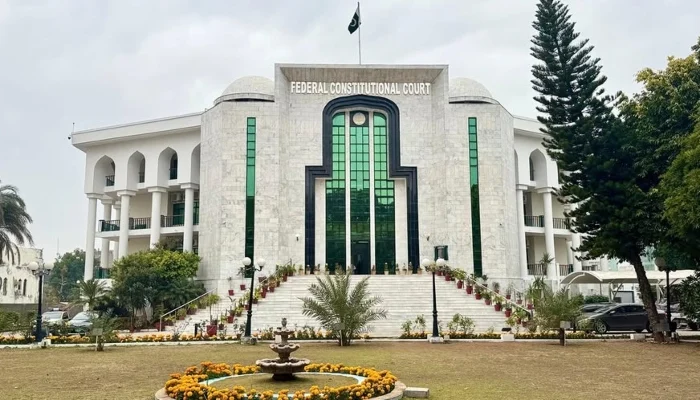

The Federal Constitutional Court (FCC) has stopped the Peshawar High Court (PHC) from hearing detention cases under the Maintenance of Public Order (MPO) Ordinance until further orders.
The significant ruling came on Thursday, November 5, 2026, during proceedings involving the detention of Pakistan Tehreek-e-Insaf (PTI) leaders and workers in Khyber Pakhtunkhwa.
Why Did the Constitutional Court Restrict PHC?
A two-member bench headed by Chief Justice Aminuddin Khan heard petitions filed by the Khyber Pakhtunkhwa government.
The provincial administration challenged earlier PHC orders that prevented authorities from arresting political workers under Section 3 of the MPO Ordinance.
The cases also involve detained PTI leaders, including Sohail Afridi.
Government Questions High Court’s Powers
During the hearing, the provincial advocate general argued that the PHC could not interfere in areas where military operations were being conducted under Article 245 of the Constitution.
He also questioned the high court’s jurisdiction under Article 199.
Justice Aamer Farooq responded by questioning whether such restrictions would prevent the PHC from hearing routine constitutional petitions.
Lawyers Challenge Constitutional Court’s Decision
Former additional advocate general Shah Faisal Ilyas objected to the order.
He argued that affected parties should receive an opportunity to present their arguments before restrictions were imposed.
Chief Justice Aminuddin directed him to review the order and submit formal objections.
What Happens to Detained PTI Workers?
The PHC had previously granted interim relief to several PTI workers challenging their detention.
In one case, 23 detainees were ordered released against two surety bonds worth Rs100,000 each.
The FCC has now restricted further hearings in MPO detention cases pending additional orders.
The court has not delivered a final judgment on the legality of the disputed detentions.