
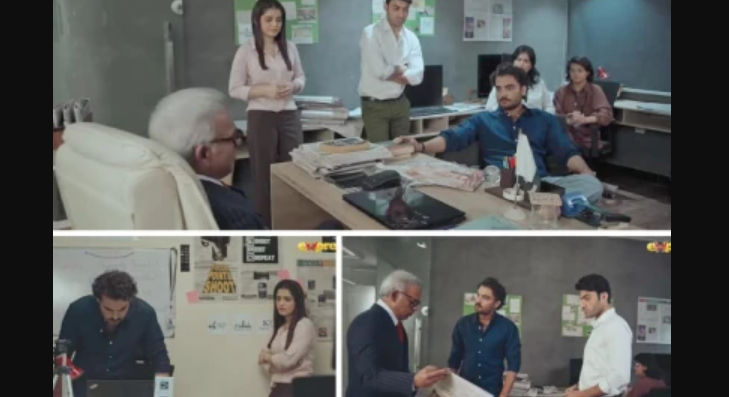

Artificial intelligence is changing digital communication at an unprecedented pace. However, it has also introduced new risks that continue to raise serious concerns worldwide.
The Pakistani drama Bhanwar explores one of those growing threats by focusing on AI-generated deepfake videos. Through its storyline, the drama highlights how artificial intelligence can manipulate reality, damage reputations, silence voices, and spread misinformation.
As digital technology evolves, the series presents a timely discussion about the ethical and social challenges linked to artificial intelligence.
A journalist’s fight for truth takes an unexpected turn
One of the drama’s central storylines follows Adeel Azam, played by Asad Siddiqui.
His character is portrayed as an ethical journalist who completes an investigative report exposing alleged wrongdoing by a pharmaceutical company.
However, his media organization refuses to publish the investigation because of internal pressure.
Despite the resistance, Adeel remains committed to journalistic integrity. Eventually, he succeeds in getting the investigation published.
Soon afterward, the conflict intensifies.
His editor asks him to issue a public apology for the report. Since he believes he has done nothing wrong, he refuses.
The following day, he discovers a shocking video.
The clip appears to show him apologizing publicly. Yet he never recorded such a statement.
When he confronts his editor, he learns that artificial intelligence created the video.
According to the storyline, the AI-generated clip accurately copies his face, voice, facial expressions, and mannerisms. Consequently, it appears genuine even though it is completely fabricated.
His editor tells him:
“He will never be able to prove to anyone that the video was AI-generated.”
The scene demonstrates how convincing deepfake technology can become when used for manipulation.
Drama highlights dangers of AI-generated deepfakes
The storyline reflects growing global concerns surrounding generative artificial intelligence.
Deepfake technology can create realistic videos that appear authentic. Therefore, it can easily mislead audiences if used irresponsibly.
The drama shows how such technology could damage reputations and influence public opinion.
It also illustrates how fabricated digital content can undermine trust in online information.
Furthermore, the story raises concerns about fraud, misinformation, and digital impersonation.
Workplace misuse of AI becomes a major concern
Beyond misinformation, Bhanwar also explores another emerging issue.
The drama examines how employers or organizations could misuse artificial intelligence against their own employees.
In the story, the AI-generated apology becomes a tool for character assassination. As a result, the journalist struggles to defend himself despite knowing the video is fake.
This fictional scenario reflects wider concerns about employee rights and digital identity protection in the age of artificial intelligence.
Director explains the message behind the story
Director Abu Aleeha said the character played by Asad Siddiqui represents a journalist who values ethics above personal gain.
He said:
“Asad Siddiqui’s character as a journalist is a very ethical and by-the-book kind of a person. I think he is an example of how everyone in digital media is running after shortcuts, views and money. We wanted to show that you can still achieve success through honesty.”
The director explained that the journalist faces opposition from both editors and channel owners after exposing the pharmaceutical company.
According to him, the character eventually resigns and joins another media organization.
Later, he becomes the victim of an AI-generated fake apology video that damages his reputation.
Investigation continues despite personal risks
Abu Aleeha added that the story later follows the journalist as he investigates a criminal network involving three women.
During the investigation, he comes under attack and suffers serious injuries while pursuing the truth.
The director said:
“After taking all those risks, he succeeds. He not only saves the lives of those girls but also exposes the network”.
The storyline emphasizes determination, ethical journalism, and the personal risks involved in exposing criminal activity.
Story reflects Pakistan’s debate on AI regulation
The issues highlighted in Bhanwar closely mirror ongoing discussions about artificial intelligence regulation in Pakistan.
Recently, the Punjab government prepared the draft Punjab Performers’ Digital Identity and Artificial Intelligence Protection Act 2026.
The proposed legislation aims to protect artists’ voices, faces, and digital likenesses from unauthorized AI use.
It would require explicit written consent before creating AI-generated replicas or cloned voices.
Additionally, the draft law proposes prison sentences and multi-million-rupee fines for offences involving deepfakes, fake endorsements, and unauthorized digital impersonation.
Entertainment industry voices similar concerns
The issue has also attracted attention within Pakistan’s entertainment industry.
Actor and filmmaker Shamoon Abbasi, who participated in discussions with Punjab government officials, described the proposed legislation as an important step toward protecting performers in the era of artificial intelligence.
Meanwhile, actor Hira Tareen recently revealed that she had encountered contracts granting production companies extensive rights over her digital likeness.
These concerns further highlight the growing importance of digital identity protection.
Strong cast supports an important message
Bhanwar features an ensemble cast that includes Mansha Pasha, Areeka Haq, Asad Siddiqui, Ali Safina, and Saleem Meraaj.
The drama airs every Wednesday and Thursday.
By combining suspense with social issues, Bhanwar brings the growing dangers of AI-generated deepfakes into mainstream storytelling while encouraging viewers to think about the future of digital trust and identity.

