

Pakistan’s largest province has long been viewed through the lens of security and natural resources. But as the debate over administrative reform returns, a more fundamental question emerges: can Balochistan continue to be governed through the same centralized model despite its vast geography and growing governance challenges?
Pakistan’s debate over new provinces rarely remains a discussion about public administration.
Within hours, it becomes a dispute over identity, territory, political influence and control over resources. Supporters describe smaller provinces as a route towards efficient government. Opponents view them as attempts to divide historic regions, weaken provincial autonomy or alter established political power.
This pattern is particularly visible in Balochistan.
Any proposal involving Pakistan’s largest province immediately raises concerns about territorial integrity, resource ownership, ethnic representation and federal influence. For many Baloch, administrative restructuring evokes fears that political authority could gradually shift away from the province or that strategic regions may become subject to greater federal control. These concerns cannot simply be dismissed.
Yet the intensity of the political response often prevents a more fundamental question from receiving attention:
Is Balochistan’s present administrative structure delivering effective government to its people?
That question has returned to the national agenda after Interior Minister Mohsin Naqvi declared on July 30, 2026 that Pakistan’s governance system had “collapsed.” He argued that Pakistan should seriously consider creating smaller administrative units—whether called provinces or by another name—to bring government closer to ordinary citizens.
A day later, Director General Inter-Services Public Relations Lieutenant General Ahmed Sharif Chaudhry expanded the discussion beyond politics. He argued that governance itself had become a national security issue, pointing out that a country of roughly 250 million people continued to operate through only four provinces. Whether this model remained suitable, he said, deserved a constitutional and democratic debate rather than political slogans.
These remarks have not resolved the controversy.
Instead, they have revived an old question that Pakistan has repeatedly avoided.
For Balochistan, however, the debate is about much more than drawing new boundaries. It is about whether one provincial administration can effectively govern a territory covering nearly 44 percent of Pakistan’s landmass, stretching from the mountains of Zhob to the coastline of Gwadar.
TTI’s Earlier Analysis Now Carries Greater Relevance
The Truth International examined this issue last year through a series of province-specific analyses.
Each article explored whether Pakistan’s administrative divisions could provide the foundation for more responsive and efficient governance. The Balochistan discussion focused on a distinction that remains as relevant today as it was then.
There is an important difference between dividing a province for political purposes and reorganizing administration for better governance.
That distinction is essential.
The purpose of administrative reform should never be to redraw ethnic boundaries, manufacture new centers of political influence or create additional offices for political elites.
Instead, the objective should be far more practical.
Government should be brought closer to the people responsible for depending on it every day.
Police stations, hospitals, schools, irrigation authorities, district administrations, disaster-management agencies, transport departments and municipal services function best when decision-makers are close enough to understand local conditions instead of relying on instructions issued hundreds of kilometres away.
Mohsin Naqvi’s remarks and the DG ISPR’s observations have now pushed this argument into mainstream political debate.
But they have also created a familiar danger.
If administrative reform becomes another political slogan or is presented through vague proposals developed behind closed doors, it will deepen mistrust across the federation. If, however, the discussion remains transparent and focused on governance rather than identity, it may finally encourage Pakistan to examine whether its administrative structure still reflects the realities of the twenty-first century.
A Province Too Vast for One Administrative Centre?
Balochistan has always been geographically vast.
What has changed is the scale and complexity of governing it.
The province now stretches across almost 348,000 square kilometres, making it larger than Germany, while its population has continued to grow according to successive census results. Although it remains Pakistan’s least populated province, its residents are dispersed across mountains, deserts, coastal regions and sparsely connected settlements separated by enormous distances.
These geographical realities create governance challenges unlike those faced anywhere else in Pakistan.
A decision taken in Quetta may directly affect communities in Gwadar, Panjgur, Chagai or Dera Bugti, where travelling to the provincial capital itself can require hundreds of kilometers of road travel.
The province’s districts also differ dramatically in their administrative needs.
Quetta functions as Balochistan’s political, educational and commercial center.
Gwadar has emerged as Pakistan’s maritime gateway under the China-Pakistan Economic Corridor (CPEC).
The agricultural districts of Nasirabad and Jaffarabad depend heavily on irrigation and water management.
The mineral-rich districts of Chagai and Saindak face entirely different development priorities.
Makran’s coastal communities confront water shortages and climate-related pressures, while northern districts such as Zhob and Sherani have distinct infrastructure and connectivity requirements.
These regions are not simply culturally diverse.
They require different forms of governance.
A single provincial administration based primarily in Quetta must therefore simultaneously manage coastal development, border security, mining regulation, healthcare shortages, education, drought management, disaster response, transport infrastructure and local government across the largest province in Pakistan.
The issue is not whether Balochistan should remain one province.
The real question is whether one highly centralized administrative system can effectively respond to such different challenges across such an enormous territory.
When Did Geography Become a Barrier to Governance?
Unlike Punjab or Sindh, Balochistan’s greatest administrative challenge is not population density.
It is distance.
In many districts, residents travel for hours simply to access government offices, specialized healthcare or higher education. Development projects often require coordination between departments headquartered in Quetta, resulting in administrative delays that can stretch for months.
The result is a governance model where physical geography itself becomes an obstacle.
Citizens living in remote districts frequently experience the provincial government as distant—not merely politically, but literally.
This is where the debate over administrative restructuring becomes relevant.
Rather than immediately proposing new constitutional provinces, policymakers could consider stronger regional administrative centres capable of delivering services closer to local populations.
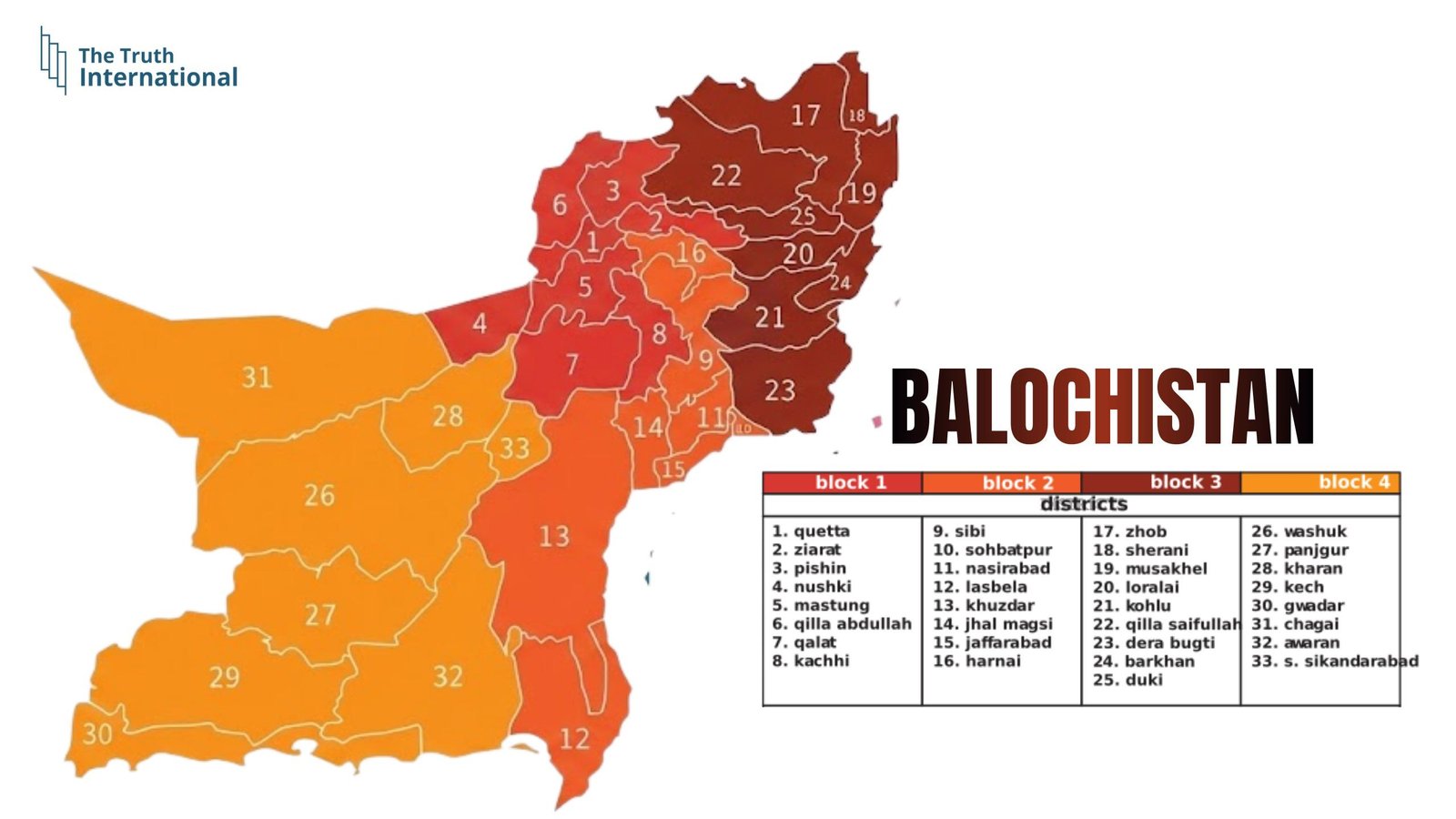
The accompanying map, developed as part of The Truth International’s earlier analysis, illustrates one such possibility.
Instead of dividing Balochistan into separate provinces, it groups the province’s districts into four administrative blocks, each capable of functioning as a regional governance hub while remaining part of a constitutionally united Balochistan.
Under such a framework:
- Block One centers around Quetta and neighboring districts, focusing on provincial administration and urban governance.
- Block Two connects central and south-eastern districts with common development and agricultural priorities.
- Block Three brings together the northern and eastern districts facing similar infrastructure and security challenges.
- Block Four covers the vast western and coastal belt, including Gwadar, Kech, Panjgur, Chagai and Washuk, where governance often involves managing enormous distances, border trade, water scarcity and strategic infrastructure.
The map should not be interpreted as a proposal for political partition.
Instead, it demonstrates how regional administrative clusters could potentially improve coordination in policing, healthcare, education, disaster management and development planning without altering Balochistan’s constitutional status.
State Presence Matters as Much as State Power
For decades, Balochistan has largely been viewed through a security lens. However, recent remarks by the DG ISPR have reinforced a broader reality: governance itself has become a national security concern.
When citizens struggle to access healthcare, education, justice or basic public services, confidence in state institutions weakens. Poor infrastructure, limited administrative capacity and delayed development create gaps that cannot be addressed through security measures alone.
This challenge is particularly evident in Balochistan. Despite its strategic importance, many districts continue to face shortages of hospitals, schools, reliable road networks and clean drinking water. While projects under the China-Pakistan Economic Corridor (CPEC), especially in Gwadar, have expanded infrastructure, many local communities continue to demand that development be matched by improved public services and greater administrative responsiveness.
Good governance, therefore, is no longer simply about delivering development—it is increasingly viewed as a prerequisite for long-term stability.
Should Balochistan Create New Provinces or Strengthen Regional Administration?
The debate should not be reduced to a simple choice between maintaining the status quo and creating new provinces.
An alternative approach is to strengthen regional administration within Balochistan itself. The four-block model illustrated in The Truth International’s map offers one possible framework by grouping districts with similar geographical and administrative needs under regional coordination centres, while preserving the province’s constitutional unity.
Such a model could improve coordination in healthcare, policing, disaster management, education and development planning without requiring the creation of entirely new provincial governments.
At the same time, many constitutional experts argue that meaningful devolution under Article 140A—through empowered local governments with independent finances and administrative authority—could achieve many of the same objectives while avoiding the political controversy surrounding new provinces.
Ultimately, the question is not simply where boundaries should be drawn, but where decisions should be made and how quickly they reach the people they affect.
The Real Debate Is About Governance
Balochistan’s future should not be defined solely by maps or administrative boundaries.
Whether Pakistan ultimately creates new provinces, strengthens regional administrations or fully empowers local governments, the success of any reform will depend on one principle: bringing government closer to the people.
Administrative restructuring alone cannot guarantee better governance. Without transparency, accountability and meaningful devolution of authority, new institutions risk becoming little more than additional layers of bureaucracy.
For Balochistan, the debate should therefore move beyond politics and focus on outcomes. The province’s greatest challenge is not its size alone, but ensuring that every citizen—whether in Quetta, Gwadar, Chagai or Zhob—can access responsive institutions capable of delivering the services and opportunities they deserve.
Only then will administrative reform become more than a change on the map—it will become a meaningful step towards a stronger and more responsive federation.

