
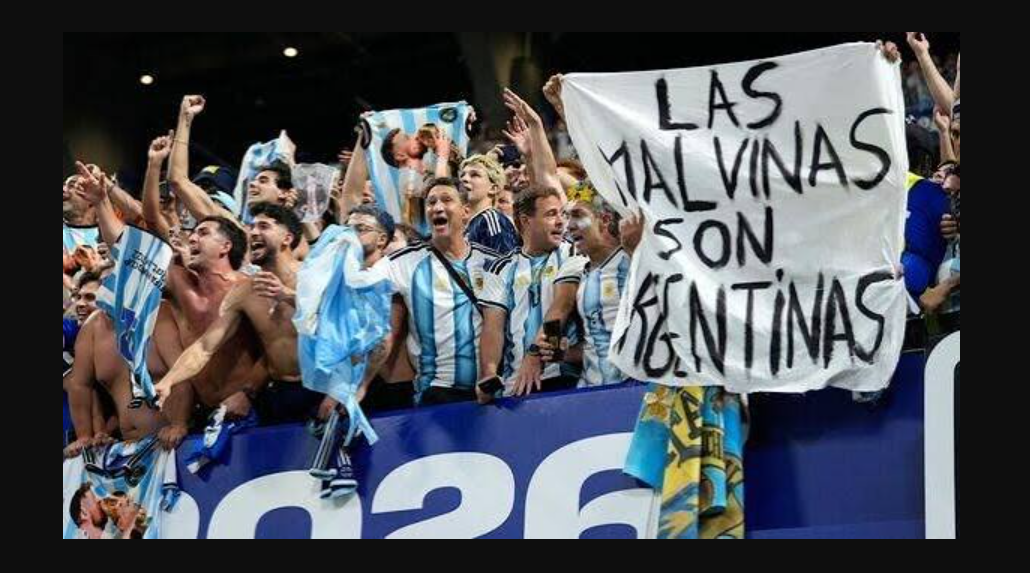

Argentina’s national football team has come under scrutiny after displaying a banner supporting its claim to the Falkland Islands during celebrations following its World Cup semi-final victory over England.
The incident has sparked international debate and prompted calls for FIFA to investigate whether the display violated rules on political statements during football events.
At the same time, the White House defended the team’s right to express its views under United States free speech protections.
White House Defends Players’ Right to Express Their Views
Andrew Giuliani, head of the White House FIFA Task Force, addressed the controversy while speaking to reporters.
He said the Argentine players had the opportunity to express their views while competing in the United States.
Referring to constitutional protections, Giuliani stated, “We believe in our First Amendment rights here in the United States of America.”
His remarks came as debate continued over whether the banner could result in disciplinary action from FIFA.
Banner Displayed After Semi-Final Victory
Argentina’s players displayed a banner after defeating England in the World Cup semi-final.
The banner read, “Las Malvinas son Argentinas,” which translates as “The Falklands are Argentine.”
The display immediately attracted international attention because the Falkland Islands remain the subject of a long-standing sovereignty dispute between the United Kingdom and Argentina.
FIFA is reportedly facing calls to determine whether the banner breached its regulations regarding political messaging during football competitions.
UK Calls for FIFA Investigation
Following the incident, the UK government supported calls for FIFA to review the matter.
A spokesperson for the British Prime Minister said, “The World Cup might not be ours, but the Falkland Islands definitely are. Our commitment to the Falklands will never waver.”
The spokesperson added that any disciplinary action against the Argentine players would ultimately be a matter for FIFA.
However, the UK government supported the view that football’s governing body should investigate the incident.
Falkland Islands Government Responds
The government of the Falkland Islands also reacted to the banner.
In its statement, officials said they were “disappointed but not surprised” by the display.
The government further stated that it hopes FIFA will “sanction all behaviour of this nature in line with its own rules”.
Officials also emphasized, “We do not wish to see politics being brought into sport.”
The statement added, “Nor do we wish the Islands and their people to be used as a political football in every conversation about England and Argentina”.
Argentina’s Political Leaders Voice Support
Argentina’s Vice President Victoria Villarruel also commented after the team’s victory.
In a message shared on social media, she wrote, “it wasn’t just another match”.
She later added, “The Falklands are Argentine,” before stating, “They banned bringing them to the stadium and forgot that we carry them in our blood and our hearts.”
Reports also noted that Argentine players sang chants referencing the Falkland Islands, Diego Maradona, and Lionel Messi after their dramatic 3-2 victory over Egypt in the Round of 16.
Long-Standing Sovereignty Dispute
The Falkland Islands remain a British Overseas Territory located in the South Atlantic Ocean.
However, Argentina continues to claim sovereignty over the islands, which it calls Las Malvinas.
In 2013, residents of the Falkland Islands voted overwhelmingly to remain a British Overseas Territory.
According to the referendum results, 1,513 people voted in favor of maintaining British status, while only three voted against.
Historical Background
The dispute over the Falkland Islands dates back decades. In 1982, Britain and Argentina fought a 74-day war after Argentine forces landed on the islands to assert their territorial claim.
British forces later regained control of the territory.
The conflict resulted in the deaths of 255 British military personnel, three island residents, and 649 Argentine soldiers.
The latest controversy has once again placed the sovereignty dispute in the international spotlight, while attention now turns to whether FIFA will take any action regarding the banner displayed during Argentina’s World Cup celebrations.

