
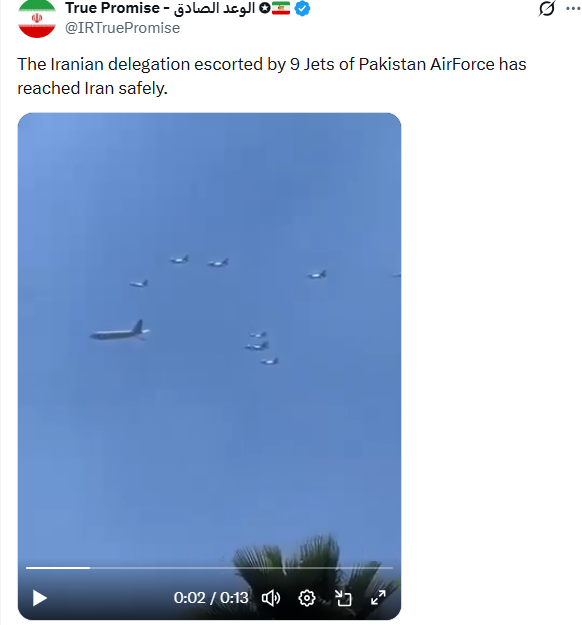

ISLAMABAD: Pakistan’s air force mounted a rare, high-security aerial shield to protect two Iranian aircraft, IRAN04 and IRAN05, as they entered Pakistani airspace for high-stakes negotiations between Washington and Tehran last week.
Authorities activated advanced electronic warfare systems, air surveillance radars, missile defence units, and Airborne Warning and Control System (AWACS) aircraft to secure the air corridor.
Several Pakistani fighter jets, including the Chengdu J-10C and the JF-17 Thunder, provided armed escort throughout the flight path. Security planners also deployed a decoy civilian aircraft, an Airbus A321, to create aerial ambiguity. Officials switched off transponders on key aircraft to reduce detection risks following intelligence warnings about potential threats from Israeli sources. True Promise, an Iranian official account on X platform, shared the clip.
Strategic Stakes Behind Extraordinary Security Measures
The unprecedented security operation reflected deep concerns that hostile forces or regional proxies could attempt to target the Iranian delegation during transit. The delegation was led by Mohammad Bagher Qalibaf, who traveled to Islamabad for negotiations aimed at stabilizing tensions between Iran and the United States.
Pakistan assumed the role of host after facilitating a temporary ceasefire between Washington and Tehran. The American delegation was headed by JD Vance. Officials warned that any successful attack on the visiting delegation could have immediately collapsed the fragile truce and triggered a wider regional escalation.
Diplomatic observers described Islamabad’s mediation effort as a high-risk but strategically significant move designed to position Pakistan as a neutral facilitator in a volatile geopolitical environment.
Talks End Without Breakthrough as Tensions Persist
Negotiations in Islamabad lasted about 21 hours but failed to produce an agreement on key issues, including Iran’s nuclear activities, access to frozen financial assets, and maritime security in the Strait of Hormuz. US officials stated that Iran rejected what they described as their final proposal, while Iranian representatives accused external interference of undermining the process.
Reports suggested that outreach by Benjamin Netanyahu to US leadership may have complicated the diplomatic environment, though no official confirmation has been issued. The collapse of the talks has raised concerns about the durability of the ceasefire, especially as Washington considers stronger maritime enforcement measures in the Gulf.

