
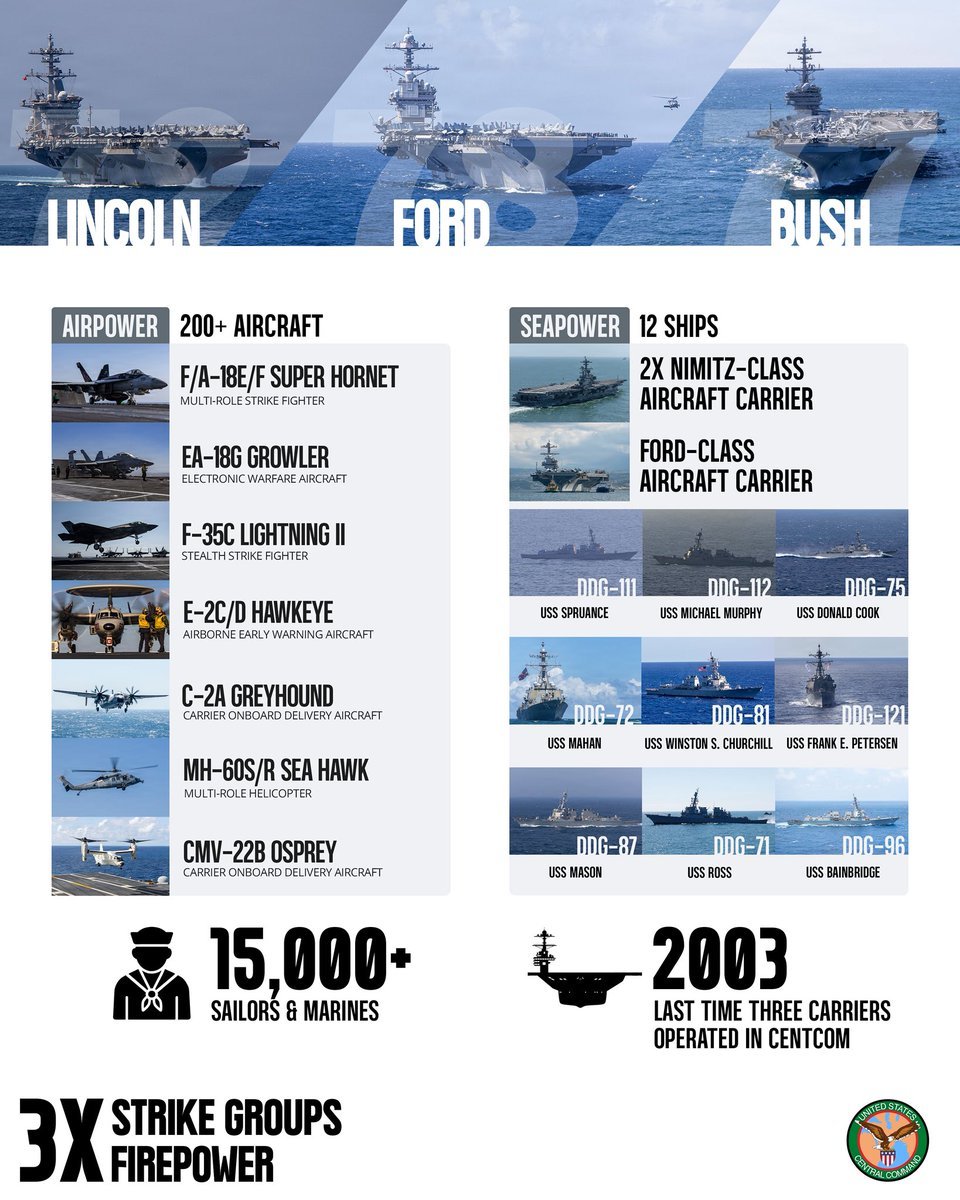

Washington — The United States has deployed three aircraft carriers to the Middle East simultaneously for the first time in decades, marking a significant escalation in naval presence. The deployment includes the USS Abraham Lincoln (CVN-72), USS Gerald R. Ford (CVN-78), and USS George H.W. Bush (CVN-77), each accompanied by its respective carrier strike group.
Massive deployment boosts operational readiness
Together, the three carrier groups bring more than 200 aircraft and approximately 15,000 sailors and Marines into the region. These forces include advanced fighter jets, surveillance aircraft, and support units capable of executing a wide range of missions. As a result, the deployment significantly enhances the United States’ ability to conduct air operations, maritime security tasks, and rapid-response missions.
Moreover, officials emphasize that such a large-scale presence improves coordination between naval and air units. Each carrier operates as a mobile airbase, allowing forces to project power across vast distances without relying on land-based infrastructure. Consequently, the deployment strengthens operational flexibility in a strategically sensitive region.
Strategic signaling underscores regional focus
Meanwhile, analysts view the simultaneous deployment as a strong signal of U.S. commitment to maintaining stability in the Middle East. The presence of multiple carrier strike groups demonstrates readiness to respond to emerging threats while reassuring regional allies.
In addition, the move reflects broader defense priorities, including safeguarding key shipping routes and deterring potential conflicts. Although officials have not specified a single trigger for the deployment, the scale of operations highlights heightened vigilance.
Ultimately, the rare alignment of three carriers underscores the United States’ capacity to project sustained military power and maintain a robust presence in critical global regions.

