
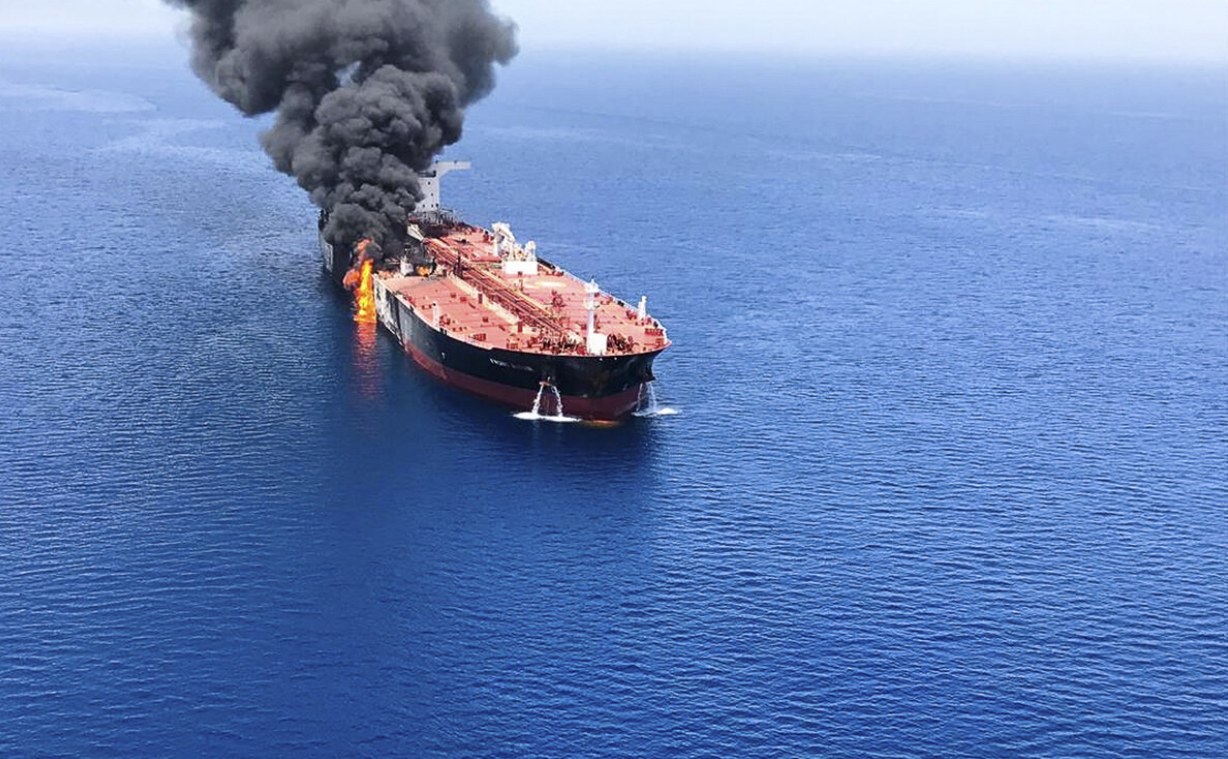

Iran’s Revolutionary Guards said on Saturday that two oil tankers transiting through the Strait of Hormuz hit mines and exploded. The incident came as the US-Iran conflict entered its seventh consecutive night, with Iran reporting three deaths from US strikes while launching retaliatory attacks on several American military sites in Kuwait and Jordan.
The Guards in a statement published by state news agency IRNA, without identifying the tankers, said “An hour ago, two oil tankers, which were trying to pass through the minefield south of the Strait of Hormuz by deceptive American intelligence agencies, exploded and caught fire.”
“To protect their capital and, more importantly, their lives, the sailors should not be deceived and enter the minefield,” they said.
US Central Command (CENTCOM) issued a brief denial, saying on X, “Like most IRGC claims, this is false.”
The Guards said separately on Saturday that they had “stopped” four ships trying to transit the Strait of Hormuz.
“In the past hours, four violating ships with the support of the terrorist US army were trying to pass through the Strait of Hormuz, and all four ships were stopped in place during a combined missile and drone operation,” the Guards said in a statement carried by the state broadcaster.
Iran has again virtually closed the Strait of Hormuz for a week.
Iran has moved to strengthen its control over the strategically vital Strait of Hormuz, urging tankers and cargo ships to navigate through channels near its northern coastline instead of the southern routes protected by the United States.
In response to Iran’s threats to shipping in the strait, the US reimposed a navy blockade against Iranian ports. It has also been carrying out nightly airstrikes on targets in Iran aimed at weakening Tehran’s abilities to monitor and threaten the strait.
Iran Hits US Military Targets in Kuwait, Jordan
Iran’s army said it struck US military targets in Kuwait and Jordan in response to American attacks, according to a statement carried by the Iranian state broadcaster on Saturday.
In Kuwait, Iranian forces targeted an ammunition depot at the Al-Adiri camp, the headquarters buildings and ammunition depots at the Ali Al-Salem base and several communication bridges.
In Jordan, fuel tanks at the Al-Azraq base were also targeted, the state broadcaster said on Telegram.
Kuwait’s army wrote on X on Saturday that explosions may be heard as a result of “air defence systems intercepting hostile targets”.
Air raid sirens were also sounded in Bahrain, which hosts a major US naval base, according to the country’s interior ministry.
US Strikes Iran Military And Maritime Sites
The US military said it had concluded strikes on Iran for the seventh consecutive night Friday, adding that it had hit several targets aimed at degrading Iranian military capabilities.
“US Central Command (CENTCOM) hit surveillance sites, military logistics infrastructure, underground weapons storage, and maritime capabilities,” the military said in a post on X.
Jordan Shoots Down Iran Missiles
Jordan’s army said on Saturday it had shot down 10 Iranian missiles with no casualties or damage, as Tehran retaliated against American strikes by pressing attacks on US allies.
“Air defense systems… intercepted 10 Iranian missiles that had entered Jordanian airspace and were targeting the Kingdom’s territory (which) were intercepted and shot down,” the army said in a statement, adding that there were no casualties or material damage.
US-Iran intensify attacks
Bombing intensified in the Middle East for the seventh consecutive night, with Iran reporting three deaths from US strikes and retaliating with attacks on several US military sites in Kuwait and Jordan.
US forces reported striking Iran with attacks designed to “continue degrading Iranian military capabilities,” according to a statement by US Central Command shared on X.
In the biggest escalation since the foes resumed hostilities, Iran accused US forces of targeting civilian infrastructure, including an airport, a railway station and two bridges, and said it had struck US assets across the region.
US President Donald Trump has previously threatened to hit Iranian infrastructure, but there was no confirmation from the US side on Friday that US forces have begun to do so.
Major General Mohsen Rezaei, a senior military advisor to Iran’s supreme leader, said Tehran will resume “full-scale offensive operations” if US strikes against it continue for another two or three days.
“Iran will no longer limit itself to retaliatory, like-for-like responses…and no political border will be safe,” Rezaei said, according to the Iranian news agency IRIB.
The war began on February 28 with deadly US-Israeli strikes on Iran, which retaliated by effectively closing the Strait of Hormuz, a vital shipping channel for much of the world’s oil, and launching attacks on Israel and American interests across the Gulf.
David Khalfa, a Middle East specialist at the Jean-Jaures Foundation, a Paris-based think-tank, noted that a “widening range of strategic infrastructure” is now being drawn into the conflict.
“The paradox is that, while the conflict continues to escalate, neither side has a strategic interest in allowing this dynamic to continue. Yet both perceive any compromise as a form of capitulation,” Khalfa told AFP.
‘Punish the aggressor’
Iran’s energy ministry urged citizens to reduce their electricity use and switch off air-conditioners in peak hours — even as temperatures in some areas soared — after the power grid came under strain from what it said were US strikes on energy facilities.
Iran’s military had threatened infrastructure across the region in the event of any attacks on its own, and on Friday launched widespread strikes.
In Kuwait, where Tehran said it targeted US military sites, the electricity ministry said an Iranian attack damaged a power and water plant and urged users to ration electricity.
The Kuwaiti military said several troops had been wounded when Iranian drones targeted a number of its bases and camps.
Iran’s Guards said they had targeted US radar systems and military aircraft in Qatar to “punish the aggressor”, with Doha saying it had intercepted a missile attack.
Iran’s Guards said they had attacked two US radar sites in Oman and the Al-Tanf military base in Syria. A Syrian military source denied there had been an attack and US forces said they had withdrawn from the base earlier this year.
UN chief Antonio Guterres called attacks on civilian infrastructure in Iran and elsewhere in the region “unacceptable”.

