
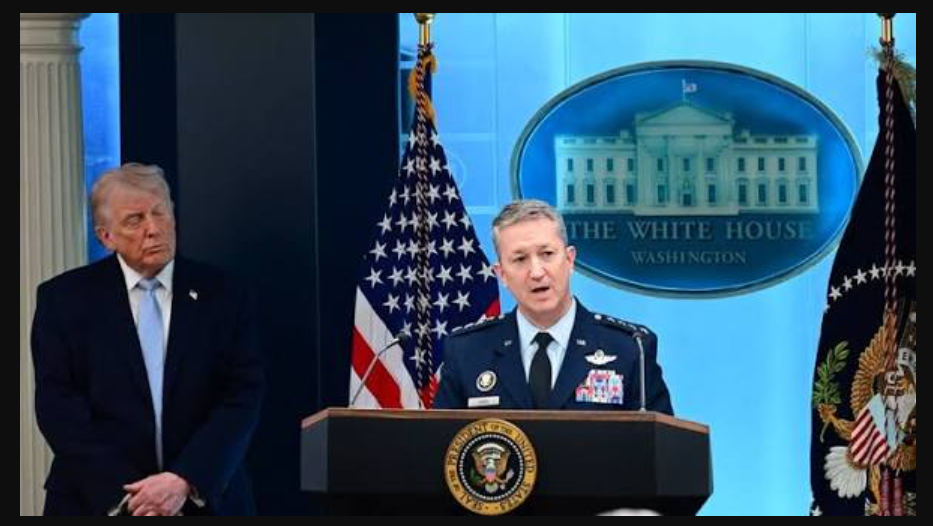

US Chairman of the Joint Chiefs of Staff General Dan Caine has reportedly urged senior officials to pursue de-escalation. His reported position comes as Washington faces growing concerns about the effectiveness and risks of further military action.
According to people familiar with the discussions, Caine warned that additional escalation could produce only limited military results.
He also reportedly cautioned that further attacks could trigger wider retaliation against US forces and regional allies.
The concerns come as President Donald Trump continues to oppose sending American ground troops into Iran. However, officials reportedly believe airpower alone may not force Tehran to accept Washington’s demands.
Military Options Face Growing Constraints
Caine reportedly raised his concerns with several senior members of the Trump administration during private discussions.
Those officials reportedly included CIA Director John Ratcliffe, Secretary of State Marco Rubio and Vice President JD Vance.
The discussions reportedly centred on the risks associated with expanding the ongoing military campaign against Iran.
Caine and other senior officials were reportedly skeptical of a proposed escalation during late July.
They were particularly concerned about possible Iranian retaliation against US allies across the region.
Moreover, officials reportedly feared that attacks could target critical regional energy infrastructure.
Trump eventually postponed the proposed operation after Gulf partners warned about the potential consequences of Iranian retaliation.
Meanwhile, Washington is also facing concerns over its available stocks of critical military equipment.
US weapons supplies reportedly include reduced stocks of air-defense interceptors and other precision-guided munitions.
Consequently, shortages could limit Washington’s ability to sustain a prolonged military campaign against Iran.
Caine Warns of Escalation Risks Despite US Military Strength
Despite his reported concerns, Caine has also emphasised the destructive capability of American military forces. The general reportedly warned Trump about the risks that could follow any decision to escalate the conflict.
At the same time, he stressed that US forces could inflict significant damage on Iran if ordered to attack. His reported position reflects the difficult choices confronting the Trump administration as the conflict continues.
Washington wants to maintain military pressure on Tehran while avoiding a costly and potentially wider regional war.
However, additional attacks could provoke retaliation against American forces, allies and strategically important infrastructure.
Therefore, administration officials are reportedly exploring an outcome that could combine diplomatic space with political gains.
Officials are reportedly seeking an agreement that Trump could present domestically as a successful outcome. At the same time, such an agreement could leave room for continued negotiations with Tehran.
Strait of Hormuz Emerges as Key Diplomatic Issue
The Strait of Hormuz has become central to efforts aimed at reducing tensions between Washington and Tehran. The strategically important waterway carries a significant share of global oil shipments and remains vital to international energy markets.
Iran has exerted control over the strait during the conflict, disrupting normal energy traffic through the region. As a result, reopening the waterway has become an important element of wider diplomatic efforts.
US officials have reported progress between Iran and Oman over arrangements that could reopen the strategic passage. “There is progress between Oman and Iran on the strait, and we expect a deal soon,” a US official said Friday.
The official said Washington expected an agreement between Iran and Oman that could restore normal oil traffic.
Iran and Oman sit on opposite sides of the strategically important waterway separating the Persian Gulf from the Gulf of Oman.
A deal over the strait could therefore create an important opening for broader negotiations. It could also help restore disrupted energy exports while reducing pressure on regional economies.
How the Iran Conflict Escalated
Regional tensions intensified on February 28 after Israel and the United States launched coordinated attacks against Iran.
The strikes targeted Iranian military, nuclear, energy and civilian infrastructure, according to the supplied account.
The attacks reportedly killed Iran’s longtime supreme leader Ali Khamenei and several senior officials. Hundreds of civilians were also reportedly killed during the military campaign.
Iran responded with missile and drone attacks against Gulf states hosting American military assets. The conflict subsequently entered a diplomatic phase as both sides explored ways to halt further hostilities.
On June 18, Iran and the United States signed a memorandum of understanding through Pakistani and Qatari mediation.
The agreement ended active hostilities and opened negotiations aimed at reaching a broader and lasting settlement.
However, those negotiations later stalled over disagreements involving maritime security and freedom of navigation. The Strait of Hormuz consequently became one of the most difficult issues in the negotiations.
Washington Searches for a Diplomatic Exit
The reported concerns from Caine highlight the increasingly difficult choices confronting the Trump administration.
Further military escalation could increase pressure on Tehran, but it could also trigger a dangerous regional response.
Iranian retaliation could threaten US allies while placing additional pressure on critical energy infrastructure.
Meanwhile, a prolonged campaign could further strain American stocks of air-defense interceptors and precision munitions. For that reason, officials are reportedly searching for a solution that combines military pressure with renewed diplomacy.
Reopening the Strait of Hormuz could provide an important starting point for broader negotiations between the parties.
For Washington, the challenge is finding a settlement that limits escalation without appearing to abandon its demands.
For Tehran, the negotiations could determine whether the conflict moves toward a broader agreement or another escalation. The future of the Strait of Hormuz may therefore prove crucial to the next stage of the Iran conflict.
Any progress on the waterway could create space for diplomacy while reducing some of the immediate regional pressure.

