

High-Profile US Delegation Signals Shift in Trade Strategy
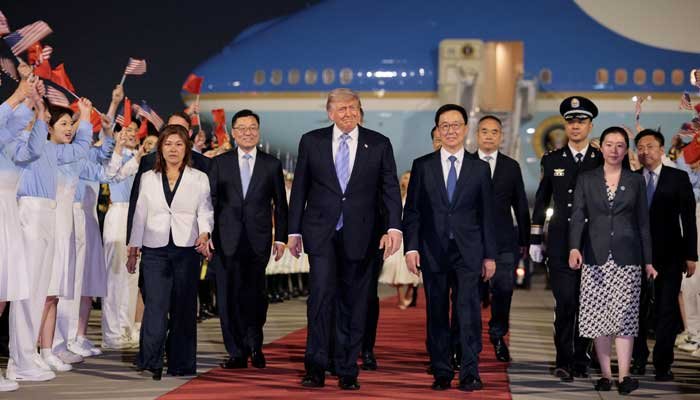
US President Donald Trump arrived in Beijing on an official state visit on Wednesday. He received a formal red-carpet welcome from Chinese officials. The visit immediately drew global attention due to its unusual delegation mix.
Trump is not traveling alone. He is accompanied by some of the most influential leaders in global technology and finance. The group includes Tesla CEO Elon Musk, Nvidia CEO Jensen Huang, and Apple CEO Tim Cook. Other major figures include BlackRock CEO Larry Fink, Blackstone co-founder Stephen Schwarzman, Citi CEO Jane Fraser, Goldman Sachs CEO David Solomon, and Cargill CEO Brian Sikes.
The presence of business leaders has turned the trip into more than a diplomatic mission. It now looks like a combined political and commercial summit between the world’s two largest economies.
Officials say the agenda includes trade imbalances, artificial intelligence, Taiwan tensions, cybersecurity risks, sanctions, and military competition in the Pacific region.
AI, Chips, and Trade Deals Dominate the Agenda
The US administration is focusing heavily on economic and technological negotiations. Artificial intelligence, semiconductor exports, electric vehicles, and supply chain security are key priorities.
Tech companies are central to these talks. Many American firms depend on China for manufacturing and sales. Apple relies heavily on Chinese production lines. Tesla operates one of its largest factories in Shanghai. Nvidia and Qualcomm depend on China as a major market for semiconductor demand.
This dependence explains why CEOs are part of the delegation. Their presence allows direct engagement with Chinese policymakers and business counterparts. It also increases the chances of immediate commercial discussions.
The spotlight is especially strong on Nvidia CEO Jensen Huang. Nvidia’s advanced AI chips remain restricted under US export controls. Washington cites national security concerns. However, US companies continue to push for wider access to Chinese markets.
US Pushes for Market Access as China Seeks Stability
The Trump administration hopes the visit will produce new commercial agreements. It also wants expanded access for US companies in China. Reduced trade barriers and clearer rules for technology exports remain key goals.
Corporate leaders may play a direct role in negotiations. Their business interests align closely with trade discussions. This includes manufacturing access, semiconductor supply chains, and digital infrastructure expansion.
China, meanwhile, is expected to focus on stabilizing relations. Beijing has repeatedly called for cooperation despite tensions. Officials see economic engagement as essential for global stability.
The summit comes at a sensitive time. Both countries are competing in AI development and advanced manufacturing. At the same time, they remain deeply interconnected through trade and investment.
Observers say the outcome of this visit could reshape global tech and trade flows for years to come.

