
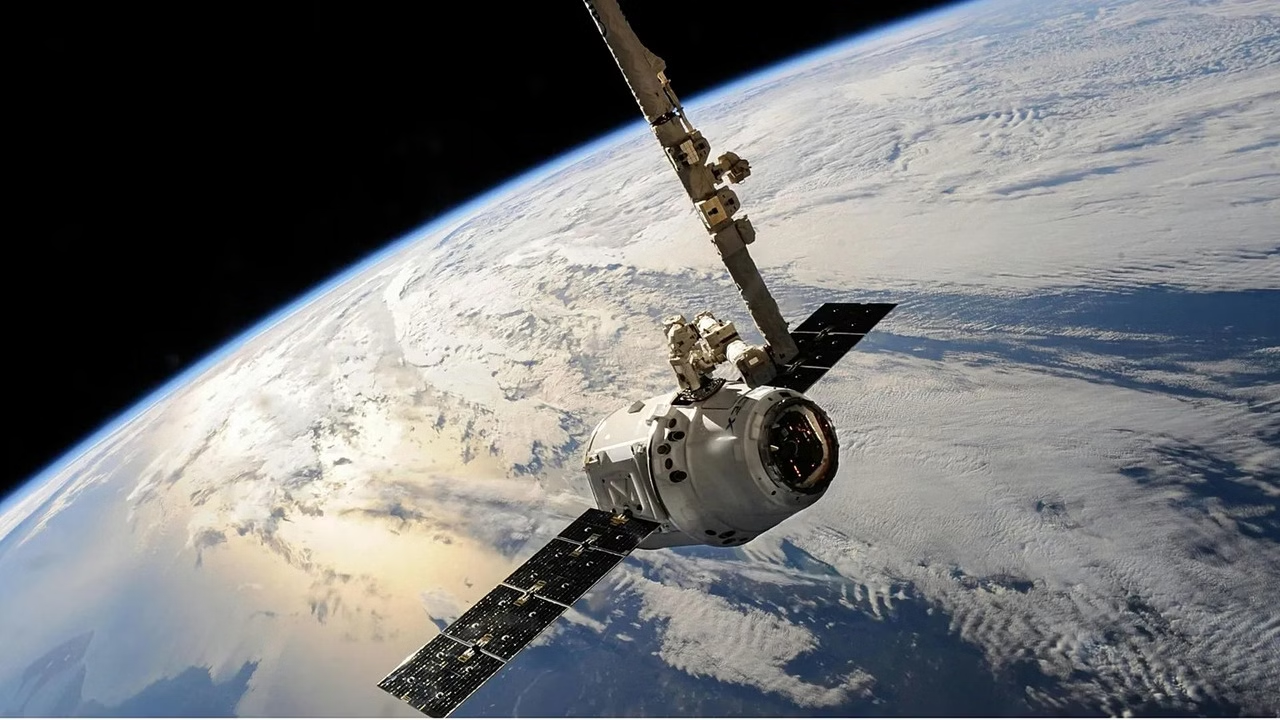

Next-generation constellation promises faster speeds, greater capacity and advanced satellite technology
WASHINGTON: SpaceX has submitted a new application to the US Federal Communications Commission (FCC) seeking approval to deploy up to 100,000 next-generation Gen3 Starlink satellites, marking one of the company’s most ambitious expansions of its global satellite internet network.
According to the filing, the Gen3 satellites feature a completely redesigned architecture rather than an incremental upgrade to the current Gen2 system. Each satellite will weigh approximately 2,000 kilograms, significantly heavier than the 575-kilogram Gen2 models, and will operate in very-low Earth orbit at an altitude of about 350 kilometres. Consequently, the larger spacecraft will require SpaceX’s Starship rocket for deployment.
The company said the upgraded constellation is expected to deliver a tenfold increase in download capacity, reaching one terabit per second per satellite. Meanwhile, upload capacity could improve by as much as 22 times, rising to between 160 and 200 gigabits per second.
Advanced technology and wider coverage
SpaceX said each satellite will provide around four terabits per second of combined radio-frequency and laser communication capacity. Furthermore, the new platform will incorporate larger phased-array antennas, next-generation onboard computers, extended solar panels and Argon Hall thrusters for improved orbital manoeuvrability.
The network will also employ electronic beam steering, optical inter-satellite links, dynamic power control and advanced beamforming technology to improve spectrum efficiency while reducing signal interference.
Testing progresses as future upgrades planned
SpaceX confirmed that testing of the Gen3 satellites is already underway. The planned constellation will operate at multiple orbital altitudes and inclinations while using a broad range of frequency bands, including Ku, Ka, V, E, W and D bands.
Because of the significant performance improvements, existing Starlink terminals are expected to require hardware upgrades to access future gigabit-class internet speeds. Separately, SpaceX recently unveiled its AI1 satellite design for artificial intelligence applications, although production has not yet begun. The FCC application is independent of another proposal involving a much larger long-term satellite deployment initiative.

