
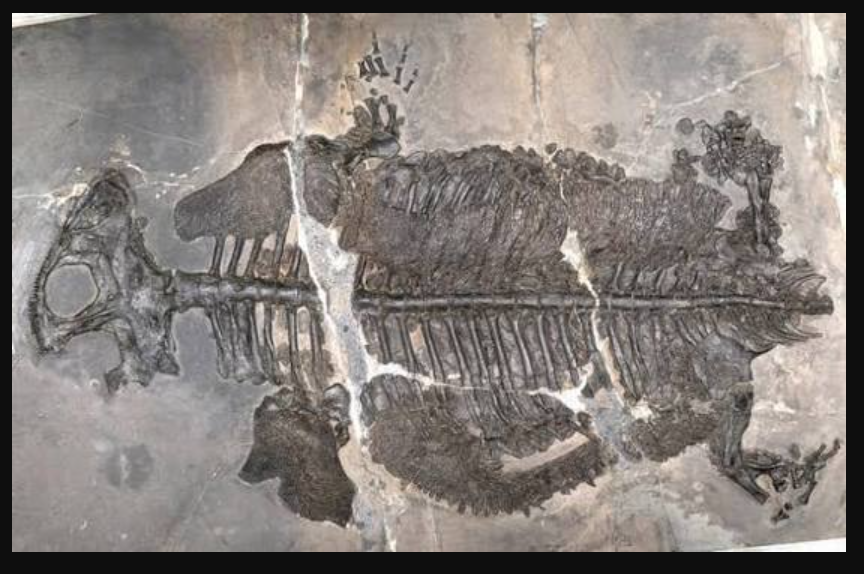

An extraordinary fossil discovery has revealed an amphibian that lived entirely in the sea around 237 million years ago. International researchers identified the species as Gerrothorax maritimus, marking the first known fully marine stem amphibian.
The discovery comes from two nearly complete skeletons found in southwest China’s Guizhou Province. Dating back to the Late Triassic period, the fossils measure at least 737 millimetres in length.
Researchers used the remains to reconstruct the animal’s appearance and understand how it adapted to marine life.
What Did the Ancient Marine Amphibian Look Like?
The reconstructed Gerrothorax maritimus had a flattened body covered in heavy bony armour. It also featured a broad, flat head, a wide mouth and sturdy, well-developed gill arches.
These physical characteristics suggest that the species had several adaptations suited to underwater living. In particular, its flattened body may have helped it remain hidden within seafloor sediments.
Its heavy armour also offered a possible solution to one of the biggest challenges amphibians face in seawater.
Why Is This Discovery Significant?
More than 8,000 amphibian species live today, but none spends its entire life in the sea. Their permeable skin supports respiration, but it also makes them vulnerable to water loss.
Seawater creates additional physiological difficulties because of its high salt content. Although some modern amphibians tolerate brackish environments, they generally remain associated with freshwater habitats.
Scientists have also discovered ancient amphibian fossils in coastal sediments. However, earlier findings did not provide sufficient evidence of a completely marine lifestyle.
The discovery of Gerrothorax maritimus changes that understanding. Jiang Dayong, the study’s corresponding author, said the species represents the first known stem amphibian to have lived entirely in a marine environment.
How Did Gerrothorax maritimus Survive Underwater?
Researchers believe the animal developed several features that helped it survive in the sea.
Its flattened body likely suited life along the seafloor, where it could conceal itself in sediments. Meanwhile, its heavy bony armour may have helped reduce water loss through its skin.
The species also retained its gills into adulthood, allowing it to breathe underwater. Researchers suggested that it may have been able to remain submerged without regularly surfacing to breathe air through its lungs.
These adaptations offer important clues about how ancient amphibians responded to challenging marine conditions.
Researchers Reconstruct an Ancient Marine Species
The findings appeared in a research article published in Nature Ecology & Evolution. The international research team included scientists from the Geological Museum of Guizhou, Peking University and the University of California, Davis.
By studying the nearly complete skeletons, researchers reconstructed a species that expands scientific understanding of amphibian evolution. The discovery also provides evidence of an ancient amphibian lineage that successfully adapted to life entirely in the marine environment.
For the latest updates, visit and follow The Truth International website (www.thetruthinternational.com) and subscribe to the YouTube Channel.

