
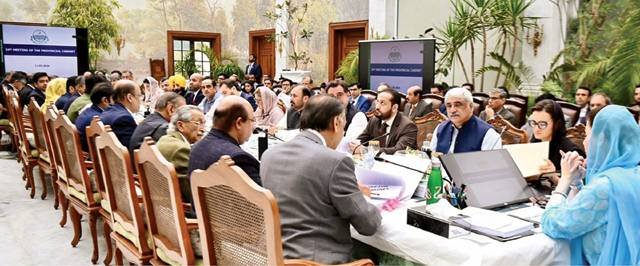

The Punjab cabinet has approved several development and public welfare initiatives during a meeting chaired by Chief Minister Maryam Nawaz Sharif in Lahore. The decisions covered policing, agriculture, transport, education and administrative reforms.
Officials informed the meeting that kidnapping for ransom has been eliminated from the Kacha area after 30 years. Moreover, they said the crime rate in the region has remained at zero since November last year.
The cabinet approved a special concession package for the youth of Rojhan in police recruitment. Additionally, it sanctioned Rs. 1.1 billion for weapons and protective equipment for police personnel deployed in the Kacha area.
Cabinet Approves Police And Agriculture Measures
The cabinet also approved a hard area allowance for police officers serving in the Kacha region. Furthermore, members relaxed rules for granting martyr packages to police personnel who lost their lives while on duty there.
Officials told the meeting that 30,000 allotment letters had been issued under the Apna Khet Apna Rozgar programme. Meanwhile, more than 171,000 people applied, and 60,000 applicants were declared eligible.
Maryam Nawaz directed authorities to encourage wheat cultivation across Punjab. She also instructed officials to link the Literacy Department with the Education Department under the education minister.
Electric Buses And Administrative Reforms Approved
The cabinet approved the recruitment of 900 Union Council secretaries across the province. In addition, the chief minister sought a report on government-owned shops throughout Punjab.
Members appreciated preparations for monsoon rains and urban flooding. Meanwhile, Maryam Nawaz reaffirmed her commitment to introduce electric buses in every district and tehsil, announcing that 1,100 buses would be provided by December.
The cabinet also reviewed the National Wheat Policy 2026-2030 for strategic reserves and stock management. Finally, members agreed to establish a four-member ministerial committee to address issues related to the Medical Entry Test and emphasised encouraging both foreign and local investment.

