
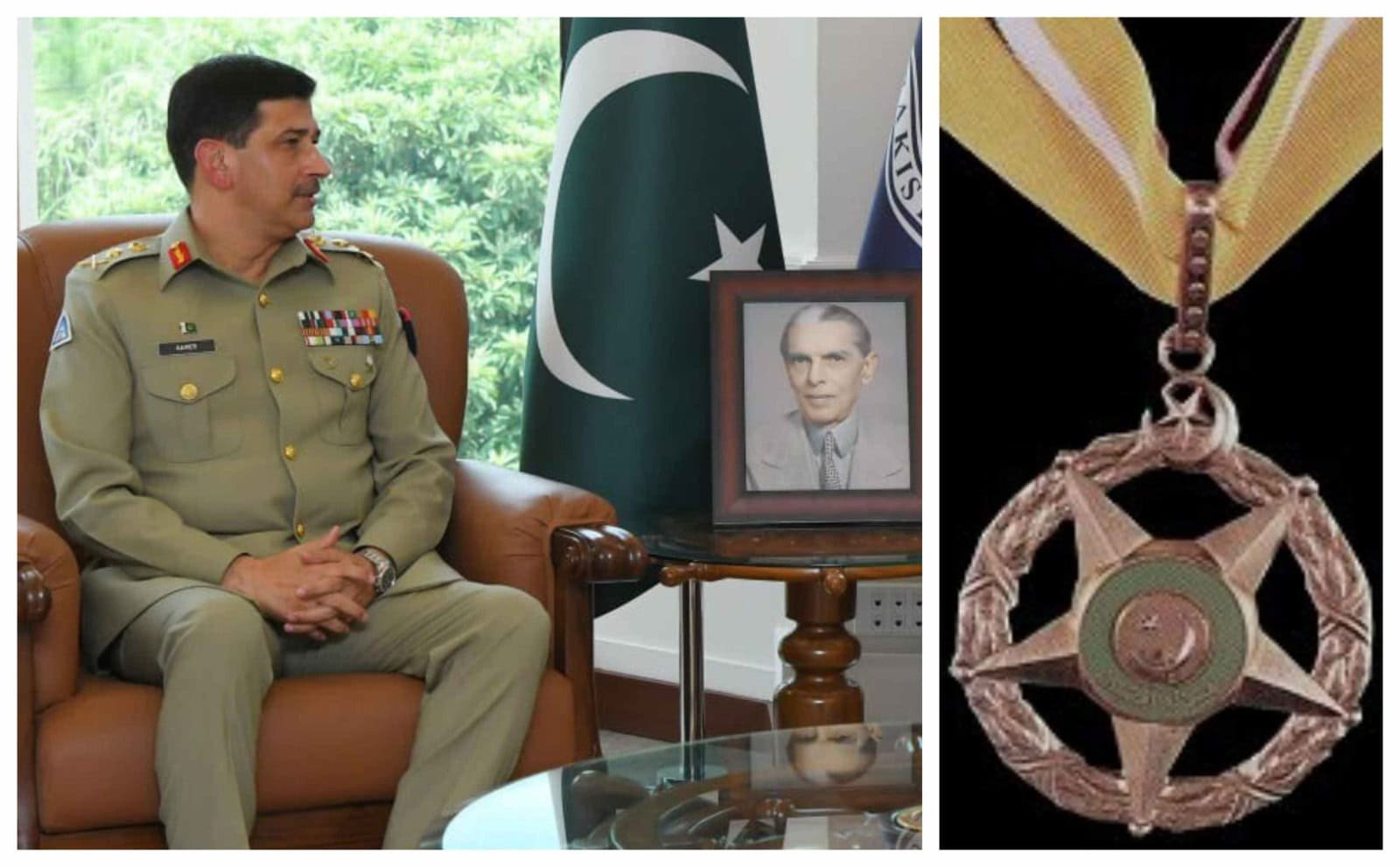

Prestigious Military Honour Conferred at Aiwan-i-Sadr
President Asif Ali Zardari has conferred the Nishan-i-Imtiaz (Military) on General Syed Aamer Raza, the first Commander of Pakistan’s newly established National Strategic Command.
The investiture ceremony was held at Aiwan-i-Sadr in Islamabad on Tuesday, August 11.
Prime Minister Shehbaz Sharif, Chief of Defence Forces and Chief of Army Staff Field Marshal Syed Asim Munir, the services chiefs and senior government and military officials attended the ceremony.
President Zardari had approved the award for General Raza on July 31, shortly after his appointment to the newly created strategic command position.
General Raza has previously received the Hilal-i-Imtiaz (Military) and Sitara-i-Basalat, adding the Nishan-i-Imtiaz to his list of military honours.
The latest decoration comes weeks after one of the most significant changes to Pakistan’s senior military command structure in recent years.
General Raza Leads Newly Created National Strategic Command
Prime Minister Shehbaz Sharif promoted then-Lieutenant General Aamer Raza to four-star general on July 24 and appointed him Commander of the National Strategic Command.
He became the first officer to hold the position.
The National Strategic Command was established as part of military restructuring introduced under the 27th Constitutional Amendment.
The constitutional changes abolished the office of Chairman Joint Chiefs of Staff Committee and created the position of Chief of Defence Forces.
Field Marshal Asim Munir became Pakistan’s first Chief of Defence Forces while continuing as Chief of Army Staff.
The National Strategic Command serves as a unified operational headquarters for Pakistan’s strategic forces.
It is intended to bring the strategic commands of the Army, Navy and Air Force under a more integrated command structure.
However, ultimate authority over Pakistan’s nuclear policy and employment remains with the National Command Authority, which is chaired by the prime minister.
Under the amended legal framework, the Commander National Strategic Command is appointed by the prime minister on the recommendation of the Chief of Defence Forces.
The commander serves a three-year term.
General Raza’s appointment therefore places him at the centre of Pakistan’s reorganised strategic military architecture.
From 6th Lancers to Four-Star Strategic Command
Before his promotion, General Raza served as Chief of General Staff of the Pakistan Army, one of the military’s most important operational appointments.
In that role, he was involved in implementing organisational reforms linked to the new military structure.
His responsibilities also included changes introduced following Pakistan’s conflict with India, including the establishment of the Army Rocket Force Command.
General Raza is a cavalry officer who was commissioned into the 6th Lancers in 1988 after training at the Officers Training School.
His career has included command of an armoured regiment and an armoured brigade.
He also commanded an infantry brigade in South Waziristan, an infantry division and Lahore’s IV Corps.
General Raza has also headed Heavy Industries Taxila.
His previous staff appointments include Director General Weapons and Equipment and Chief of Staff at II Corps.
His professional background has largely been associated with conventional military operations, command assignments and force development.
His elevation to lead the National Strategic Command therefore represents a major expansion of his responsibilities into Pakistan’s highest strategic command structure.
Following his appointment, General Raza has also held meetings with senior military leadership, including Field Marshal Asim Munir and Chief of Naval Staff Admiral Naveed Ashraf.
The Naval Chief congratulated him on becoming the first Commander of the National Strategic Command.
The conferment of the Nishan-i-Imtiaz comes as Pakistan completes a major restructuring of its senior defence leadership.
General Raza will now play a central role in operational coordination among the country’s strategic forces under the new command system.

