
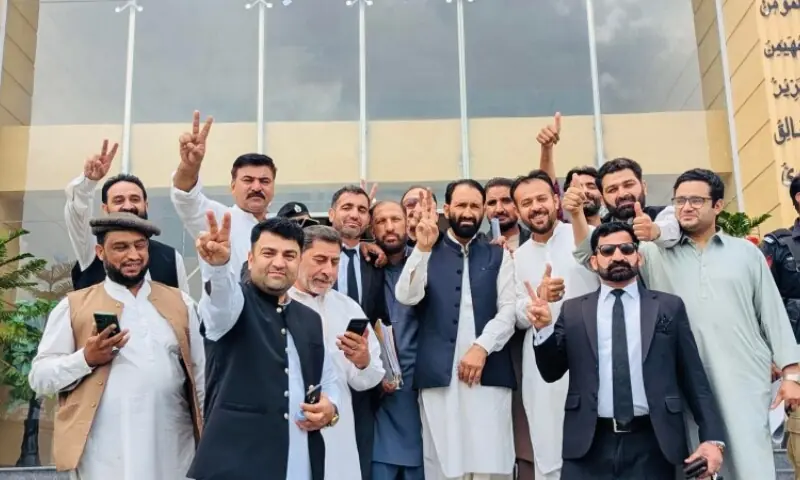

ISLAMABAD: Gilgit-Baltistan Chief Election Commissioner Raja Shahbaz Khan on Wednesday announced verdicts on three pending election petitions, confirming the Pakistan Peoples Party (PPP) as the largest party in the regional assembly with 11 seats.
The Chief Election Commissioner declared PPP candidate Attaullah Khan the winner from GBA-16 Diamer-II. Meanwhile, Pakistan Muslim League-Nawaz (PML-N) candidates Malik Kefayat secured victory in GBA-17, while another PML-N candidate was declared successful from GBA-13 Astore-I.
The petitions were filed by rival candidates who challenged the Form-47 results. After hearing arguments from all parties, the Election Commission had suspended the results and reserved its verdict before announcing the final decisions.
Following the ruling, the PPP now holds 11 seats in the Gilgit-Baltistan Assembly. The PML-N has secured six seats, while four independent candidates, who recently joined the Istehkam-e-Pakistan Party (IPP), have won four seats. PTI-backed candidates secured two seats, and the Majlis Wahdat-i-Muslimeen obtained one seat.
The Chief Election Commissioner said notifications for the successful candidates would now be issued. Subsequently, six reserved seats for women and three technocrat seats will be allocated among political parties according to their final strength in the assembly.
Earlier, supporters of independent candidate Imam Malik had blocked the Karakoram Highway in Chilas while demanding re-polling at selected polling stations in GBA-16. Although the Election Commission initially ordered re-polling at three stations, it later withdrew the decision and postponed the final results until June 17.
The June 7 Gilgit-Baltistan Assembly elections recorded a voter turnout of 70 percent. However, the Human Rights Commission of Pakistan expressed concern over the Election Commission’s decision to suspend planned re-polling in five constituencies. The commission warned that abrupt changes could strengthen perceptions of political interference and undermine public confidence in the electoral process.

