
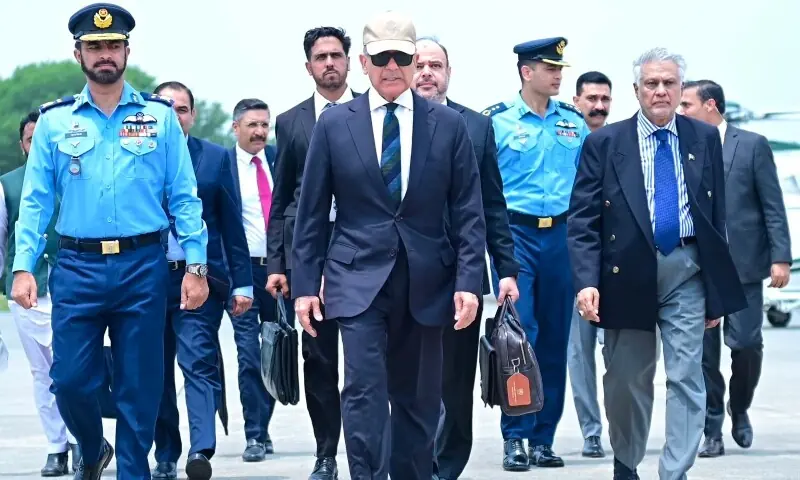

Prime Minister Shehbaz Sharif and Chief of Army Staff Field Marshal Asim Munir arrived in Tehran on Friday. They joined international leaders to attend the state funeral of Iran’s late supreme leader, Ayatollah Ali Khamenei. A joint military strike by the United States and Israel killed Khamenei earlier this year on February 28. State broadcaster PTV reported that senior Iranian officials welcomed the high-level Pakistani contingent at the airport.
The Prime Minister’s Office confirmed that a diverse diplomatic team accompanied the premier to display strong bilateral solidarity. The delegation includes National Assembly Speaker Ayaz Sadiq, Deputy Prime Minister and Foreign Minister Ishaq Dar, Information Minister Attaullah Tarar, and PPP Chairman Bilawal Bhutto Zardari. Additionally, PPP Secretary General Nayyer Bukhari and Sindh Chief Minister Murad Ali Shah joined the group. Separately, Senate Chairman Yousaf Raza Gilani landed in the capital with a distinct parliamentary team earlier in the day to attend the initial funeral prayers.
Navigating Diplomacy Amid Regional Friction
The PMO stated that Prime Minister Shehbaz will extend deep, heartfelt condolences to the interim Iranian leadership and the bereaved family members. This high-profile visit aims to reaffirm Pakistan’s complete diplomatic support for Iran during a period of intense national mourning. Following his engagements in Tehran, the prime minister will proceed directly to Turkiye. Representatives from China, Afghanistan, and various neighboring nations in the Caucasus region also arrived in the city to pay their respects to the late leader.
The public funeral processions take place against the backdrop of a highly fragile regional peace. Hostilities in the region recently stopped after the United States and Iran signed the Islamabad Memorandum of Understanding, which established a tentative ceasefire. The late supreme leader’s formal funeral ceremonies will begin on Saturday. His body will lie in state at a central Tehran prayer complex before moving through a succession of ideologically significant cities, including Qom, Karbala, Najaf, and ultimately Mashhad. Iranian President Masoud Pezeshkian emphasized that a massive public turnout at the procession would deliver a decisive response to international bullying and violence.

