
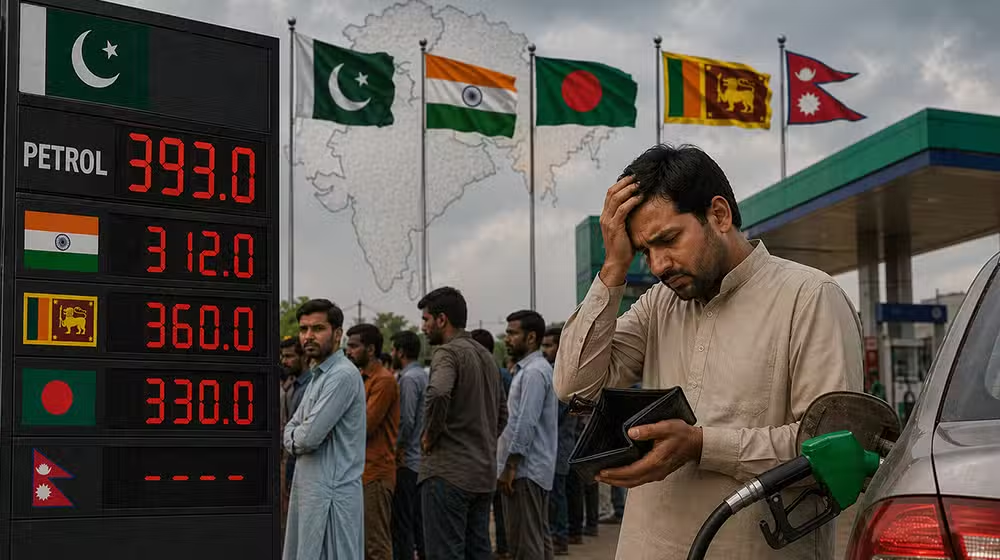

Pakistan faces the heaviest fuel affordability burden in South Asia, even though petrol prices remain broadly similar across the region in US dollar terms. According to the latest World Bank data, the gap between income levels and fuel costs places significant pressure on Pakistani households.
Income gap drives affordability crisis
Petrol prices currently stand at around $1.41 per litre in Pakistan, compared with $1.10 in India, $1.05 in Bangladesh, and $1.40 in Sri Lanka. Moreover, these rates fluctuate based on global oil trends, taxation, and currency movements, keeping regional prices relatively aligned.
However, affordability changes sharply when measured against income. Pakistan’s per capita income ranges between $1,400 and $1,600, significantly lower than India’s $2,600–$2,700, Bangladesh’s $2,500–$2,600, and Sri Lanka’s $4,500+. As a result, fuel consumes a much larger share of household earnings in Pakistan.
In addition, analysts note that Pakistan consistently ranks at the bottom in South Asia in terms of fuel affordability. Even small changes in global oil prices or domestic taxation therefore have a disproportionate impact on consumers.
Meanwhile, India and Bangladesh benefit from higher income levels, which help cushion fuel price volatility. Similarly, Sri Lanka, despite past economic challenges, maintains stronger per capita income, improving its ability to absorb energy costs.
Furthermore, Pakistan recently raised petrol and diesel prices to Rs. 393.35 and Rs. 380.19 per litre, respectively. Consequently, inflationary pressure is expected to rise further, particularly for transport and food sectors.
Overall, experts emphasize that the issue is not only fuel pricing but the imbalance between income growth and energy costs. Unless income levels improve, Pakistan is likely to remain highly vulnerable to global oil shocks compared to its regional peers.

