
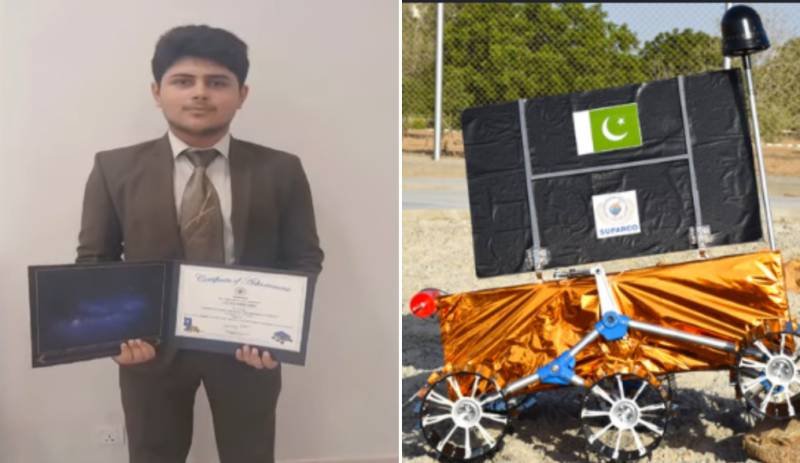

17-Year-Old Tayyab Kareem Wins Nationwide SUPARCO Naming Competition
Pakistan’s first indigenous lunar rover has officially been named Jinnah-I, marking another major milestone in the country’s expanding space programme.
The Space and Upper Atmosphere Research Commission (SUPARCO) unveiled the name on Thursday, August 13, following a nationwide competition that attracted more than 4,000 proposed names from across Pakistan.
The name honours Quaid-e-Azam Muhammad Ali Jinnah, the founder of Pakistan, and is intended to represent the country’s determination to advance into new areas of science, technology and space exploration.
Seventeen-year-old Tayyab Kareem from Bahawalnagar emerged as the winner of the public competition. Latest reports from the naming ceremony say seven participants had proposed the name Jinnah-I, with a draw conducted to select the final winner among them.
Kareem received a Rs100,000 cash prize along with national recognition for his winning entry.
SUPARCO had announced the naming competition as part of an effort to involve the Pakistani public, particularly young people and space enthusiasts, in the country’s first lunar rover programme. The Rs100,000 prize had been announced when the contest was launched.
SUPARCO Chairman Muhammad Yousuf Khan said the name was more than simply an identity for a spacecraft.
He described Jinnah-I as a symbol of resilience, determination, national progress and Pakistan’s ambition to explore new scientific frontiers.
Jinnah-I to Explore Moon’s South Polar Region
Jinnah-I is being developed for deployment on the Moon as part of China’s Chang’e-8 mission, a major robotic lunar exploration project led by the China National Space Administration.
Pakistan and China formally signed an agreement in February 2025 allowing SUPARCO’s indigenous rover to join Chang’e-8.
The agreement was concluded in the presence of President Asif Ali Zardari and Chinese President Xi Jinping during Zardari’s visit to China.
Pakistan’s rover is expected to weigh approximately 35 kilograms and will operate in the Moon’s south polar region, an area considered particularly important for future scientific research and long-term lunar exploration.
SUPARCO scientists and engineers have designed, manufactured, assembled, integrated and tested the rover domestically, according to information previously released by the national space agency.
Once deployed, Pakistani scientists are expected to control and operate the rover remotely from Earth.
The rover will carry advanced scientific equipment developed by SUPARCO as well as an internationally developed scientific payload involving Chinese and European researchers.
Its scientific objectives include examining the composition of lunar soil and studying whether lunar material could potentially be useful for future exploration.
Jinnah-I will also help map geological and surface features around its landing region.
Another important objective will be studying radiation levels and plasma conditions on the lunar surface. Such measurements can help scientists understand the environment future robotic and human missions could face.
The rover will additionally test technologies that could contribute to longer-term lunar operations and research related to a sustainable human presence on the Moon.
Chang’e-8 itself is designed to perform in-situ scientific research, technological demonstrations, lunar mapping and resource-utilisation experiments. The mission forms part of wider preparations connected with the proposed International Lunar Research Station initiative.
Latest Reports Put Chang’e-8 Mission in 2029
There is currently a discrepancy in the publicly available launch timeline for Jinnah-I.
Reports from Thursday’s naming announcement say Jinnah-I is expected to travel to the Moon aboard Chang’e-8 in 2029.
However, SUPARCO’s existing Lunar Rover Programme information and earlier official announcements continue to list the Chang’e-8 mission for 2028.
This suggests the mission timeline may have shifted, although SUPARCO’s publicly available programme page had not yet been updated to reflect the 2029 date at the time of reporting.
The naming process itself has also been reported slightly differently. Pre-event reports citing SUPARCO said nine shortlisted participants would take part in the final balloting, while reports from Thursday’s ceremony said seven participants had submitted Jinnah-I and a draw among them selected Tayyab Kareem.
The final confirmed outcome, however, is that the rover has been named Jinnah-I, with the 17-year-old Bahawalnagar student selected as the winning participant.
Pakistan’s involvement in Chang’e-8 represents a significant expansion of its cooperation with China in space exploration.
The country has already participated in lunar research through iCube-Qamar, Pakistan’s lunar satellite that travelled aboard China’s Chang’e-6 mission in 2024.
The Jinnah-I rover will take that participation a major step further by placing a Pakistan-developed robotic vehicle directly on the lunar surface.
If successful, the mission will provide Pakistani engineers and scientists with practical experience in planetary robotics, remote lunar operations, scientific instrument development and deep-space exploration.
It could also strengthen Pakistan’s capabilities in areas extending beyond lunar exploration, including robotics, autonomous systems, remote sensing and advanced space engineering.
For SUPARCO, naming the rover after Muhammad Ali Jinnah is intended to connect the mission with a broader message of national scientific ambition.
For 17-year-old Tayyab Kareem, meanwhile, the winning suggestion means that a name submitted from Bahawalnagar is now set to become part of Pakistan’s first attempt to operate a rover on another celestial body.

