
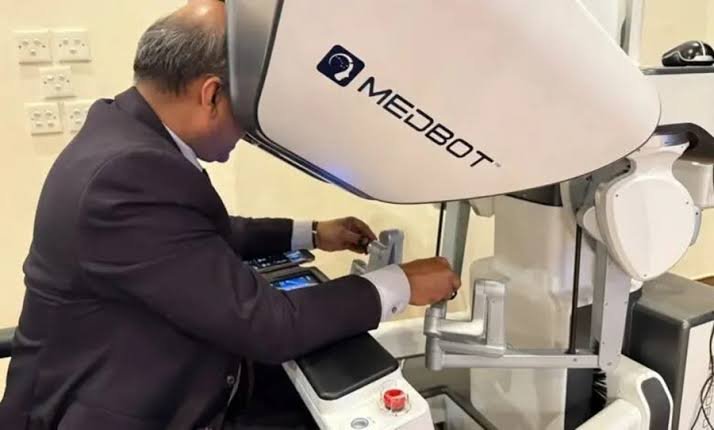

Pakistan has achieved a significant breakthrough in medical technology after successfully demonstrating robotic telesurgery in Islamabad. The procedure allowed a surgeon to operate on a patient remotely while remaining at a separate location.
The achievement highlights Pakistan’s growing capabilities in advanced healthcare, robotic surgery and digitally connected medical services.
The development was reported on November 5, 2026, following the successful demonstration during the International Conference on Future of Healthcare (FHCC 2026).
ProPakistani
How Did Pakistan’s First Robotic Telesurgery Work?
Professor Dr. Syed Tanseer Asghar, Registrar of Shaheed Zulfiqar Ali Bhutto Medical University (SZABMU), performed the robotic gallbladder removal procedure.
Instead of standing inside the hospital’s operating theatre, he controlled the surgical instruments remotely from the Gandhara Heritage and Culture Centre in Islamabad.
Meanwhile, the patient remained at Kulsum International Hospital, where a medical team assisted throughout the operation.
The procedure, medically known as a robotic cholecystectomy, involved the surgical removal of the patient’s gallbladder.
Advanced robotic equipment and real-time digital communication connected the operating surgeon with the hospital team.
Female Surgeon Plays Key Role in Historic Operation
Dr. Sana Sharafat Ali, a consultant robotic and vascular surgeon, played an important role during the procedure.
She supervised the robotic equipment beside the patient and provided essential surgical assistance.
Her responsibilities included managing the robotic patient cart and coordinating with Professor Asghar.
The successful collaboration demonstrated how surgeons at different locations can work together during complex medical procedures.
The operation was conducted with an on-site surgical team available to provide immediate assistance whenever required.
The News
Pakistan Plans First Robotic Surgery and AI Health Centre
Following the achievement, SZABMU Vice Chancellor Professor Dr. Tanwir Khaliq highlighted the growing importance of modern technology in healthcare.
He confirmed that approval had been secured for establishing the university’s first Robotic Surgery and Artificial Intelligence Health Centre.
The proposed facility will support medical research, advanced surgical training and the development of artificial intelligence applications in healthcare.
It is also expected to strengthen cooperation between medical universities, hospitals and technology specialists.
Could Patients Receive Surgery Without Travelling to Major Cities?
The successful demonstration has created new possibilities for specialist medical treatment in Pakistan.
Robotic telesurgery could eventually allow experienced surgeons to operate on patients in distant hospitals without travelling to those locations.
This technology may particularly benefit people living in remote and underserved regions where specialist surgical services are limited.
However, wider adoption will require reliable internet connectivity, specialized medical equipment, trained surgical teams and strict patient safety standards.
Experts also emphasize the importance of clear medical protocols and regulatory oversight before remote surgery becomes widely available.
A New Chapter for Pakistan’s Healthcare Industry
The procedure represents an important development in Pakistan’s use of robotic surgical technology.
It also demonstrates the potential of collaboration between healthcare institutions and emerging technology specialists.
Although the demonstration was described as a landmark in Islamabad, Pakistan had previously hosted cross-border robotic procedures. The latest achievement is therefore particularly significant for its locally operated remote surgical system.
The development could encourage further investment in medical research, robotics and specialist training.
For Pakistan’s healthcare sector, the achievement offers a glimpse into a future where distance may become less of a barrier to specialized surgical treatment.

