

By Anum Waqar
At a Pakistani university, one question may matter more than the final examination: Which country will give me a visa? For a medical student, an engineer or a young researcher, the answer can decide not only a career but an entire family’s future. A foreign job offers money, certainly. It may also offer functioning institutions, fairer promotion and the simple confidence that tomorrow will be better than today.
Pakistan should find this deeply troubling. Instead, its leaders often point proudly to the dollars overseas workers send home, as though the money settles the argument. It does not. A country can benefit from migration while still failing the people who feel compelled to leave. Pakistan is doing both.
In 2025, 762,499 Pakistanis registered for overseas employment, according to government figures cited in the Pakistan Economic Survey. That is more than 2,000 registrations each day. The total was higher than the 727,381 reported in 2024. Saudi Arabia alone accounted for about 530,000 registrations in 2025. These are official labour registrations, not a count of graduates permanently abandoning Pakistan. Many migrants are construction workers, drivers and technicians. Confusing all of them with scientists would be dishonest. Ignoring the departure of trained professionals would be equally dishonest.
The $41.6 Billion Comfort Blanket
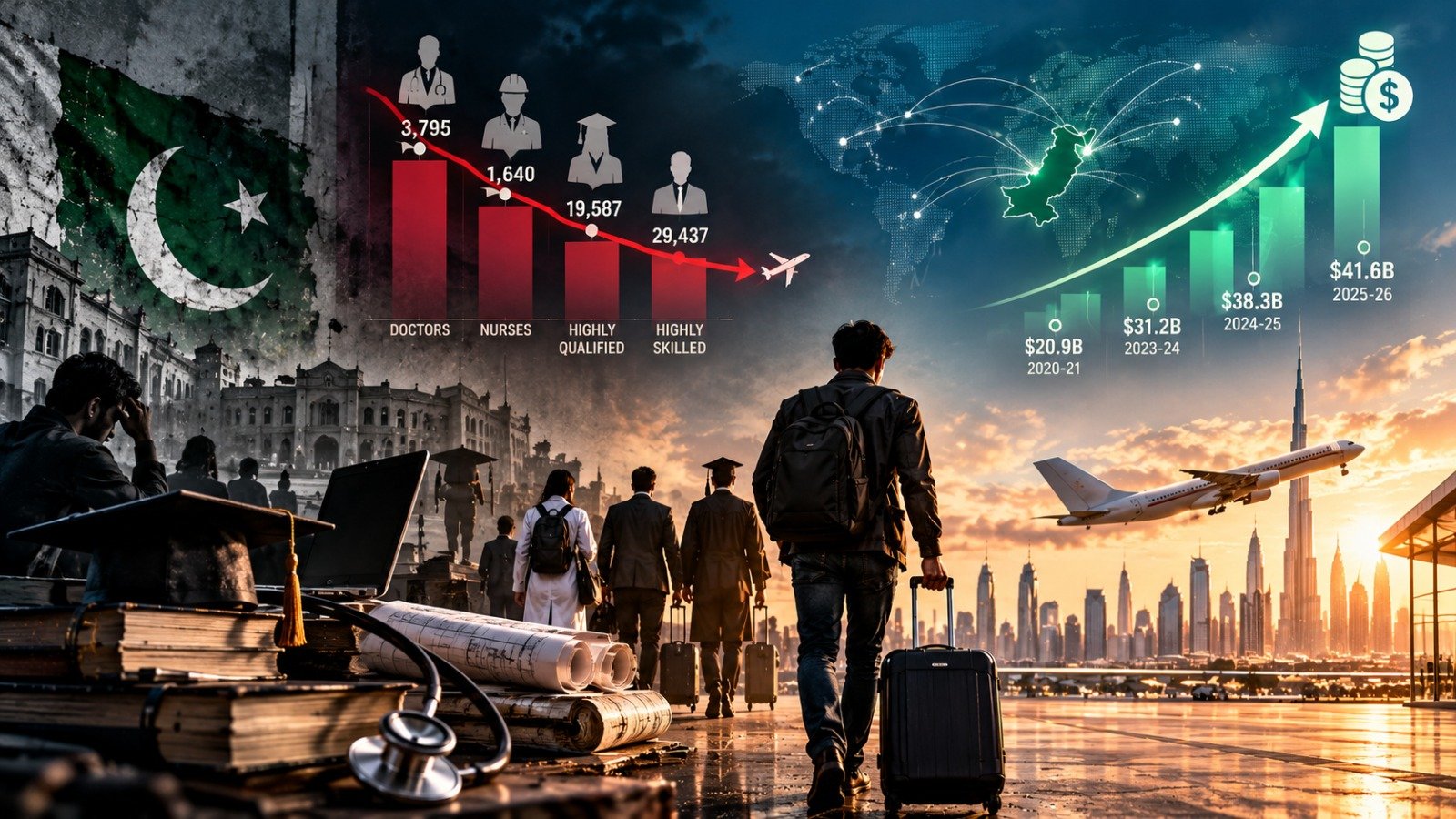
The State Bank reported a record $41.6 billion in workers’ remittances for the fiscal year ending June 2026, up 8.6% from the year before. That money is indispensable. It pays for food, medicine and education. It helps the country manage its chronic shortage of foreign currency. Millions of families have good reason to celebrate every transfer.
Yet a government should ask why its citizens must cross borders to secure decent livelihoods. There is something perverse about presenting a growing reliance on overseas earnings as a complete economic victory. The state gets foreign exchange; families get breathing room; officials get an impressive headline. What the country does not automatically get is stronger factories, better hospitals or productive jobs at home.
A remittance can pay a medical bill. It cannot operate on the patient. It can support a student. It cannot replace a lecturer who has left. Dollars coming in and expertise going out are not equal items on a national balance sheet. Both matter, but they perform different jobs. Pakistan celebrates the visible inflow while rarely calculating the harder, slower costs of its lost opportunities.
A Job Market That Punishes Ambition
The economic facts explain why so many people look elsewhere. Pakistan’s Labour Force Survey for 2024–25 put unemployment at 7.1%. Among people aged 20 to 24, it was 12.3%; among women of that age, 16.6%. The survey put the average monthly wage for paid employees at Rs39,042. These numbers do not represent every graduate’s salary, but they show how narrow the financial choices are for ordinary workers.
The deeper problem is job quality. The same survey found that 80.8% of employed Pakistanis were in informal work. Many such jobs lack security, benefits and clear paths for advancement. A degree, meanwhile, is no guarantee of work that makes full use of the knowledge behind it. Families spend years paying fees, preparing children for examinations and telling them education is the route upward. Too often, the first credible opening appears outside Pakistan.
That is a painful failure of economic policy. Producing graduates is not the same as building an economy that needs them. Universities can hand out diplomas, but they cannot create a thriving technology industry by themselves. Hospitals can train doctors, but cannot retain them without supervision, equipment and credible career prospects. Research grants announced at ceremonies mean little if funding disappears when politics changes.
The Price of an Unfair System
Pay is only part of the decision. Ambitious professionals also ask whether appointments are transparent, whether managers know their jobs and whether merit matters more than connections. These questions are difficult to put into a headline statistic. They are impossible to leave out of the migration debate.
Imagine two equally capable engineers. One has a demanding manager, access to modern tools and a visible route to promotion. The other faces favouritism, delayed decisions and no serious investment in professional skills. A higher salary abroad appeals to both. For the second engineer, however, leaving is also a way to escape uncertainty and wasted potential.
This is why speeches urging young people to be patriotic miss the point. Patriotism cannot substitute for predictable rules. Love of country does not make a laboratory functional; a salary arrive on time or a promotion fair. People are not betraying Pakistan when they compare the opportunities available to them. They are doing what responsible adults do: weighing the futures they can realistically build.
The state should stop treating that calculation as an insult and start treating it as a verdict on its own performance.
A Hospital Cannot Run on Remittances
Healthcare makes the cost especially clear. Figures presented in Pakistan’s National Assembly in October 2026 showed that 3,795 doctors and 1,639 nurses secured registered overseas employment in 2025. The comparable counts for doctors were 3,625 in 2024 and 2,093 in 2026 up to the reporting date. These statistics cover a specific official channel; they neither capture every departure nor prove that each person settled abroad forever.
Still, they describe a continuing flow from a system that needs experienced clinicians. Training a doctor takes years. Training a specialist takes longer. When a senior physician leaves, the loss may extend beyond one vacant position. Junior colleagues lose supervision. Patients wait longer. Smaller cities and rural areas, already struggling to attract specialists, have fewer options.
Blaming doctors is easy and wrong. Nobody should have to accept poor working conditions or sacrifice a family’s future to demonstrate loyalty. But policymakers cannot applaud overseas earnings while remaining indifferent to the reasons medical workers seek careers abroad. The sensible answer is neither forced service nor moral lectures. It is better training, safer workplaces, fair recruitment and pay that reflects demanding work.
The Talent Pakistan Never Learns to Use
The same damage can unfold less visibly in science, engineering and business. A researcher who leaves may take years of practical knowledge and valuable professional networks. A senior engineer may have been the person who could train an entire team. A capable manager might have helped a Pakistani company compete internationally. These losses rarely appear in a budget document, yet they can accumulate over decades.
There is a second problem: Pakistan helps finance skills whose greatest economic rewards may then arise somewhere else. Public institutions, private colleges and families invest enormous sums and years of effort in education. When skilled people spend their most productive years abroad, other economies may capture much of that return.
That does not make educated migrants’ national property. Nor does it mean every departure is a permanent loss. Overseas Pakistanis can bring investment, research partnerships, clients and technology home. Some return with better training. Others build successful cross-border companies without relocating. Migration can become a powerful network rather than a one-way exit.
But connections do not turn themselves into jobs. They need trustworthy contracts, functioning institutions and local partners who can execute. Pakistan cannot assume that a successful diaspora will automatically rescue an underperforming domestic economy.
Why the Ticket Becomes One Way
Many young people leave promising to return. Then they find stable employment, develop professional ties, marry and raise children. A return that once sounded simple becomes a complicated question about schools, healthcare, safety and a spouse’s career. Every year spent building a life elsewhere raises the practical cost of moving back.
A minister can ask the diaspora to invest. A university can invite an accomplished graduate to deliver a patriotic lecture. Neither gesture answers the question that matters: Will returning allow this person and their family to live and work with dignity? If the answer is uncertain, even a deep attachment to Pakistan may not be enough.
This is also why counting everyone who leaves as permanently lost is misleading. The policy goal should be to make circulation possible: overseas training followed by meaningful work at home, joint research projects, visiting doctors, international investment and easy recognition of qualifications. The country should welcome knowledge in whatever form it can realistically attract.
The Reform Pakistan Keeps Avoiding
The solution is not another slogan about stopping brain drain. People have a right to move, and Pakistan benefits from their success. The challenge is to make staying an ambitious option rather than a concession, and returning a serious professional decision rather than an emotional gamble.
Start with hiring and promotions. Public hospitals, universities and research institutions should publish clear selection rules and apply them. Protect funding for training and laboratories from political whims. Reward excellent work. Remove needless obstacles facing returning professionals. Make it easier for companies to invest in technology and hire people for what they can do, not whom they know.
Measure the problem properly, too. Overseas employment registrations cannot tell us exactly how many graduates settle permanently, which specialties face the greatest shortages or how many migrants come back. Government should track those questions carefully, with privacy safeguards, instead of throwing around frightening totals for political effect.
And do not forget the majority who lack advanced degrees. Pakistan needs better technical education, export businesses, opportunities for women and decent work for the many millions whose choices are even narrower than those of doctors or engineers. A national strategy that serves only the professional elite would miss the scale of the crisis.
The Question No Leader Wants to Answer
There is a vicious circle here. Students see successful graduates overseas and begin treating emigration as proof of achievement. Employers at home struggle to find experienced workers. Weak teams make it harder for businesses and institutions to grow. The next generation then sees even fewer reasons to stay. What begins as a rational individual decision becomes a national economic weakness.
Pakistan does not suffer from a shortage of talented people. Their success abroad makes that obvious. It suffers from an economy and a governing system that too often fail to turn talent into opportunity. Record remittances are an achievement of hardworking Pakistanis, not a substitute for reform by the state.
The measure of success will not be how many billions arrive from abroad next year. It will be whether a student can imagine a rewarding life in Karachi, Lahore, Islamabad or Peshawar without treating departure as the first step. Until that day comes, Pakistan will keep exporting its future and congratulating itself on the receipt.

