
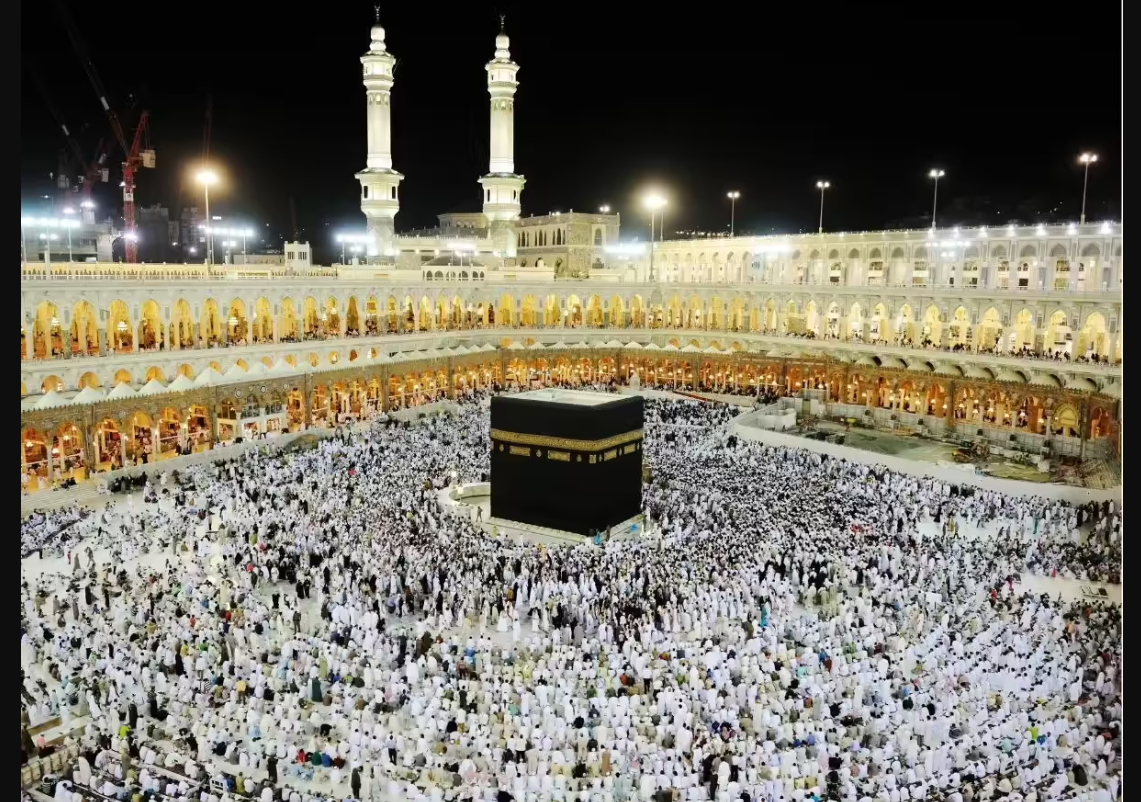

The federal cabinet has approved Pakistan’s first-ever four-year Hajj Policy and Plan for 2027-2030, introducing several reforms aimed at improving Hajj management and services for pilgrims.
The new framework replaces the previous system of announcing a separate Hajj policy each year. Consequently, the government expects better planning, improved operational efficiency, and enhanced facilities for intending pilgrims.
The decision was taken during a federal cabinet meeting chaired by Prime Minister Shehbaz Sharif.
Four-year policy replaces annual Hajj planning
According to the cabinet briefing, Pakistan will now follow a long-term Hajj policy covering the period from 2027 to 2030. Previously, authorities prepared Hajj policies on an annual basis.
However, the new framework is expected to simplify planning while allowing officials to manage Hajj operations more efficiently.
The cabinet also appreciated Federal Minister for Religious Affairs Sardar Muhammad Yousaf and his ministry’s team for the arrangements made during this year’s Hajj.
Pilgrims can register continuously until 2030
One of the major reforms allows intending pilgrims to register for Hajj without waiting for annual registration announcements.
Instead, continuous registration will remain open until 2030. As a result, applicants will be able to register whenever it is convenient for them.
The government will then prepare a priority-based waiting list based on the registration data. This approach is expected to improve planning and reduce uncertainty for intending pilgrims.
Shariah-compliant Hajj savings scheme introduced
The new policy also introduces a Shariah-compliant Hajj savings scheme. The scheme will allow people planning to perform Hajj in the future to gradually save the required amount through an organized mechanism.
Consequently, prospective pilgrims will have more time to prepare financially before undertaking the pilgrimage.
Government to digitize the entire Hajj management system
Another key feature of the policy is the complete digitization of Hajj management. Under the new system, payments, complaint registration, and monitoring mechanisms will operate through a digital platform.
Therefore, authorities aim to improve transparency, efficiency, and overall service delivery. The digital system is also expected to simplify administrative procedures for pilgrims.
New policy includes quotas, training, and Takaful coverage
The policy maintains separate quotas for the government and private Hajj schemes. It also introduces both long-duration and short-duration Hajj programs.
Additionally, all pilgrims will receive mandatory training before departure. The policy further provides Takaful coverage and includes emergency response arrangements to improve pilgrim safety and welfare.
Transparent appointments and independent validation
The federal cabinet directed that Hajj assistants must be appointed through a transparent process based strictly on merit.
In addition, the government ordered third-party validation of both government and private Hajj operations. These measures aim to strengthen accountability while improving service quality.
Regulations will remain flexible
The cabinet was informed that standard operating procedures (SOPs) and other regulations will be developed to implement the policy.
Officials also said amendments may be introduced whenever necessary. These changes will ensure continued compliance with Saudi Arabian laws and regulations governing Hajj operations.
Cabinet approves health outsourcing policy
During the same meeting, the cabinet approved a policy to outsource services at the Isolation Hospital and Infectious Treatment Centre and the Regional Blood Centre in Islamabad.
The Ministry of National Health was directed to complete the outsourcing process according to the applicable rules and regulations.
Pakistan Railways reports higher revenue
The cabinet also received a briefing on the performance of Pakistan Railways. Officials informed the meeting that railway revenue increased by Rs95 billion during 2024-25.
As a result, total revenue exceeded Rs115 billion in the 2025-26 fiscal year, reflecting a 24.19 percent increase. The briefing also highlighted growth in freight earnings, operational revenue, property and land income, along with a 3.37 percent increase in passenger revenue.
According to officials, improvements in railway operations have also strengthened freight cargo movement across the country.
The cabinet appreciated Railways Minister Hanif Abbasi and his team for the improved performance of Pakistan Railways.
Cabinet endorses committee decisions
The federal cabinet also ratified the decisions taken by the Cabinet Committee on Legislation during its meeting held on May 19.
Additionally, it endorsed the decisions approved by the Economic Coordination Committee (ECC) during its meeting on July 2, 2026.

