
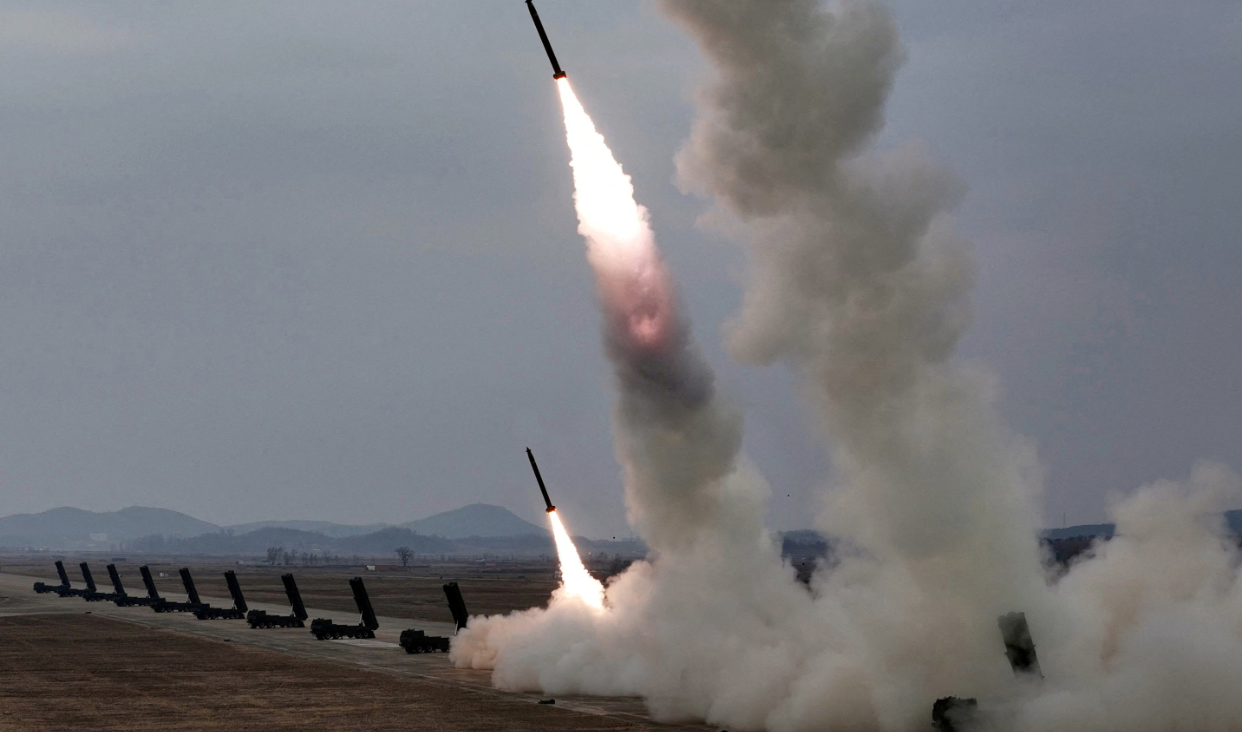

North Korea fired ballistic missiles into the sea on Sunday as tensions linked to the Iran war continue to grow globally, raising fresh concerns among regional security analysts who are closely watching the situation. The missiles were launched from the eastern coastal area and traveled about 140 kilometers before landing in the sea, which also marks the fourth missile test conducted this month and the seventh launch recorded so far this year.
Military Messaging Behind the Launches
Experts believe North Korea is using these launches as a calculated signal of strength while the global conflict environment adds more strategic weight to its actions, especially as the Iran war shapes wider geopolitical calculations. A former South Korean presidential security adviser said:
“The missile launches may be a way of showing that — unlike Iran — we have self-defence capabilities,”
He further added:
“The North also appears to be exerting pressure preemptively and make a show of force before engaging in dialogue with the United States and South Korea,”
Therefore, analysts see these actions as both pressure tactics and preparation for possible diplomatic engagement, since missile testing often increases before negotiations.
Launch Area Points to Advanced Military Systems
The missiles were fired near Sinpo on the east coast, a region widely linked with submarine and missile development infrastructure, which is why experts suspect that advanced weapons systems may have been involved in this latest test. Sinpo is already known for submarine-launched ballistic missile programs, and earlier tests from this area have reportedly reached distances of up to 600 kilometers, showing the continued development of range and capability.
South Korea confirmed that the missiles remained over open waters, while Japan also reported no impact within its exclusive economic zone, although regional defense systems stayed on high alert throughout the incident. Officials described the launch as a violation of United Nations resolutions and urged North Korea to immediately stop such provocative actions.
Regional Security Response Intensifies
South Korea quickly convened an emergency security meeting to assess defense readiness and regional risk levels, while surveillance systems continued to closely monitor any further activity from the North. Consequently, tensions across East Asia remain elevated, and military analysts continue to warn that the risk of escalation is increasing, even though no immediate counter-response has been announced.
Diplomatic Signals and Future Engagement Possibilities
Diplomatic discussions are still being considered despite rising tensions, as United States leadership has shown interest in future dialogue while South Korea has also indicated openness to engagement under the right conditions. Reports suggest that possible high-level meetings could be explored, although no official schedule has been confirmed yet, even as Donald Trump is expected to visit Asia in May.
There is growing attention on potential engagement with Kim Jong Un, but current geopolitical conditions make direct talks uncertain at this stage.
Nuclear Expansion Raises Global Concerns
International monitoring agencies continue to report steady nuclear development in North Korea, with the International Atomic Energy Agency recently highlighting significant progress and suggesting possible expansion in uranium enrichment capabilities. Meanwhile, North Korea continues to strengthen its nuclear deterrent strategy as leader Kim Jong Un has publicly reinforced that nuclear status remains essential for national security.
Therefore, military modernization continues at a steady pace, while regional observers remain increasingly concerned about long-term stability risks.
Conclusion
North Korea’s missile launches highlight rising regional and global tensions, especially as the Iran war adds further complexity to an already fragile security environment. Moreover, these military actions appear to serve both deterrence and diplomatic signaling purposes, which keeps international attention firmly focused on how the situation develops next.

