
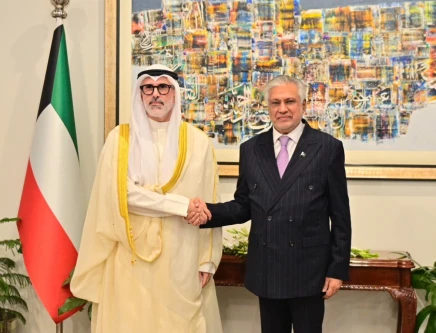

Kuwaiti Foreign Minister Congratulates Ishaq Dar
Kuwait has congratulated Pakistan on the signing of the Makkah Joint Defence Agreement with Saudi Arabia and Turkiye.
Kuwaiti Foreign Minister Sheikh Jarrah Jaber Al-Ahmad Al-Sabah spoke with Pakistan’s Deputy Prime Minister and Foreign Minister Ishaq Dar late on Sunday.
During the telephone conversation, Sheikh Jarrah congratulated Dar on the newly signed trilateral defence agreement.
Pakistan’s Foreign Office confirmed the conversation on Monday. Kuwait’s official Foreign Ministry website also identifies Sheikh Jarrah as the country’s current foreign minister.
The two foreign ministers also discussed the broader regional situation.
According to Pakistan’s Foreign Office, their conversation included developments involving East Jerusalem.
They also reviewed relations between Pakistan and Kuwait and discussed areas of mutual interest.
Economic cooperation was another major part of the conversation.
Both sides discussed ways to increase investment and strengthen cooperation in important sectors.
They also reviewed progress following Sheikh Jarrah’s recent official visit to Pakistan.
The Kuwaiti foreign minister visited Islamabad in late July, where he held high-level meetings focused on trade, investment, defence, security and regional stability.
Pakistan and Kuwait agreed to remain closely engaged as regional diplomatic activity continues.
The latest conversation signals growing international attention around the Makkah defence agreement.
Pakistan Briefs Canada on New Defence Agreement
Dar also discussed the agreement separately with Canadian Foreign Minister Anita Anand.
Pakistan’s Foreign Office said the two ministers exchanged views on regional developments and the recently signed defence pact.
Dar briefed Anand on the main purpose of the agreement.
He told the Canadian foreign minister that Pakistan, Saudi Arabia and Turkiye intended to contribute collectively to regional peace, stability and security.
The two officials also discussed the evolving situation involving the United States and Iran.
The conversation came as Pakistan continued diplomatic outreach following the signing of the Makkah agreement on Friday, August 7.
Prime Minister Shehbaz Sharif, Saudi Crown Prince and Prime Minister Mohammed bin Salman, and Turkish President Recep Tayyip Erdogan signed the agreement in Makkah.
The pact creates a collective defence commitment between the three countries.
An external armed attack against one member would be regarded as an attack against all three.
The agreement is designed to strengthen deterrence and deepen defence cooperation among Islamabad, Riyadh and Ankara.
The deal has attracted significant regional attention because it comes during a period of heightened instability across the Middle East.
It also brings together three countries with longstanding bilateral military relationships under a formal trilateral defence framework.
Dar Says Makkah Pact Is Defensive and Open to Other Countries
Ishaq Dar has sought to address questions surrounding the agreement by stressing that it is purely defensive.
He said the pact is not directed against any particular country.
According to Dar, its purpose is to strengthen efforts towards peace, security, stability and prosperity across the wider region.
Dar also said the Makkah Accord could eventually include other regional countries.
However, any country seeking to participate would need to respect the fundamental principles of the agreement and commit to resolving differences through cooperation, mutual respect and peaceful means.
He stressed that the agreement does not cancel or replace existing bilateral or multilateral defence arrangements involving Pakistan, Saudi Arabia or Turkiye.
Instead, it adds another framework for cooperation between the three signatories.
Dar also linked the agreement’s collective defence provision to Article 51 of the United Nations Charter, which recognises the right to individual and collective self-defence following an armed attack.
Pakistan has presented the agreement as the result of years of coordination between the three countries.
The government says the pact reflects their desire to develop stronger strategic cooperation while responding to growing security challenges.
Kuwait’s congratulations add another diplomatic response to an agreement that could influence future security cooperation across the region.
Islamabad is now working to explain the pact internationally while maintaining that its central objective remains collective defence rather than confrontation.

