
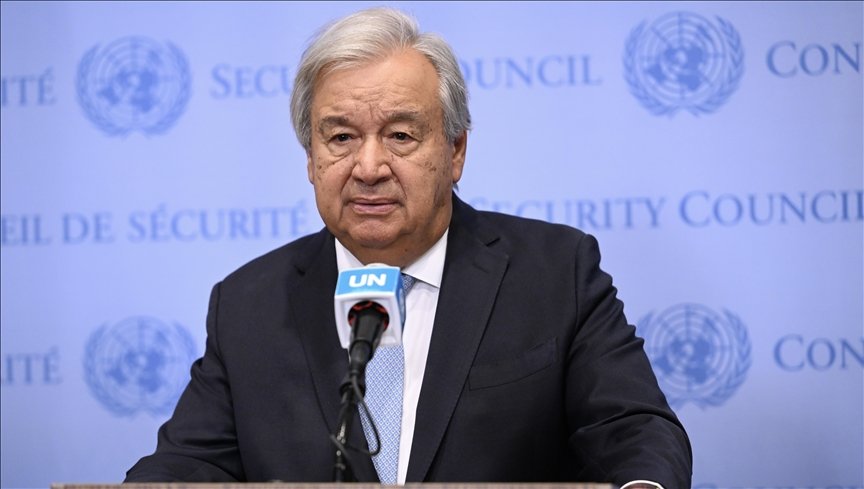

United Nations Secretary-General Antonio Guterres has urged world leaders to prevent the uncontrolled spread of lethal autonomous weapons. His warning comes as artificial intelligence increasingly transforms modern warfare and military operations.
Guterres wants countries to establish strict, legally binding rules governing weapons that can identify and attack targets without human intervention. Meanwhile, representatives from 128 countries have gathered in Geneva to discuss possible international restrictions.
Guterres Calls for Binding Rules on Killer Robots
Addressing the conference through a video message on Monday, November 16, Guterres warned against allowing autonomous machines to make life-and-death decisions.
“Take action to prevent the use and spread of these merciless weapons,” the UN chief urged the conference in a video message.
He also called on participating countries to begin negotiations for an international legal framework.
“I call on you to move towards negotiating a legally binding instrument to regulate autonomous weapon systems — including clear prohibitions and restrictions,” he said.
Furthermore, Guterres stressed the importance of protecting civilians from the devastating consequences of armed conflicts.
“We must never stop shielding civilians from the carnage and devastation of armed conflict, and preventing unnecessary suffering.”
The debate centres on lethal autonomous weapons systems, commonly known as LAWS. These systems use artificial intelligence to identify, select and attack targets with varying levels of human involvement.
128 Countries Face Crucial Decision in Geneva
The United Nations Review Conference of the Convention on Conventional Weapons (CCW) brings together representatives from 128 countries.
Their discussions will determine whether negotiations should begin on legally binding international restrictions.
However, reaching an agreement could prove difficult because participating countries hold different positions. Although many governments support stronger regulations, countries developing these technologies remain reluctant to accept restrictions.
The disagreements became apparent even before Monday’s discussions officially began.
Russia’s representative objected to allowing observers, including the European Union and civil society organisations, to participate in the debate. Consequently, the disagreement temporarily suspended the proceedings.
Campaigners suggested that Russia’s objection could help avoid scrutiny over alleged use of autonomous weapons in Ukraine.
Anna Hehir, head of military AI governance at the Future of Life Institute, urged governments to prevent individual countries from blocking progress.
“States must ensure that Russia, or any of the handful of governments blocking progress, are not allowed to hold the future hostage,” she said.
“The stakes are too high.”
Red Cross Calls for Ban on Certain Autonomous Weapons
The International Committee of the Red Cross (ICRC) has called for prohibiting two categories of autonomous weapons.
These include unpredictable autonomous weapons and systems designed or used to directly target human beings.
ICRC President Mirjana Spoljaric stressed that governments must retain responsibility for decisions involving human lives.
“States have a crucial responsibility to ensure that the future of warfare is not handed over to machines,” she said ahead of the conference.
She also warned that today’s decisions could shape how future generations judge international leaders.
“Future generations will judge whether leaders acted to prevent a world where machines autonomously kill humans.”
Meanwhile, Human Rights Watch has also warned about the consequences of failing to establish meaningful restrictions. The organisation said the conference could leave civilians “dangerously exposed” without decisive action.
Five Countries Oppose UN Resolution on Autonomous Weapons
The international disagreement extends beyond the Geneva conference.
Last month, 163 countries at the UN General Assembly adopted a resolution calling for negotiations on rules governing autonomous weapons.
However, five countries voted against the resolution. These included the United States, Russia, Belarus, Israel and North Korea.
Nine countries abstained, including Iran, Saudi Arabia and China.
North Korea also drew attention after boasting about a new AI-enabled torpedo system last week.
According to Laure de Roucy-Rochegonde of the French Institute of International Relations, China has maintained a “carefully cultivated ambiguity” on the issue.
Disagreement Over Legally Binding AI Weapons Regulations
Countries also remain divided over how quickly international restrictions should emerge.
Washington has proposed a five-year process to develop a non-binding international instrument. However, non-governmental organisations and the ICRC favour a much faster approach.
They are advocating a one-year timeline for establishing legally binding rules.
The disagreement highlights the challenge of regulating military artificial intelligence while several countries continue developing autonomous weapons.
Ultimately, the Geneva discussions will test whether governments can agree on international safeguards. The central question remains whether machines should ever receive the authority to make independent decisions about human lives.
For the latest updates, visit and follow The Truth International website (www.thetruthinternational.com) and subscribe to the YouTube Channel.