
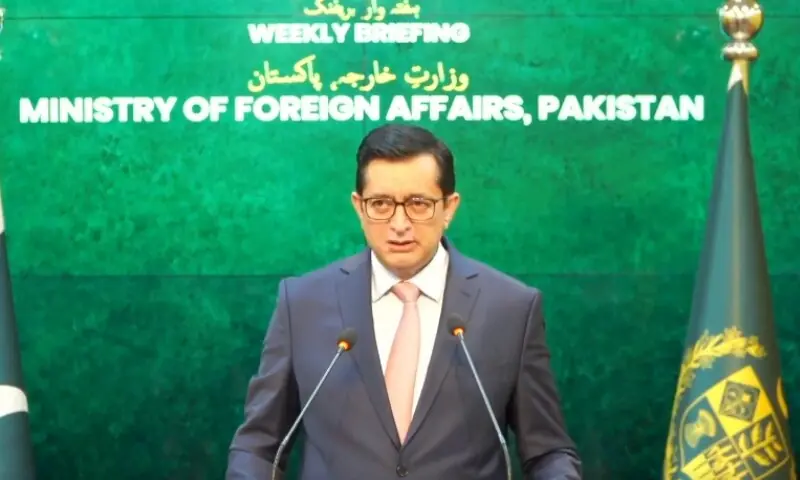

Pakistan has signalled a cautious shift in its approach to US sanctions against Iran, saying it will follow all applicable sanctions regimes under international and domestic law. Foreign Office spokesperson Sajjad Haider Khan made the statement during the weekly media briefing on Thursday.
His remarks marked a broader formulation than Pakistan’s earlier position on trade with Iran.
Pakistan Clarifies Position on Iran Sanctions
Khan said Pakistan remains committed to international law and its domestic legal framework.
“Pakistan is a responsible member of the international community and adheres, and shall continue to adhere, to all applicable sanctions regimes in accordance with international and domestic laws,” he said.
The spokesperson did not specify which sanctions Pakistan considers applicable. However, his statement gives Islamabad more room to consider the practical impact of US sanctions on Pakistani businesses and financial institutions.
Pakistan has not announced any suspension of trade with Iran.
It has also not said that it will formally join the US sanctions campaign.
Earlier Position Focused on International Law
Pakistan previously placed greater emphasis on its international legal obligations and bilateral agreements with Iran. When Washington announced its latest sanctions, former Foreign Office spokesperson Tahir Andrabi said Pakistan would continue following international law and its trade agreements with Tehran.
The latest statement takes a broader approach.
It adds domestic law and applicable sanctions regimes to the framework governing Pakistan’s position.
Therefore, Islamabad appears to be keeping its options open while assessing the consequences of the new US measures.
Why US Sanctions Can Affect Pakistan
US sanctions do not automatically become international law for Pakistan. However, they can create practical challenges for Pakistani banks and companies that conduct international transactions. Many financial institutions depend on access to the US financial system, dollar clearing and correspondent banking networks.
US secondary sanctions can also expose foreign financial institutions to restrictions if they conduct certain transactions with sanctioned Iranian entities.
As a result, Pakistani businesses may face financial risks even when a US sanction does not directly apply to them under Pakistani law.
Role of SWIFT and Global Banking
The international financial messaging network SWIFT does not impose sanctions or determine whether transactions are lawful. Instead, financial institutions and relevant authorities remain responsible for compliance.
SWIFT has previously disconnected Iranian banks to comply with sanctions imposed under European law.
That experience demonstrates how sanctions can affect access to international financial infrastructure.
For Pakistan, the issue therefore involves both legal obligations and practical financial risks.
Domestic Regulations Also Matter
Pakistan’s domestic banking and foreign-exchange rules could also affect trade with Iran.
The State Bank’s Pakistan-Iran trade mechanism includes requirements related to international sanctions.
Businesses must ensure that transactions do not involve entities subject to applicable sanctions.
Consequently, Pakistani companies have already approached Iran-related transactions with caution.
The latest US measures could increase that caution without requiring Pakistan to formally adopt Washington’s sanctions.
Pakistan Reaffirms Ties With Washington
At the same time, the Foreign Office stressed Pakistan’s relationship with the United States.
“Pakistan highly values its enduring and multifaceted strategic partnership with the United States and remains fully committed to further strengthening its long-standing diplomatic, economic and security ties with Washington,” Khan said.
Islamabad also reaffirmed its support for multilateralism and international law.
“Pakistan reaffirms its commitment to a rule-based international system rooted in multilateralism and international law,” he added.
The statement shows Pakistan is seeking to maintain its relationship with Washington while preserving its broader diplomatic position.
Islamabad Continues US-Iran Mediation
The sanctions issue comes as Pakistan continues efforts to facilitate communication between Washington and Tehran.
Khan said Islamabad would continue urging both sides to exercise restraint.
“Pakistan, being a mediator in communication between Iran and the United States, believes that it is important to continue urging both sides to exercise restraint, resolve outstanding issues through dialogue and diplomacy, and honour their respective commitments under the Islamabad Memorandum of Understanding,” he said.
Pakistan considers dialogue and diplomacy the only viable route toward a peaceful resolution. For now, Islamabad has stopped short of announcing a trade suspension with Iran or formally adopting the US sanctions campaign.
Instead, its latest position leaves room to consider international obligations, Pakistani law and the financial consequences of Iran-related transactions.
For the latest updates, visit and follow The Truth International website (www.thetruthinternational.com) and subscribe to the YouTube Channel.

