
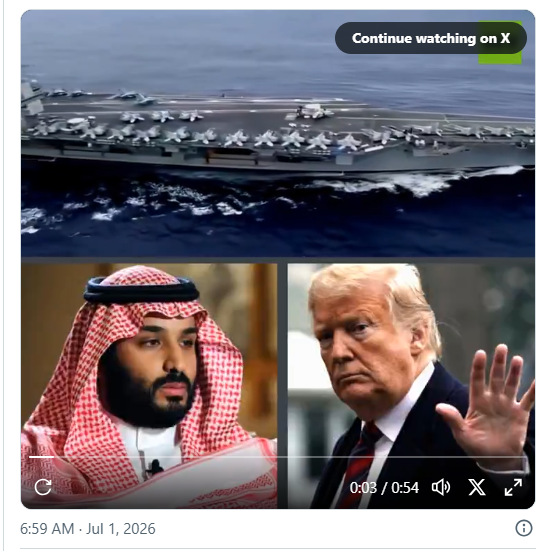

The relationship between the United States and Saudi Arabia appears to be entering a period of strategic divergence rather than an outright rupture. Reports that President Donald Trump is considering reducing the U.S. military presence in Saudi Arabia after the Kingdom reportedly refused to allow American forces to use its bases for operations against Iran underscore Riyadh’s increasingly independent foreign policy.
Saudi Arabia’s reluctance to become directly involved in a U.S.-Iran military confrontation is consistent with its regional strategy since restoring diplomatic relations with Iran through Chinese mediation in 2023. Since then, the Kingdom has prioritized de-escalation and regional stability over participation in military conflicts that could threaten its security and economic ambitions.
Trump WEIGHS reducing US military footprint in Saudi Arabia after kingdom BLOCKED access to bases for Project Freedom — WSJ
Washington THREATENED to cut off air-defense interceptors protecting kingdom from Iranian ATTACKS
Now Rubio SKIPS Riyadh, MBS BOYCOTTED G7 over Iran war pic.twitter.com/bCmBcnal20
— RT (@RT_com) July 1, 2026
At the same time, reports that Washington is reviewing its military posture in the Gulf are not unprecedented. The United States has periodically reassessed its force deployments in the Middle East as it shifts greater strategic attention toward the Indo-Pacific while encouraging regional partners to assume more responsibility for their own security.
If the United States reduces air-defense support for Saudi Arabia, it would represent a notable policy shift. Nevertheless, Washington retains significant strategic interests in Gulf security, including safeguarding global energy markets, maintaining freedom of navigation, and deterring regional threats. For these reasons, any reduction in military support is unlikely to signify a complete abandonment of the U.S.-Saudi security partnership.
Similarly, diplomatic developments such as changes in high-level visits or leaders skipping international summits should not automatically be interpreted as evidence of a major diplomatic breakdown. Such decisions are often influenced by scheduling priorities, domestic political considerations, or tactical diplomatic calculations.
Meanwhile, Saudi Arabia continues to deepen its economic and strategic engagement with China. As the Kingdom’s largest oil customer, China has become an increasingly important partner in energy, infrastructure, technology, and investment. Riyadh’s expanding ties with Beijing, however, reflect a broader strategy of diversifying its international partnerships rather than replacing its long-standing relationship with Washington.
Taken together, these developments suggest that Saudi Arabia is pursuing a more autonomous and multi-aligned foreign policy. The Kingdom seeks to balance relations with the United States, China, Russia, and regional powers while avoiding entanglement in direct confrontations between Washington and Tehran.
Although the U.S.-Saudi partnership is becoming more transactional and less automatic than in previous decades, the available evidence points to strategic recalibration rather than a diplomatic divorce. Unless both governments take more consequential steps—such as terminating defense agreements, closing U.S. military facilities in the Kingdom, or formally downgrading diplomatic relations—it would be premature to conclude that the alliance is fundamentally unraveling.

