
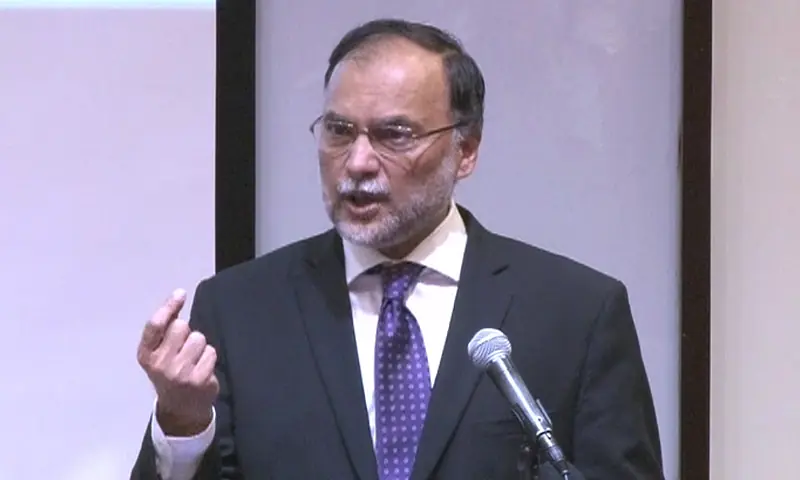

Federal Minister for Planning, Development and Special Initiatives Ahsan Iqbal has expressed serious concerns over the existing National Finance Commission (NFC) Award framework. He warned that the current revenue-sharing structure is limiting the federal government’s financial flexibility.
His remarks come at a time when Pakistan is preparing to present the Budget 2026-27, and fiscal pressures are increasingly shaping policy discussions.
NFC Formula Under Scrutiny Amid Fiscal Pressure
Ahsan Iqbal said the federation is facing growing financial constraints due to the existing NFC distribution formula. He explained that revenue-sharing arrangements with provinces have significantly reduced the federal fiscal space.
As a result, he added, it has become more difficult for the Centre to finance strategic national development projects.
He stressed that large-scale infrastructure and national initiatives are now facing funding challenges under the current system.
Federal Government’s Fiscal Space Shrinking
The minister highlighted that the federal government’s ability to manage long-term development priorities is being affected.
He said the shrinking fiscal space is creating difficulties in balancing development needs and operational obligations.
Moreover, he noted that strategic projects require stable and predictable funding, which is becoming harder to ensure.
Proposal on BISP Funding Responsibility
Ahsan Iqbal clarified that the federal government is not proposing the abolition of the Benazir Income Support Programme (BISP). Instead, he suggested a shift in financial responsibility.
He proposed that provincial governments should fund beneficiaries belonging to their respective provinces.
He stated, “Our proposal is that the province to which a beneficiary belongs should provide the financial assistance, as poverty reduction is a provincial responsibility under the 18th Amendment.”
The minister argued that poverty alleviation and social welfare fall within provincial jurisdiction under the 18th Constitutional Amendment.
Relief for Federal Budget Through Provincial Role
According to Ahsan Iqbal, transferring BISP funding responsibility to provinces could ease pressure on the federal budget.
He said this adjustment would allow the Centre to focus more resources on national development priorities and strategic projects.
BISP, launched in 2008, remains Pakistan’s largest social protection programme. It supports over 10 million low-income families, especially women, through direct financial assistance.
Rejection of Federal Control Rumours
The minister also rejected speculation regarding federal administrative control over Karachi.
He clarified that no such proposal is under consideration and dismissed the reports as unfounded.
His statement aimed to address growing political discussions around administrative restructuring.
Population Growth and NFC Incentives
In earlier remarks, Ahsan Iqbal also emphasized the need for reforms in the NFC Award linked to population management.
He argued that provinces should receive incentives for controlling population growth rates.
He warned that if current trends continue, Pakistan’s population could reach between 370 million and 400 million by 2050.
Such growth, he noted, would place severe pressure on health, education, employment, water, and food systems.
Call for Reform in Resource Distribution
The minister pointed out that nearly 82 percent of NFC resource distribution is based on population share.
He said this structure does not encourage provinces to manage population growth effectively.
He further suggested that provinces showing improvement in population control should be rewarded with additional incentives and recognition.
Conclusion: Debate on Fiscal Federalism Intensifies
Ahsan Iqbal’s remarks highlight rising debate over fiscal federalism in Pakistan. His concerns over the NFC Award and proposals on BISP funding reflect growing pressure on the federal budget.
As Budget 2026-27 approaches, discussions over revenue sharing, social welfare financing, and population-based resource distribution are expected to gain further momentum.

