
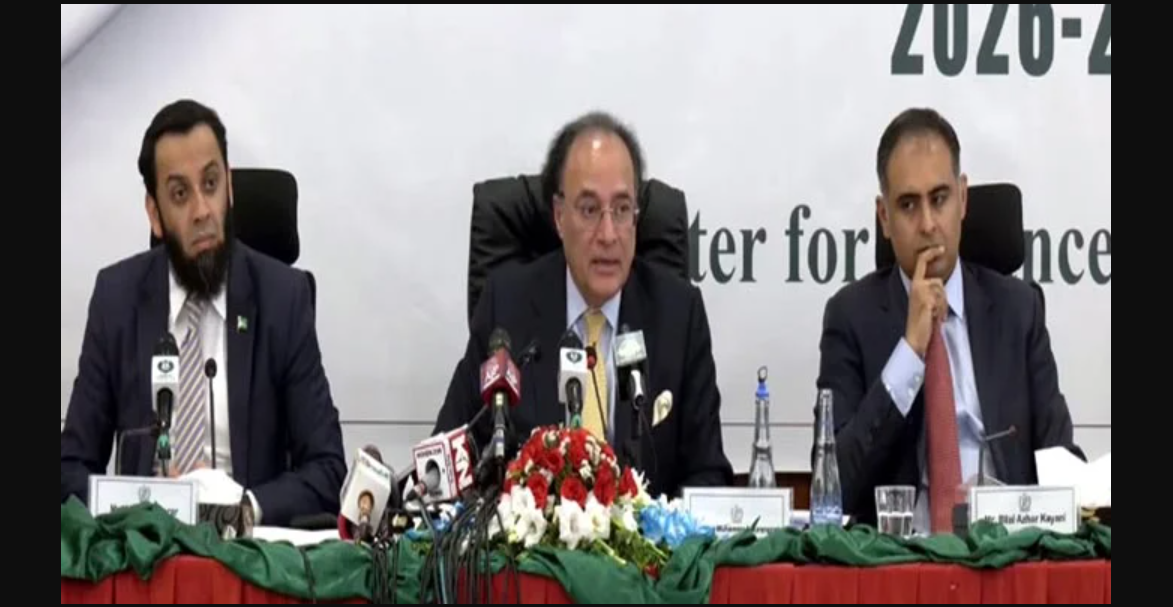

Federal Minister for Finance and Revenue Senator Muhammad Aurangzeb said Pakistan has entered a new economic phase and is now moving beyond stability toward growth.
During a post-budget press conference in Islamabad, the minister said the government had focused on building conditions that support long-term economic expansion, improve exports, and strengthen private sector participation.
According to Aurangzeb, the federal budget for FY2026–27 reflects that broader direction.
Pakistan Moves From Recovery Toward Growth
Aurangzeb said the country’s economic priorities have evolved over the past year.
“When we sat here last year, we spoke about economic recovery. Today, I can say that we have made meaningful progress and are now moving forward towards growth.”
He explained that the latest budget aims to convert economic recovery into sustained development.
Furthermore, he described export-led growth as the central theme of the government’s economic approach.
“The main theme of this budget is export-led growth. A key question has been what constitutes the enabling environment for exports, and in this budget, we have made comprehensive efforts to address those factors.”
Government Targets Higher Exports and Lower Trade Deficit
Speaking about trade and competitiveness, Aurangzeb highlighted tariff reforms and cost reduction measures. He said the government had entered the second year of its five-year tariff reform plan.
The objective, he explained, is to reduce the cost of intermediate goods and raw materials. At the same time, he stressed the need to lower the goods trade deficit while increasing service exports.
According to the minister, information technology exports are expected to reach $4.5 billion in the next fiscal year. To support that target, the government decided to retain the 0.25 percent Final Tax Regime.
“This is why the government has announced to maintain the 0.25 percent Final Tax Regime (FTR) as per the discussions that came through the IT industry, freelancers and PASHA.”
Relief Measures and Tax Reforms Introduced
Aurangzeb said the government attempted to provide relief to lower-income salaried groups. He noted adjustments in tax slabs and broader fiscal relief measures.
The minister also discussed changes designed to support businesses and exporters. He said the government reduced the super tax rate for large businesses.
“We have reduced the super tax rate for large businesses from 10 percent to 8 percent, which is a significant move in the right direction.” Aurangzeb added that additional relief for sub-exporters would also be incorporated.
“This proposal was presented to the prime minister and the cabinet, who specifically instructed that relief should be provided to sub-exporters as well.”
He added that the budget supports production, documentation, and industrial growth.
“This is about setting the right direction of travel – moving towards a tax system that supports growth rather than constrains it.”
Agriculture and Financing Remain Key Priorities
The finance minister highlighted agriculture as another area receiving policy support. He said taxes had been removed to encourage value addition across the agriculture sector.
According to Aurangzeb, agricultural financing increased by 15 percent year-on-year. Overall agricultural financing has now crossed Rs2 trillion.
He also referred to the Zarkhez-e Scheme for small farmers and described it as collateral-free. The Prime Minister’s Youth Business and Agriculture Loan Scheme reached Rs262 billion in total size.
Out of that amount, Rs125 billion has been allocated for agriculture. Aurangzeb further announced incentives for imported agricultural machinery.
He said customs and regulatory duties on eligible imported equipment had been reduced to zero. These measures apply where machinery is unavailable locally and supports productivity gains.
Export Financing and Tariff Reform Take Center Stage
Aurangzeb said export competitiveness depends on more than taxation. “It is also about access to affordable financing.” To support exporters, the government allocated Rs71 billion in subsidy.
As a result, exporters will continue accessing financing at a concessional rate of 4.5 percent.
“This is a major feature of the budget. Despite policy rate and inflation dynamics, exporters will have access to financing at 4.5 percent, which runs into trillions of rupees.”
He added that tariff reforms would continue to lower production costs and strengthen export capacity.
Digital Tax System and Revenue Transformation
The government also announced structural reforms within tax administration. Aurangzeb said authorities aim to reduce human intervention and expand automation.
“We want to move towards a technology-driven, faceless system in income tax and sales tax, similar to what has been introduced in customs.”
Digital monitoring, according to the government, is already generating additional revenue.
Meanwhile, revenue authorities said a broader transformation process remains underway. Officials expect the digital foundation and operating reforms to take another two to three years.
Energy Challenges and Private Sector Role
Aurangzeb acknowledged continuing pressure on the energy sector. He said those challenges would remain a focus in the coming fiscal year.
At the same time, he encouraged stronger private sector participation in economic development. According to the minister, service exports will also contribute to reducing the trade deficit.
Concluding his remarks, Aurangzeb said the budget reflects confidence in Pakistan’s economic direction.
“This budget is not just about numbers; it is about direction, continuity and confidence in Pakistan’s economic future.”

