
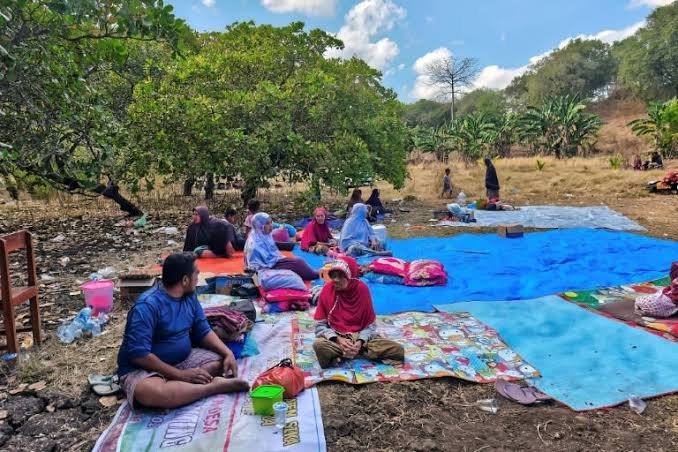

Around 5,000 Evacuated as Aftershocks Continue Across Flores
The death toll from the powerful earthquake that struck Indonesia’s Flores Island has risen to 48 as thousands of displaced residents wait for emergency assistance.
The 7.7-magnitude earthquake hit the island early on Saturday and caused widespread damage to homes, public buildings and critical infrastructure.
Indonesia’s National Disaster Management Agency said around 5,000 people were forced to leave their homes following the quake.
At least 341 aftershocks were recorded in the hours after the main tremor, increasing fear among residents and complicating emergency operations.
Some communities remained without electricity and telecommunications on Sunday.
At least one important emergency access road also remained blocked, making it difficult for rescue and relief teams to reach affected areas.
Residents in several villages said they urgently needed food, drinking water, medicines and supplies for children.
In Nangahale village on the northern coast of Flores, some residents spent more than 24 hours sheltering on higher ground.
Many remained afraid to return to their homes because of continuing aftershocks and memories of earlier disasters.
Flores was struck by another 7.7-magnitude earthquake in 1992.
That earthquake triggered a tsunami that killed around 2,500 people.
The memory of that disaster has intensified fear among survivors of the latest earthquake.
Helicopters, Aircraft and Ships Sent as Emergency Aid Operation Expands
Indonesia has begun deploying additional emergency resources to help affected communities.
BNPB chief Suharyanto said at least five helicopters, several aircraft, a naval vessel and search and rescue ships were heading toward Flores.
Authorities said survivors urgently required emergency tents, food, medicines and clean drinking water.
Other priority supplies include blankets, camp beds, floor mats and electricity generators.
The number of people injured has risen to at least 101.
Officials said no people were currently reported missing or trapped beneath collapsed structures.
The earthquake’s epicentre was located just off the northern coast of Flores.
Geological authorities described the earthquake as shallow, which can result in stronger shaking at the surface.
The island has relatively few high-rise buildings, but the earthquake still caused extensive structural damage.
At least 914 homes were reported to have suffered severe damage.
Hundreds of additional homes were damaged to a lesser extent.
Public infrastructure also suffered significant destruction.
At least 93 educational facilities and 36 healthcare facilities were damaged.
Another 38 government buildings were affected by the earthquake.
The International Federation of Red Cross and Red Crescent Societies said preparations were underway to deliver assistance to thousands of people staying in temporary shelters.
The Indonesian government has sent around 50,000 relief packages to the disaster zone.
The packages reportedly weigh a combined 275 tonnes.
European Commission President Ursula von der Leyen also offered European Union assistance.
She said the bloc was ready to provide support through its Copernicus Earth observation satellite system to assist search and rescue operations.
Hospitals Damaged as Authorities Warn Residents to Remain Alert
In Ruteng, located around 200 kilometres from the most severely affected areas, emergency crews used heavy machinery to remove rubble from roads.
The local hospital suffered significant damage.
Patients were moved into temporary tents outside the hospital building because of concerns about structural safety.
Despite the damage, medical workers continued providing emergency treatment.
A woman underwent an emergency Caesarean section inside an undamaged storage room that had been converted into a temporary operating theatre.
Hospital officials said both the mother and baby survived the procedure safely.
Authorities have warned residents that it remains impossible to predict when the aftershocks will stop.
Manggarai regency officials urged people to remain vigilant and avoid damaged buildings.
Immediately after Saturday’s earthquake, many residents fled toward higher ground when they saw the sea retreat.
A sudden retreat of the sea can be an indication of an approaching tsunami.
Authorities initially issued a tsunami warning but later cancelled it after monitoring conditions.
Indonesia’s geological agency reported waves of up to 1.6 metres in some coastal areas.
Officials have still advised residents to stay away from damaged structures because continuing aftershocks could cause weakened buildings to collapse.
Indonesia is highly vulnerable to earthquakes because it lies along the Pacific Ring of Fire.
The region is one of the world’s most active seismic zones and stretches from Japan through Southeast Asia and across the Pacific Ocean.
Indonesia has suffered several catastrophic earthquakes and tsunamis in the past.
In 2004, a 9.1-magnitude earthquake off Sumatra triggered a massive tsunami across the Indian Ocean.
Around 220,000 people were killed across the region, including approximately 170,000 in Indonesia.
With thousands displaced in the latest disaster, authorities are now focusing on delivering essential supplies, restoring communications and providing safe shelter while aftershocks continue.

