
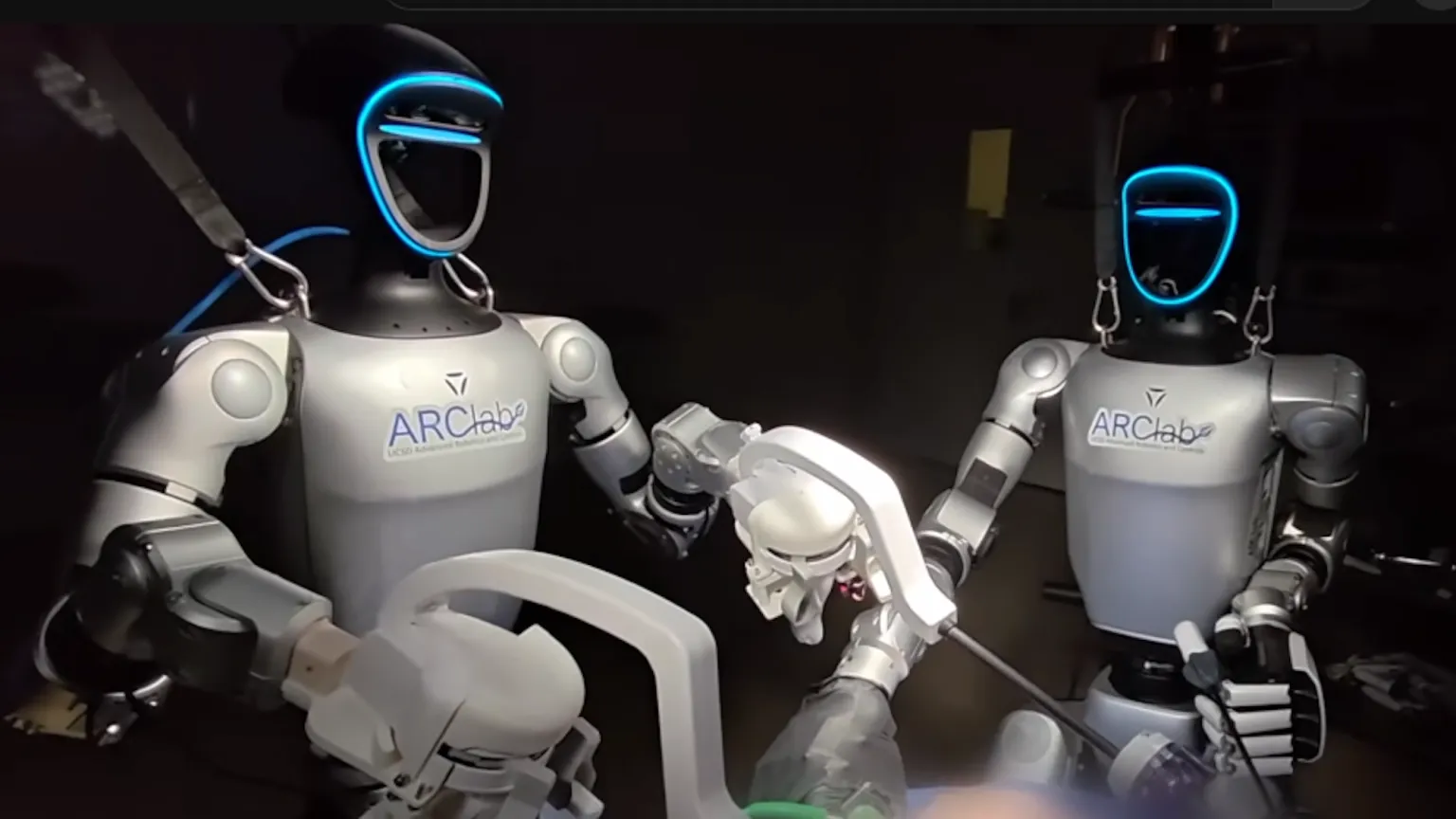

Researchers at the University of California San Diego have achieved a major breakthrough in robotic surgery. They successfully used teleoperated humanoid robots to complete two surgeries during a preclinical trial. Consequently, the study marks an important step toward expanding robotic assistance in operating rooms.
Robots Complete Two Successful Surgeries
In the first procedure, a humanoid robot worked alongside a human surgeon to perform a gallbladder removal. Meanwhile, the second operation involved two humanoid robots working together without direct human assistance during the procedure.
Both surgeries were conducted on large non-primate mammals. According to the researchers, the results demonstrate that humanoid robots could initially support surgeons before eventually performing procedures through teleoperation.
Furthermore, the team believes the technology could help address global surgeon shortages. It may also reduce waiting times and improve healthcare access in rural and underserved communities.
Technology Shows Promise for Future Healthcare
Unlike conventional surgical robots, humanoid robots can move more freely and occupy less operating room space. In addition, they can perform a wider variety of medical and support tasks.
The robots, named Surgie, stand about five feet tall and weigh approximately 60 pounds. Researchers said their compact size makes them suitable for hospitals, disaster zones, and remote healthcare facilities.
Although the technology still requires improvements in calibration and communication latency, the researchers remain optimistic. They expect rapid advances in the coming years.
Beyond surgery, the robots could eventually assist medical teams by fetching equipment, cleaning operating rooms, and performing routine support duties. Therefore, humanoid robots may become valuable assistants in future healthcare environments.

